


Myanmar’s pro-military lawmakers yesterday elected junta chief Min Aung Hlaing as president, with the former armed forces commander set to maintain his rule in a civilian guise after snatching power by force five years ago.
The coup-leading general ousted the elected government of Aung San Suu Kyi in 2021, triggering a civil war that has killed tens of thousands of people.
Myanmar Parliament Speaker Aung Lin Dwe announced Min Aung Hlaing was elected president, chosen by military-aligned members of parliament installed in a recent election overseen by the junta he leads.
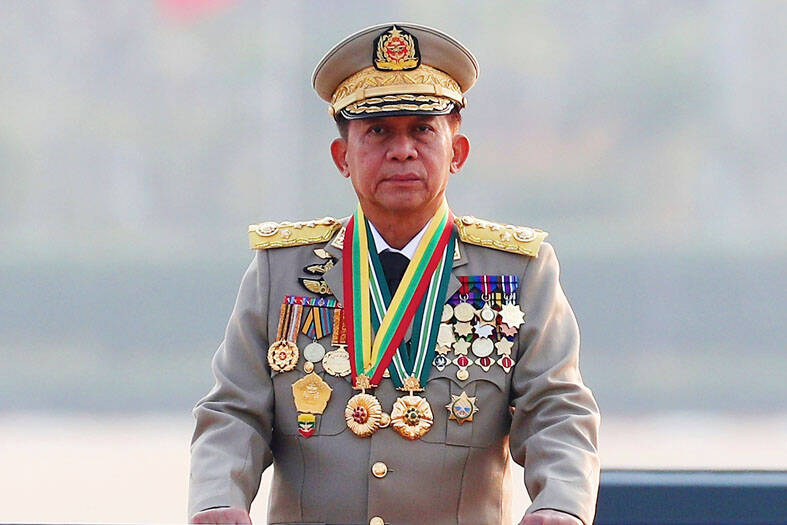
Photo: AP
Min Aung Hlaing secured 429 of 584 votes cast in the upper and lower houses of parliament, a parliament official said.
While the junta touted the parliament’s reopening last month as a return of power to the people, analysts describe it as civilian window dressing intended to launder the military’s continuing rule.
“There is no hope for the country under his presidency. The country will only get worse,” a Yangon resident said, on condition of anonymity. “I never expected anything from this government anyway.”
The pro-military Union Solidarity and Development Party (USDP) won more than 80 percent of parliamentary seats contested in the phased poll that concluded in January.
Serving members of the Myanmar armed forces also occupy unelected seats, making up one-quarter of the total.
Analysts said the decision by Myanmar’s top brass to cloak its command in civilian dress gives some regional partners cover to engage with and invest in a country that many Western nations consider a pariah.
Key junta ally China congratulated Min Aung Hlaing on his election win and pledged “high-quality” cooperation on Beijing’s Belt and Road infrastructure projects.
“China supports the new Myanmar government in safeguarding national peace and stability, and realizing development and prosperity,” Chinese Ministry of Foreign Affairs spokeswoman Mao Ning (毛寧) said.
Min Aung Hlaing is expected to be sworn in as president next week.
The new government is expected to march in lockstep with the top brass now that the USDP is entrenched in parliament with backup from the unelected military lawmakers.

A signaling system malfunction disrupted high-speed rail (HSR) services beginning at 8am today, with trains temporarily reduced to three northbound and three southbound trains per hour as authorities conduct inspections. The malfunction occurred on a section of track in Miaoli County during pre-operation checks early this morning, forcing northbound and southbound trains to use a single track, the HSR operator said. The regular schedule has been replaced with three hourly trains offering only nonreserved seating in each direction, stopping at every station, it said, adding that business class cars would still have reserved seating. Departures from terminal stations are scheduled at the top
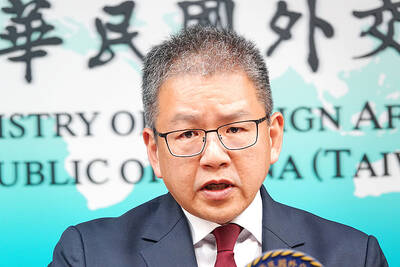
Taiwan is still in the process of assessing the possibility of recruiting workers from Eswatini, the Ministry of Foreign Affairs said yesterday, adding that its goal is to help Eswatini upgrade its vocational training centers. If there are plans to recruit workers from Eswatini, safeguarding national security, protecting public health and ensuring the employment rights of Taiwanese would be prerequisites, Department of West Asian and African Affairs Director-General Yen Chia-liang (顏嘉良) told a news conference. Key considerations would also include filling labor shortages in specific industries, and fostering bilateral professional and technical exchanges, he said. Yen was asked about the progress of labor

A US uncrewed surface vessel (USV) encountered multiple Chinese warships during an autonomous transit of the Taiwan Strait, US defense company Seasats said in a statement on Wednesday. Seasats announced that a Lightfish USV had completed the first autonomous transit of the Taiwan Strait. Over five days, the USV traversed the entire length of the Strait while constantly monitoring surface vessel traffic, the company said. The Lightfish encountered multiple Chinese warships, one of which was a Chinese People’s Liberation Army Navy (PLAN) Type 056 corvette, it said. The Chinese vessels were operating “well within Taiwan’s exclusive economic zone without transmitting their identity via the

‘NO SECURITY RISK’: The Railway Bureau reassured the public that the technicians’ activities were limited to technical guidance and did not involve sensitive systems The Railway Bureau yesterday said it had invited eight Chinese technicians to assist with an airport MRT construction project. The bureau issued the confirmation after an Internet user said Chinese nationals had entered the construction zone of Taiwan Taoyuan International Airport’s Terminal 3 project. They asked why “individuals from an enemy state” were allowed access to such a major national infrastructure project, which raised serious concerns over Taiwan’s industrial safety, sensitive systems and information security. The bureau’s Northern Region Engineering Branch Office said subcontractor Taiwan Handle Industrial Co (台灣手把工業) of the Taoyuan airport MRT’s “Contract No. CU05 Project A14 Station Civil, MEP &


 RSS
RSS