


Iran and the US yesterday appeared at an impasse, with each side hardening its position over talks and setting the stage for another potential escalation in the Middle East war.
US President Donald Trump issued a warning to Tehran on social media to “get serious soon” on negotiating a deal to end the war, a day after he said a deal to end the war is near, despite Tehran’s dismissal of his 15-point ceasefire plan.
Thousands more US troops neared the region, while Tehran tightened its grip on the crucial Strait of Hormuz.
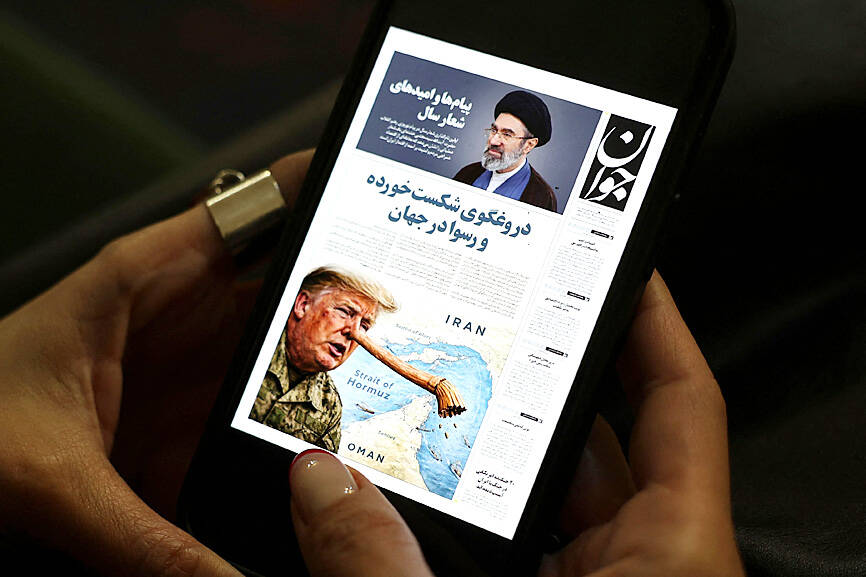
Photo: AFP
With its stranglehold on traffic through the strait, which leads from the Persian Gulf toward the open ocean, Iran has been blocking ships it perceives as linked to the US and Israeli war effort, but letting through a trickle of others.
Jasem Mohamed al-Budaiwi, secretary-general of the Gulf Cooperation Council, a bloc of six Gulf Arab nations, said Iran was charging for safe passage through the strait.
The Fars and Tasnim news agencies quoted Iranian lawmaker Mohammadreza Rezaei Kouchi as saying that parliament was working to formalize that process.
“We provide its security, and it is natural that ships and oil tankers should pay such fees,” he was quoted as saying.
Lloyd’s List Intelligence called it a “de facto ‘toll booth’ regime.”
“While not all ships are paying a direct toll, at least two vessels have and the payment is settled in yuan,” Lloyd’s List said.
Meanwhile, sirens over Israel warned of barrages of incoming Iranian missiles and Gulf nations worked to intercept fire. Heavy strikes were reported in Iran’s capital and other cities.
The US and Iran have both produced a list of demands, and now appear at an impasse. Short of a negotiated solution, the US would need a dramatic escalation to end Iran’s attacks and restore the free flow of oil through the strait.
Trump vowed to strike Iran’s power plants if it does not fully reopen the strait — and his new deadline for that looms this weekend, when the war would also mark a month.
Iran’s grip on the strait and relentless attacks on Gulf regional energy infrastructure have sent oil prices skyrocketing and concerns of a global energy crisis surging. Brent crude, the international standard, yesterday traded at US$104, up more than 40 percent from Feb. 28, when the war started.
“To make it crystal clear, this war is a catastrophe for world’s economies,” German Minister of Defense Boris Pistorius told reporters during a visit to Australia.

‘NO SECURITY RISK’: The Railway Bureau reassured the public that the technicians’ activities were limited to technical guidance and did not involve sensitive systems The Railway Bureau yesterday said it had invited eight Chinese technicians to assist with an airport MRT construction project. The bureau issued the confirmation after an Internet user said Chinese nationals had entered the construction zone of Taiwan Taoyuan International Airport’s Terminal 3 project. They asked why “individuals from an enemy state” were allowed access to such a major national infrastructure project, which raised serious concerns over Taiwan’s industrial safety, sensitive systems and information security. The bureau’s Northern Region Engineering Branch Office said subcontractor Taiwan Handle Industrial Co (台灣手把工業) of the Taoyuan airport MRT’s “Contract No. CU05 Project A14 Station Civil, MEP &

A US uncrewed surface vessel (USV) encountered multiple Chinese warships during an autonomous transit of the Taiwan Strait, US defense company Seasats said in a statement on Wednesday. Seasats announced that a Lightfish USV had completed the first autonomous transit of the Taiwan Strait. Over five days, the USV traversed the entire length of the Strait while constantly monitoring surface vessel traffic, the company said. The Lightfish encountered multiple Chinese warships, one of which was a Chinese People’s Liberation Army Navy (PLAN) Type 056 corvette, it said. The Chinese vessels were operating “well within Taiwan’s exclusive economic zone without transmitting their identity via the

Taiwan is still in the process of assessing the possibility of recruiting workers from Eswatini, the Ministry of Foreign Affairs said yesterday, adding that its goal is to help Eswatini upgrade its vocational training centers. If there are plans to recruit workers from Eswatini, safeguarding national security, protecting public health and ensuring the employment rights of Taiwanese would be prerequisites, Department of West Asian and African Affairs Director-General Yen Chia-liang (顏嘉良) told a news conference. Key considerations would also include filling labor shortages in specific industries, and fostering bilateral professional and technical exchanges, he said. Yen was asked about the progress of labor
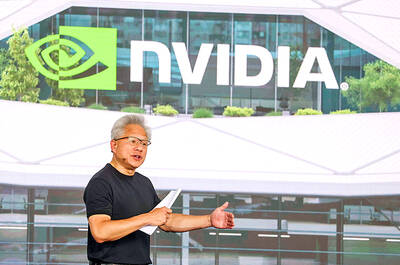
‘BOOMING’: ’ The number of partners we have here is incredible. You can see from their stock prices. They’re doing so well, they’re so happy,’ Jensen Huang said Nvidia Corp’s spending in Taiwan has ballooned to about US$150 billion a year, 10 times the US$10 billion to US$15 billion the company spent five years ago, Nvidia chief executive officer Jensen Huang (黃仁勳) said yesterday, suggesting Taiwan’s strategic importance in the global artificial intelligence (AI) supply chain. “Taiwan is the epicenter of the AI revolution. This is where the chips come, packaging comes. This is where the systems are made. This is where AI supercomputers were created,” Huang said at a meeting for the company’s employees in Beitou-Shilin Technology Park (北投士林科技園區) in Taipei, the planned site of Nvidia’s Taipei headquarters. “Taiwan


 RSS
RSS