


President Donald Trump said Monday the United States and Iran had held "very good" talks towards ending the three-week Middle East war, putting threatened US attacks on Iran’s power plants on hold in a stunning about-turn.
In a social media post that immediately sent oil prices tumbling, Trump said Washington and Tehran had held "productive conversations" over the last two days towards "a complete and total resolution" of hostilities in the Middle East.
In Iran, media outlets quoted the foreign ministry denying any such talks and suggesting Trump was angling to bring down energy prices sent soaring by the war -- with no mention of his claim on state television’s latest news bulletin.
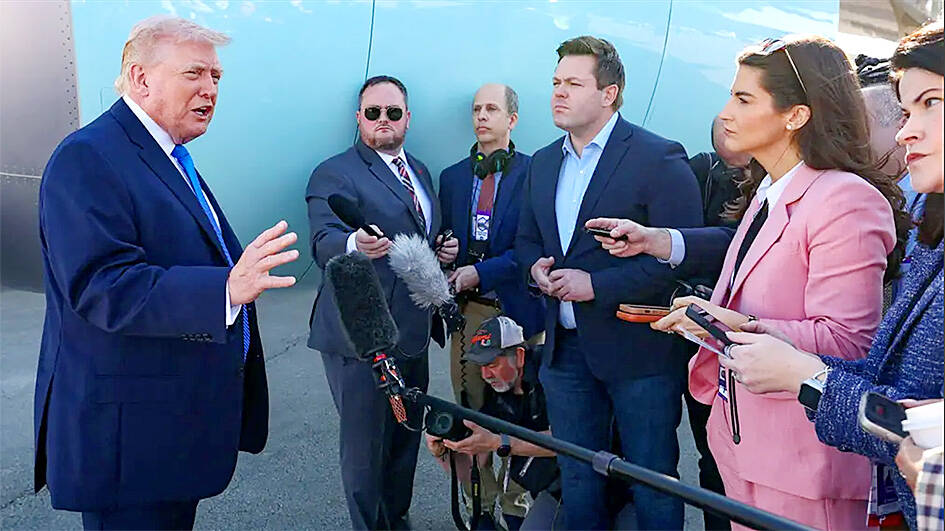
Photo: Reuters
But Trump asserted he had told the Pentagon, on the basis of talks to date, to "postpone any and all military strikes against Iranian power plants and energy infrastructure for a five day period, subject to the success of the ongoing meetings."
He said the US-Iranian sides would keep talking "throughout the week."
The bombshell announcement came ahead of a Monday night ultimatum for the Islamic republic to reopen the Strait of Hormuz shipping lane -- or see Trump "obliterate" its power plants.
In response, Iran had threatened to deploy naval mines in the Gulf and target power plants across the region -- ramping up its rhetoric after warnings the world faced an energy crisis of historic proportions if the US-Israeli war with Iran drags on.
- Strikes -
Tehran has retaliated against US-Israeli attacks by throttling traffic through Hormuz, conduit for a fifth of global crude, hitting energy sites and US embassies across the Gulf as well as targets in Israel.
Israel hit Tehran with fresh strikes on Monday, with the latest wave reported by the military minutes after Trump’s announcement.
The head of the International Energy Agency Fatih Birol warned overnight that, in the event of a protracted war, daily oil losses put the world on track for a crisis worse than the combined impact of both 1970s oil shocks and Russia’s invasion of Ukraine.
Oil prices have been driven above $100 a barrel by the conflict -- and they tumbled sharply after Trump’s announcement, while and European stocks rebounded.
International benchmark Brent North Sea crude plunged more than 14 percent to $96.00 per barrel, while the main US oil contract West Texas Intermediate shed more than 14 percent to $84.37 per barrel.
Sign of the conflict’s tentacular impact, the world’s second economy China had said earlier Monday it was capping domestic fuel cost increases to mitigate the effect of surging oil prices.
- Lebanon ground campaign -
Weighing in before Trump’s post, China’s foreign ministry had warned of an "uncontrollable situation" should the war expand further.
Key Iran ally Russia meanwhile called after Trump’s announcement for an "immediate cessation of hostilities".
In a call with Iran’s top diplomat Abbas Araghchi, Russia’s Sergei Lavrov called for "a political settlement that takes into account the legitimate interests of all parties involved, above all Iran," the Russian foreign ministry said.
The US president had offered varying timelines and objectives for the war, saying Friday he was considering "winding down" the operation -- only to later threaten Iran’s power plants, of which it has more than 90.
Israeli Prime Minister Benjamin Netanyahu, who has yet to comment on Trump’s announcement, has spoken of a long-term campaign against Iran’s government, a state sponsor of Hamas, which launched the October 7, 2023 attack triggering the Gaza war.
In Lebanon, Israel has also expanded its ground campaign against Iran-backed Hezbollah, warning of "weeks of fighting" there.
The Lebanon violence has killed more than 1,000 people and displaced more than a million, according to the health ministry.
On Monday Israel’s military said it was working to intercept a new salvo of missiles from Iran -- while confirming its own artillery fire had killed an Israeli civilian a day earlier near the Lebanese border.
In Iran, at least 3,230 people have died in the war, including 1,406 civilians, according to the US-based Human Rights Activists News Agency. AFP is not able to access the sites of strikes nor independently verify tolls in Iran.

‘NO SECURITY RISK’: The Railway Bureau reassured the public that the technicians’ activities were limited to technical guidance and did not involve sensitive systems The Railway Bureau yesterday said it had invited eight Chinese technicians to assist with an airport MRT construction project. The bureau issued the confirmation after an Internet user said Chinese nationals had entered the construction zone of Taiwan Taoyuan International Airport’s Terminal 3 project. They asked why “individuals from an enemy state” were allowed access to such a major national infrastructure project, which raised serious concerns over Taiwan’s industrial safety, sensitive systems and information security. The bureau’s Northern Region Engineering Branch Office said subcontractor Taiwan Handle Industrial Co (台灣手把工業) of the Taoyuan airport MRT’s “Contract No. CU05 Project A14 Station Civil, MEP &

A US uncrewed surface vessel (USV) encountered multiple Chinese warships during an autonomous transit of the Taiwan Strait, US defense company Seasats said in a statement on Wednesday. Seasats announced that a Lightfish USV had completed the first autonomous transit of the Taiwan Strait. Over five days, the USV traversed the entire length of the Strait while constantly monitoring surface vessel traffic, the company said. The Lightfish encountered multiple Chinese warships, one of which was a Chinese People’s Liberation Army Navy (PLAN) Type 056 corvette, it said. The Chinese vessels were operating “well within Taiwan’s exclusive economic zone without transmitting their identity via the
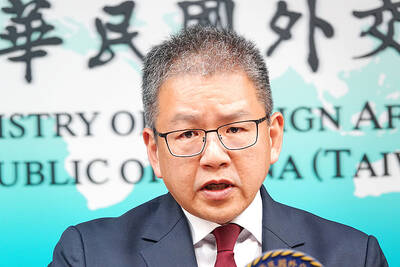
Taiwan is still in the process of assessing the possibility of recruiting workers from Eswatini, the Ministry of Foreign Affairs said yesterday, adding that its goal is to help Eswatini upgrade its vocational training centers. If there are plans to recruit workers from Eswatini, safeguarding national security, protecting public health and ensuring the employment rights of Taiwanese would be prerequisites, Department of West Asian and African Affairs Director-General Yen Chia-liang (顏嘉良) told a news conference. Key considerations would also include filling labor shortages in specific industries, and fostering bilateral professional and technical exchanges, he said. Yen was asked about the progress of labor

‘BOOMING’: ’ The number of partners we have here is incredible. You can see from their stock prices. They’re doing so well, they’re so happy,’ Jensen Huang said Nvidia Corp’s spending in Taiwan has ballooned to about US$150 billion a year, 10 times the US$10 billion to US$15 billion the company spent five years ago, Nvidia chief executive officer Jensen Huang (黃仁勳) said yesterday, suggesting Taiwan’s strategic importance in the global artificial intelligence (AI) supply chain. “Taiwan is the epicenter of the AI revolution. This is where the chips come, packaging comes. This is where the systems are made. This is where AI supercomputers were created,” Huang said at a meeting for the company’s employees in Beitou-Shilin Technology Park (北投士林科技園區) in Taipei, the planned site of Nvidia’s Taipei headquarters. “Taiwan


 RSS
RSS