


Italians yesterday began voting in a two-day referendum on reforms that Italian Prime Minister Giorgia Meloni said would make the judiciary more independent — but which critics said would do the opposite.
The poll risks turning into a referendum on the far-right leader herself, ahead of parliamentary elections next year.
Meloni’s hard-right government wants to change Italy’s constitution to separate the role of judges and prosecutors, and reform their oversight body.

Photo: EPA
The plan would make it “more modern, more meritocratic, more autonomous, more accountable and above all, free from political constraints,” Meloni said.
However, critics condemn it as a political power grab that fails to address the real challenges, from years-long trials to prison overcrowding.
Center-left Democratic Party Secretary Elly Schlein said it was badly drafted and “weakens the independence of the judiciary.”
“We have to vote ‘no,’ because the independence of our judicial system is fundamental,” said Margherita Rossi, a 21-year-old student who came from Milan to Rome to vote. “There is no turnout threshold: Even if only 10 people show up, they’ll still be able to change the constitution.”
Opinion polls show the two camps are neck-and-neck.
A decisive “no” would be a blow for Meloni, but she has dismissed suggestions that she might quit if she loses.
“I worry about what they could do after if it is passed,” army officer Francescantonio De Luca said.
Voting closes today, with preliminary results expected later the same day.
The most divisive part of the reform involves changes to the Superior Council of the Judiciary (CSM), an oversight and disciplinary body whose members are elected by their peers and parliament.
The reform would divide the CSM into two separate councils, one for judges and one for prosecutors, and create a new 15-member disciplinary court.
Members would be drawn by lots instead, with three members of the court chosen by Italy’s ceremonial president and three from a list of experienced lawyers approved by parliament.
Criminal defense lawyer Franco Moretti, who heads the “no” campaign, said the new court risked being “the armed wing of politics.”
“When needed, it could be used to settle scores with that part of the judiciary that has dared to touch it,” he said.
The second part of the reform would prevent judges and public prosecutors from switching between the two functions, addressing concerns that too-cosy relations between the two groups harm defendants.
Critics said that only a tiny minority change roles. In any case, since 2022 they have only been allowed to switch once, while in the first decade of their career.

‘NO SECURITY RISK’: The Railway Bureau reassured the public that the technicians’ activities were limited to technical guidance and did not involve sensitive systems The Railway Bureau yesterday said it had invited eight Chinese technicians to assist with an airport MRT construction project. The bureau issued the confirmation after an Internet user said Chinese nationals had entered the construction zone of Taiwan Taoyuan International Airport’s Terminal 3 project. They asked why “individuals from an enemy state” were allowed access to such a major national infrastructure project, which raised serious concerns over Taiwan’s industrial safety, sensitive systems and information security. The bureau’s Northern Region Engineering Branch Office said subcontractor Taiwan Handle Industrial Co (台灣手把工業) of the Taoyuan airport MRT’s “Contract No. CU05 Project A14 Station Civil, MEP &

A US uncrewed surface vessel (USV) encountered multiple Chinese warships during an autonomous transit of the Taiwan Strait, US defense company Seasats said in a statement on Wednesday. Seasats announced that a Lightfish USV had completed the first autonomous transit of the Taiwan Strait. Over five days, the USV traversed the entire length of the Strait while constantly monitoring surface vessel traffic, the company said. The Lightfish encountered multiple Chinese warships, one of which was a Chinese People’s Liberation Army Navy (PLAN) Type 056 corvette, it said. The Chinese vessels were operating “well within Taiwan’s exclusive economic zone without transmitting their identity via the
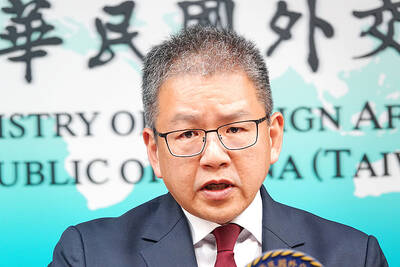
Taiwan is still in the process of assessing the possibility of recruiting workers from Eswatini, the Ministry of Foreign Affairs said yesterday, adding that its goal is to help Eswatini upgrade its vocational training centers. If there are plans to recruit workers from Eswatini, safeguarding national security, protecting public health and ensuring the employment rights of Taiwanese would be prerequisites, Department of West Asian and African Affairs Director-General Yen Chia-liang (顏嘉良) told a news conference. Key considerations would also include filling labor shortages in specific industries, and fostering bilateral professional and technical exchanges, he said. Yen was asked about the progress of labor

‘BOOMING’: ’ The number of partners we have here is incredible. You can see from their stock prices. They’re doing so well, they’re so happy,’ Jensen Huang said Nvidia Corp’s spending in Taiwan has ballooned to about US$150 billion a year, 10 times the US$10 billion to US$15 billion the company spent five years ago, Nvidia chief executive officer Jensen Huang (黃仁勳) said yesterday, suggesting Taiwan’s strategic importance in the global artificial intelligence (AI) supply chain. “Taiwan is the epicenter of the AI revolution. This is where the chips come, packaging comes. This is where the systems are made. This is where AI supercomputers were created,” Huang said at a meeting for the company’s employees in Beitou-Shilin Technology Park (北投士林科技園區) in Taipei, the planned site of Nvidia’s Taipei headquarters. “Taiwan


 RSS
RSS