


US President Donald Trump has allowed the sale of some Iranian oil to contain surging crude prices and floated “winding down” military efforts.
Trump’s comments came shortly after he ruled out a ceasefire and kept the door open to deploying ground troops. The conflict has roiled financial markets and sent energy prices soaring, prompting the US Treasury to take the extraordinary step of allowing the sale of Iranian oil and petrochemical products that have been loaded onto tankers.
“We are getting very close to meeting our objectives as we consider winding down our great Military efforts in the Middle East,” Trump wrote on social media.
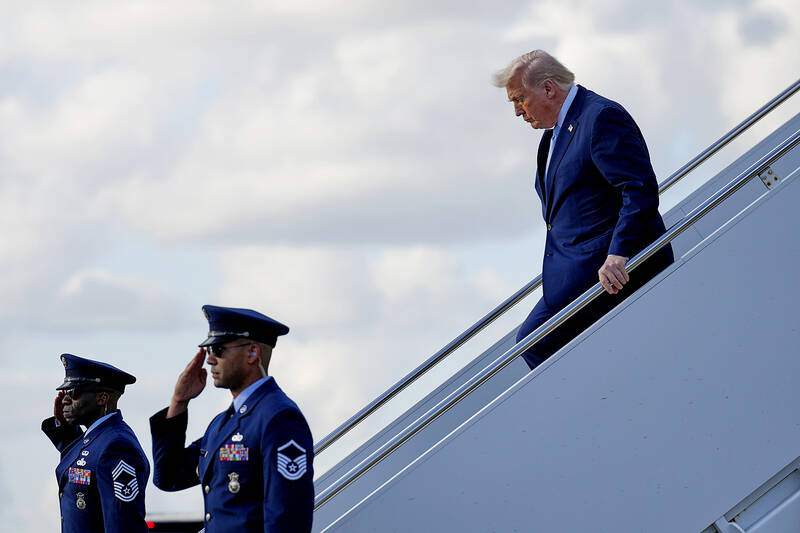
Photo: AP
However, Israeli Minister of Defense Israel Katz yesterday said the joint campaign would intensify significantly, a day after Tehran launched ballistic missiles at the joint US-UK military base in Diego Garcia.
The base was not damaged, a person familiar with the matter said, but the attack demonstrated a capability that goes beyond what Iran was known to have possessed.
The International Atomic Energy Agency said Tehran had informed it that the Natanz nuclear site had been attacked and that there were no reports of an increase in off-site radiation levels at the site, which is one of Iran’s key enrichment facilities.
The war also continued to affect Gulf neighbors, including the United Arab Emirates, which said Iran had fired eight drones and three missiles at the country.
It is unclear how Iran would respond to any unilateral decision by the US to pause strikes after recent attacks that targeted the country’s energy infrastructure and killed more high-profile officials, including Supreme National Security Council secretary Ali Larijani.
Despite weeks of US-Israeli bombardment, the regime is not close to falling, and is instead coalescing around the remaining hardliners, western intelligence assessments and people familiar with the matter said.
Iranian officials have become reluctant to even discuss reopening the Strait of Hormuz amid the intense bombing campaign, which continued overnight.
The Israeli army said it was striking targets in Tehran and had detected missiles launched from Iran, which continued to launch retaliatory strikes at Gulf Arab neighbors as well.
Trump also addressed the Strait, pressuring allies to help the US secure the waterway militarily, but indicated that he would leave that effort to other nations.
“The Hormuz Strait will have to be guarded and policed, as necessary, by other Nations who use it — The United States does not!” Trump said. “If asked, we will help these Countries in their Hormuz efforts, but it shouldn’t be necessary once Iran’s threat is eradicated. Importantly, it will be an easy Military Operation for them.”
Trump’s suggestion that the nations most reliant on Mideast energy and other goods shipped through the Strait should have the responsibility of policing it belies the global reach of the oil market.
Even though the US is pumping a record amount of oil, crude prices are set in a world market, so supply shocks tied to the Strait would ripple from Beijing to Washington.

‘NO SECURITY RISK’: The Railway Bureau reassured the public that the technicians’ activities were limited to technical guidance and did not involve sensitive systems The Railway Bureau yesterday said it had invited eight Chinese technicians to assist with an airport MRT construction project. The bureau issued the confirmation after an Internet user said Chinese nationals had entered the construction zone of Taiwan Taoyuan International Airport’s Terminal 3 project. They asked why “individuals from an enemy state” were allowed access to such a major national infrastructure project, which raised serious concerns over Taiwan’s industrial safety, sensitive systems and information security. The bureau’s Northern Region Engineering Branch Office said subcontractor Taiwan Handle Industrial Co (台灣手把工業) of the Taoyuan airport MRT’s “Contract No. CU05 Project A14 Station Civil, MEP &

A US uncrewed surface vessel (USV) encountered multiple Chinese warships during an autonomous transit of the Taiwan Strait, US defense company Seasats said in a statement on Wednesday. Seasats announced that a Lightfish USV had completed the first autonomous transit of the Taiwan Strait. Over five days, the USV traversed the entire length of the Strait while constantly monitoring surface vessel traffic, the company said. The Lightfish encountered multiple Chinese warships, one of which was a Chinese People’s Liberation Army Navy (PLAN) Type 056 corvette, it said. The Chinese vessels were operating “well within Taiwan’s exclusive economic zone without transmitting their identity via the
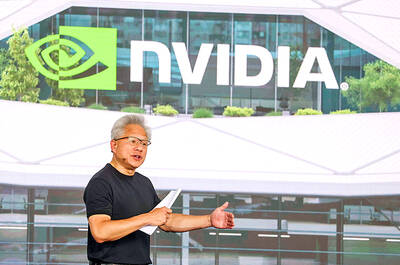
‘BOOMING’: ’ The number of partners we have here is incredible. You can see from their stock prices. They’re doing so well, they’re so happy,’ Jensen Huang said Nvidia Corp’s spending in Taiwan has ballooned to about US$150 billion a year, 10 times the US$10 billion to US$15 billion the company spent five years ago, Nvidia chief executive officer Jensen Huang (黃仁勳) said yesterday, suggesting Taiwan’s strategic importance in the global artificial intelligence (AI) supply chain. “Taiwan is the epicenter of the AI revolution. This is where the chips come, packaging comes. This is where the systems are made. This is where AI supercomputers were created,” Huang said at a meeting for the company’s employees in Beitou-Shilin Technology Park (北投士林科技園區) in Taipei, the planned site of Nvidia’s Taipei headquarters. “Taiwan
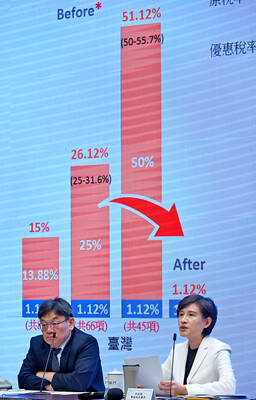
GREATER REACH? Auto parts and wood products would face tariffs of up to 15%, matching those targeting the EU, Japan and South Korea, Vice Premier said The US has announced that preferential tariff treatment for Taiwan’s non-semiconductor Section 232 goods would take effect retroactively from May 1, the Executive Yuan said yesterday. The US government yesterday posted a notice on the Federal Register’s public inspection Web site previewing tariff concessions for Taiwan under a memorandum of understanding (MOU) on Taiwan-US investment after two months of negotiations. The MOU signed on Jan. 15 stipulated three major preferential tariff arrangements: a 15 percent “reciprocal” tariff rate for Taiwan without stacking most-favored nation (MFN) rates; preferential Section 232 treatment for semiconductors and related products; and preferential Section 232 treatment for non-semiconductor


 RSS
RSS