


The military plans to use part of a proposed NT$1.25 trillion (US$39.1 billion) special defense budget to purchase hundreds of robot dogs that can be deployed for patrols, reconnaissance and potentially combat operations, sources said.
Set to be commercially released next year, the robot dog would be equipped with a thermal imaging sensor chip, the sources said, but did not elaborate on whether it would be a human-in-the-loop or fully autonomous system.
The US-made autonomous quadrupedal robots are a more mature technology than humanoid robots, an official with knowledge of the matter said on condition of anonymity.
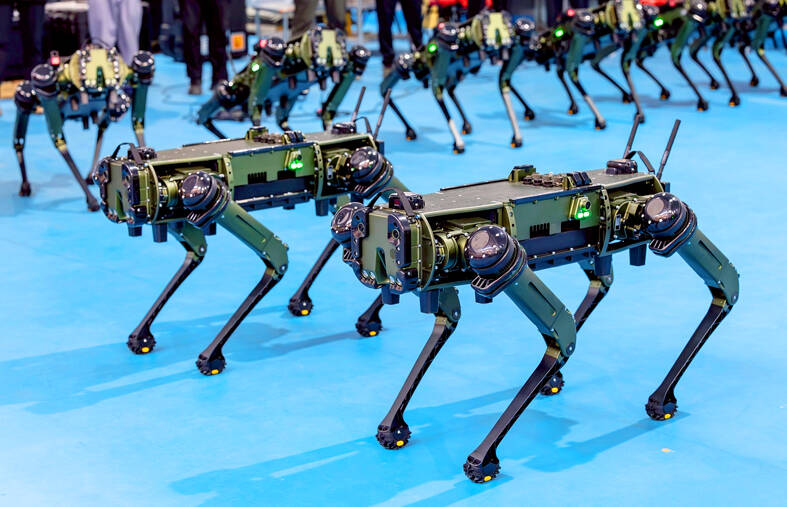
Photo: Screen grab from Hsiao Bi-khim’s Facebook page
Globally, many defense manufacturers have developed robot dogs that can be purchased off the shelf, they said.
However, the military’s plan is to buy robot platforms from the US and use domestically developed “smart” thermal imagers for deployment as guards at military bases to defend outlying islands, the official said.
Using robot dogs would help solve a shortage of troops to guard the nation’s infrastructure, they said.
Another advantage of the quadrupedal vehicle design is its superior balance, allowing robots to navigate gradients, staircases and unpaved gravel surfaces that characterize local military bases, the official said.
The Chungshan Institute of Science and Technology’s artificial intelligence (AI)-boosted thermal image technology — which is expected to be completed next year — would significantly enhance the robots’ capabilities, they said.
Using algorithms to sharpen images, this prototype device would enhance users’ situational awareness on the battlefield, the official said.
The institute is already planning to develop photonic chip technology that would reduce Taiwan’s dependence on foreign suppliers for image intensifier tubes, which are manufactured by six companies worldwide, they said.
Last month, a government official said the military’s interest in robot dogs in part stemmed from the military’s strategic shift toward focusing on combat operations in towns and cities.
Taiwan’s narrow alleys and streets present a challenge to the mobility of conventional vehicles, but four-legged drones can navigate them with ease, the official said on condition of anonymity.
Robot dogs can conduct reconnaissance and battle damage assessment missions in areas too dangerous or restrictive for infantry or uncrewed aerial vehicles to operate, such as tunnels and ruins, he said.
Uncrewed ground drones can be equipped with gear that can serve as mobile telecommunication relays between ground units and satellites in a contested electronic warfare environment, he said.
The military expects to arm at least some of the robot dogs with machine guns and light anti-armor rockets to take part in combat, the official said.

‘NO SECURITY RISK’: The Railway Bureau reassured the public that the technicians’ activities were limited to technical guidance and did not involve sensitive systems The Railway Bureau yesterday said it had invited eight Chinese technicians to assist with an airport MRT construction project. The bureau issued the confirmation after an Internet user said Chinese nationals had entered the construction zone of Taiwan Taoyuan International Airport’s Terminal 3 project. They asked why “individuals from an enemy state” were allowed access to such a major national infrastructure project, which raised serious concerns over Taiwan’s industrial safety, sensitive systems and information security. The bureau’s Northern Region Engineering Branch Office said subcontractor Taiwan Handle Industrial Co (台灣手把工業) of the Taoyuan airport MRT’s “Contract No. CU05 Project A14 Station Civil, MEP &

A US uncrewed surface vessel (USV) encountered multiple Chinese warships during an autonomous transit of the Taiwan Strait, US defense company Seasats said in a statement on Wednesday. Seasats announced that a Lightfish USV had completed the first autonomous transit of the Taiwan Strait. Over five days, the USV traversed the entire length of the Strait while constantly monitoring surface vessel traffic, the company said. The Lightfish encountered multiple Chinese warships, one of which was a Chinese People’s Liberation Army Navy (PLAN) Type 056 corvette, it said. The Chinese vessels were operating “well within Taiwan’s exclusive economic zone without transmitting their identity via the

‘BOOMING’: ’ The number of partners we have here is incredible. You can see from their stock prices. They’re doing so well, they’re so happy,’ Jensen Huang said Nvidia Corp’s spending in Taiwan has ballooned to about US$150 billion a year, 10 times the US$10 billion to US$15 billion the company spent five years ago, Nvidia chief executive officer Jensen Huang (黃仁勳) said yesterday, suggesting Taiwan’s strategic importance in the global artificial intelligence (AI) supply chain. “Taiwan is the epicenter of the AI revolution. This is where the chips come, packaging comes. This is where the systems are made. This is where AI supercomputers were created,” Huang said at a meeting for the company’s employees in Beitou-Shilin Technology Park (北投士林科技園區) in Taipei, the planned site of Nvidia’s Taipei headquarters. “Taiwan
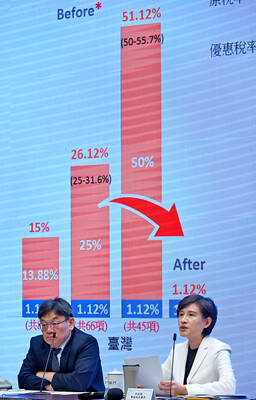
GREATER REACH? Auto parts and wood products would face tariffs of up to 15%, matching those targeting the EU, Japan and South Korea, Vice Premier said The US has announced that preferential tariff treatment for Taiwan’s non-semiconductor Section 232 goods would take effect retroactively from May 1, the Executive Yuan said yesterday. The US government yesterday posted a notice on the Federal Register’s public inspection Web site previewing tariff concessions for Taiwan under a memorandum of understanding (MOU) on Taiwan-US investment after two months of negotiations. The MOU signed on Jan. 15 stipulated three major preferential tariff arrangements: a 15 percent “reciprocal” tariff rate for Taiwan without stacking most-favored nation (MFN) rates; preferential Section 232 treatment for semiconductors and related products; and preferential Section 232 treatment for non-semiconductor


 RSS
RSS