


US President Donald Trump and Japanese Prime Minister Sanae Takaichi on Thursday affirmed their shared commitment to peace and stability across the Taiwan Strait and opposition to any attempts to unilaterally change the “status quo.”
The two leaders met at the White House to discuss trade and cooperation in defense, technology and space, a fact sheet published by the White House on the meeting said.
Kyodo News said Takaichi expressed concern during the meeting about the severe security environment in the Indo-Pacific region in the face of an “increasingly assertive” China, while also noting reports that the US has shifted some of its military assets in the region to the Middle East.
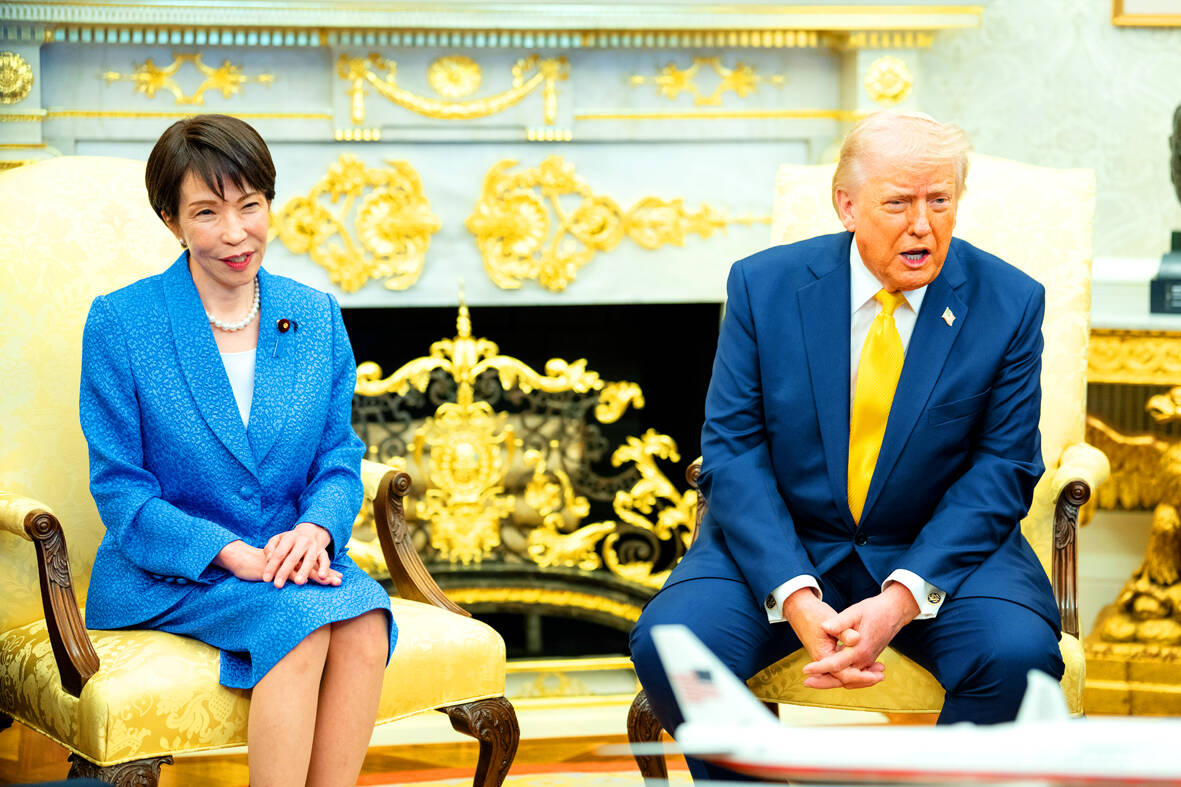
Photo: EPA
The White House said the two leaders affirmed their commitment to peace and stability across the Taiwan Strait as an “indispensable element of regional security and global prosperity,” the White House said.
Trump and Takaichi also expressed support for the peaceful resolution of cross-strait issues through dialogue, and opposed any attempts to unilaterally change the “status quo,” including by force or coercion, it said.
Thursday’s summit was the second between the two leaders. The two first held a summit in Tokyo in October last year.
Additionally, to bolster deterrence, both sides agreed to quadruple the production of the upgraded interceptor missile SM-3 Block IIA, jointly developed by Japan and the US.
The SM-3 Block IIA is designed primarily to counter short and medium-range missiles. Under a collaborative production model, Japan is responsible for key components while the US handles overall manufacturing.
The missile interceptor is one of the most representative joint weapons programs in US-Japan defense cooperation.
In Taipei, Presidential Office spokeswoman Karen Kuo (郭雅慧) yesterday said that Taiwan welcomes the US-Japan leaders’ meeting and expressed “appreciation for the important consensus reached on strengthening the US-Japan alliance and security in the Indo-Pacific region.”
The two nations again reaffirmed that peace and stability in the Taiwan Strait are indispensable to regional security and global prosperity, and they oppose any attempts to change the “status quo” through force or coercion, which fully reflect the broad consensus of the international community, Kuo said.
Taiwan will continue to uphold the principle of “peace through strength,” strengthening self-defense capabilities and promoting society-wide defense resilience, while deepening cooperation with like-minded countries to jointly safeguard a rules-based international order and ensure peace, stability and prosperity in the region, she added.
The Ministry of Foreign Affairs also expressed its “heartfelt gratitude” to the two leaders for reaffirming their commitment to security across the Taiwan Strait.
The ministry said in a statement that it welcomes the international community to continue advocating for peace and stability in the Taiwan Strait, citing Taiwan’s vital role in the global economy and crucial strategic location in the first island chain.
Additional reporting by Lin Tsuei-yi
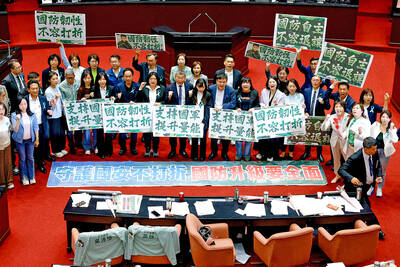
WHAT WAS ALL THAT FOR? Jaw Shaw-kong said that Cheng Li-wen had pushed for more drastic cuts and attacked him, just for the outcome to be nearly identical to his bill The legislature yesterday passed a supplementary budget bill to fund the purchase of separate packages of US military equipment, with the combined amount of spending capped at NT$780 billion (US$24.8 billion). The Chinese Nationalist Party (KMT) and Taiwan People’s Party (TPP) used their legislative majority to pass the bill, which runs until 2033 and has two main funding provisions. One was for NT$300 billion of arms sales already approved by the US for Taiwan on Dec. 17 last year, the other was for NT$480 billion for another arms package expected to be announced by Washington. The bill, which fell short of the NT$1.25
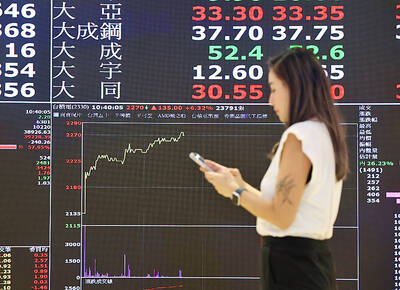
Taiwanese shares yesterday posted a record daily gain of more than 1,700 points to close above 40,000 points for the first time, led by large-cap semiconductor stocks such as Taiwan Semiconductor Manufacturing Co (TSMC, 台積電) and MediaTek Inc (聯發科) amid optimism about the artificial intelligence (AI) boom. The TAIEX ended up 1,778.51 points, or 4.57 percent, at 40,705.14 after moving between 39,228.39 and 40,755.52, while the New Taiwan dollar closed up NT$0.038 at NT$31.610 per US dollar, ending three consecutive sessions of declines. Turnover on the main board totaled NT$1.007 trillion (US$31.9 billion), with foreign institutional investors buying a net NT$66.98 billion

A former television news host and six military personnel — active and retired — have been indicted on espionage charges, Kaohsiung prosecutors said yesterday. Lin Chen-you (林宸佑), a former CTi News host and YouTuber, last year allegedly made videos at the direction of a Chinese agent criticizing the Democratic Progressive Party’s recall campaign, the Ciaotou District Prosecutors’ Office told a news conference in Kaohsiung. He allegedly received 4,325 tether coins for the videos from an unidentified person surnamed Huang (黃), believed to be an agent of a hostile foreign power, they said. Lin, also known as Ma Te (馬德), has a show named
NON-INTERFERENCE: The US called Taiwan a trusted and capable partner, while an African Union leader urged nations to reflect on respect for sovereign choices Taiwan is a “trusted and capable” partner of the US and Taipei’s global relationships, including with Eswatini, provide significant benefits, the US Department of State said of President William Lai’s (賴清德) trip to the southern African kingdom. Lai arrived in the former Swaziland on Saturday on a surprise visit after a planned trip last month was canceled when Seychelles, Mauritius and Madagascar denied overflight permission for his aircraft due to Chinese pressure. “Taiwan is a trusted and capable partner of the United States and many others, and its relationships around the world provide significant benefits to the citizens of those countries,


 RSS
RSS