


China does not plan to invade Taiwan next year and seeks to control the nation without the use of force, the US intelligence community said on Wednesday.
The assessment in the intelligence agencies’ annual report on global threats comes as Beijing has stepped up pressure on Taiwan with frequent military drills, even as US President Donald Trump has downplayed the risk of Chinese military action while he is in office.
The Pentagon late last year said that the US military believed China was preparing to be able to win a fight for Taiwan by next year, the centenary of the founding of the Chinese People’s Liberation Army (PLA), and was refining options to take Taiwan by “brute force” if needed.
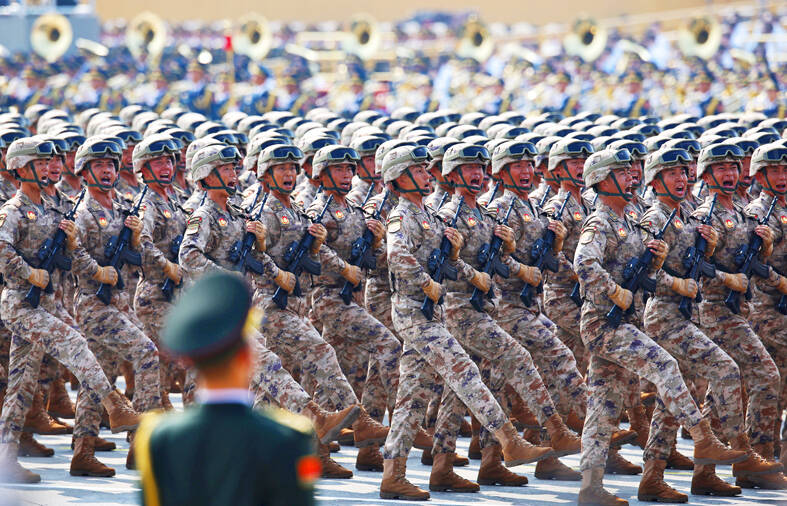
Photo: EPA
“China, despite its threat to use force to compel unification if necessary and to counter what it sees as a US attempt to use Taiwan to undermine China’s rise, prefers to achieve unification without the use of force, if possible,” the US intelligence agencies said in the report.
The US “assesses that Chinese leaders do not currently plan to execute an invasion of Taiwan in 2027, nor do they have a fixed timeline for achieving unification,” the report said.
It reiterated previous views that the PLA was making “steady, but uneven” progress on capabilities it could use to capture Taiwan.
Beijing would almost certainly consider a variety of factors in deciding whether and how to pursue military approaches to unification, the report said, listing factors such as “PLA readiness, the actions and politics of Taiwan, and whether or not the US will militarily intervene on Taiwan’s behalf,” the report said.
Chinese officials acknowledge that a full-scale amphibious invasion of Taiwan would be extremely challenging and risky, particularly if the US intervenes, it said.
A conflict over Taiwan could disrupt US access to trade and critical semiconductors, unsettle global supply chains, and spark market turmoil, it said.
“Even without Washington’s involvement, US and global economic and security interests would face significant and costly consequences, with tech supply chains disrupted and investor fear across markets,” it said.
In addition, a protracted war with the US risks unprecedented economic costs to the US, Chinese and global economies, it added.
Beijing yesterday said that the US should “stop hyping” China as a threat.
“The US should ... speak and act cautiously on the Taiwan issue,” should “correct their understanding of China and stop hyping up the China threat theory,” Chinese Ministry of Foreign Affairs spokesman Lin Jian (林劍) told a news conference.
In Taipei, a national security official yesterday said that while Beijing has pushed back its timetable for a potential attack on Taiwan, the threat remains far from over.
Political interference and “united front” efforts are expected to continue, with China adjusting its expansion goals and timeline in line with evolving strategic conditions and realities on the ground, said the official on condition of anonymity.
US intelligence assessments are ongoing and continuously updated, they said.
For this year, the view that China might be delaying its timeline for an invasion of Taiwan rests on two main factors, they said.
First, purges within the Chinese military over the past two years reflect deep-seated corruption and structural problems in command under an authoritarian system, they said, adding that the actions have also significantly undermined the PLA’s ability to integrate and develop joint combat capabilities.
As the purges continue, their effects on equipment modernization, internal discipline and overall morale have forced Chinese decisionmakers to prioritize internal stability above all else, the official said.
Second, in the past few months, several international conflicts have highlighted a stark gap between China’s vaunted military equipment and tactics, and the reality on the ground, they said.
The shortfall has come as a major shock to the Chinese military and its top decisionmakers, as it underscores the potential outcomes if the PLA were to face US forces or comparable equipment in a conflict, they said.
Meanwhile, the report said that Japanese Prime Minister Sanae Takaichi’s remarks that a hypothetical Chinese attack on Taiwan could bring about a Japanese military response departed from the rhetoric of previous Japanese leaders.
However, Japanese Chief Cabinet Secretary Minoru Kihara yesterday told a news conference that “the [Japanese] government’s position of judging an existential crisis situation with all the information it gathers is consistent with the past.”
“The assessment that there has been a major shift is not accurate,” Kihara added.
Additional reporting by AFP

‘NO SECURITY RISK’: The Railway Bureau reassured the public that the technicians’ activities were limited to technical guidance and did not involve sensitive systems The Railway Bureau yesterday said it had invited eight Chinese technicians to assist with an airport MRT construction project. The bureau issued the confirmation after an Internet user said Chinese nationals had entered the construction zone of Taiwan Taoyuan International Airport’s Terminal 3 project. They asked why “individuals from an enemy state” were allowed access to such a major national infrastructure project, which raised serious concerns over Taiwan’s industrial safety, sensitive systems and information security. The bureau’s Northern Region Engineering Branch Office said subcontractor Taiwan Handle Industrial Co (台灣手把工業) of the Taoyuan airport MRT’s “Contract No. CU05 Project A14 Station Civil, MEP &

A US uncrewed surface vessel (USV) encountered multiple Chinese warships during an autonomous transit of the Taiwan Strait, US defense company Seasats said in a statement on Wednesday. Seasats announced that a Lightfish USV had completed the first autonomous transit of the Taiwan Strait. Over five days, the USV traversed the entire length of the Strait while constantly monitoring surface vessel traffic, the company said. The Lightfish encountered multiple Chinese warships, one of which was a Chinese People’s Liberation Army Navy (PLAN) Type 056 corvette, it said. The Chinese vessels were operating “well within Taiwan’s exclusive economic zone without transmitting their identity via the
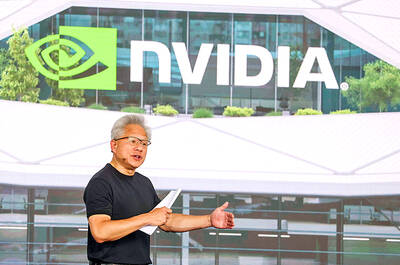
‘BOOMING’: ’ The number of partners we have here is incredible. You can see from their stock prices. They’re doing so well, they’re so happy,’ Jensen Huang said Nvidia Corp’s spending in Taiwan has ballooned to about US$150 billion a year, 10 times the US$10 billion to US$15 billion the company spent five years ago, Nvidia chief executive officer Jensen Huang (黃仁勳) said yesterday, suggesting Taiwan’s strategic importance in the global artificial intelligence (AI) supply chain. “Taiwan is the epicenter of the AI revolution. This is where the chips come, packaging comes. This is where the systems are made. This is where AI supercomputers were created,” Huang said at a meeting for the company’s employees in Beitou-Shilin Technology Park (北投士林科技園區) in Taipei, the planned site of Nvidia’s Taipei headquarters. “Taiwan
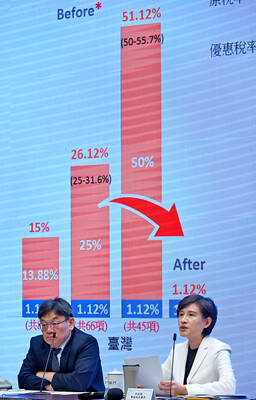
GREATER REACH? Auto parts and wood products would face tariffs of up to 15%, matching those targeting the EU, Japan and South Korea, Vice Premier said The US has announced that preferential tariff treatment for Taiwan’s non-semiconductor Section 232 goods would take effect retroactively from May 1, the Executive Yuan said yesterday. The US government yesterday posted a notice on the Federal Register’s public inspection Web site previewing tariff concessions for Taiwan under a memorandum of understanding (MOU) on Taiwan-US investment after two months of negotiations. The MOU signed on Jan. 15 stipulated three major preferential tariff arrangements: a 15 percent “reciprocal” tariff rate for Taiwan without stacking most-favored nation (MFN) rates; preferential Section 232 treatment for semiconductors and related products; and preferential Section 232 treatment for non-semiconductor


 RSS
RSS