


The Afghan government yesterday said that about 400 people were killed in a Pakistani airstrike on a drug rehabilitation center in the capital, Kabul, in the deadliest attack in months of violence between the two neighbors.
Hundreds more were said to have been wounded at the facility, which was hit on Monday night, flattening buildings used to treat people from across the country for addictions to marijuana, amphetamines and other narcotics.
There was no immediate independent verification of the toll, but reporters saw at least 30 bodies taken from the site in the chaotic and smoldering aftermath of the attack on Monday night.
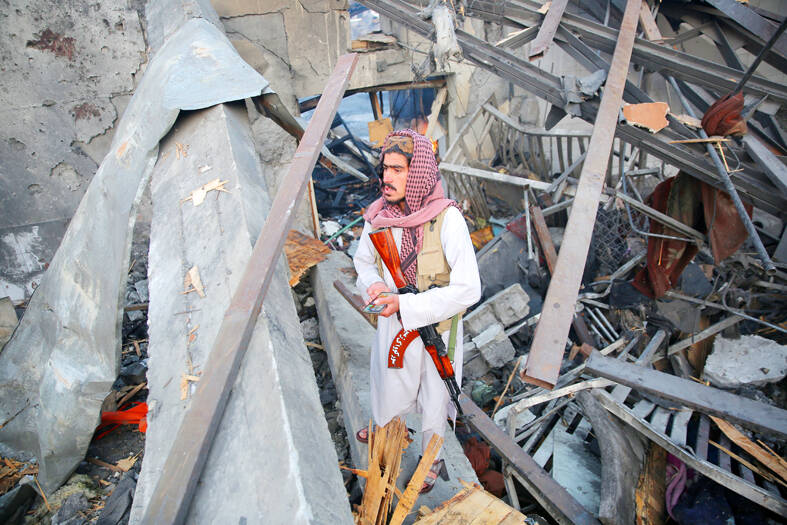
Photo: EPA
They then saw more than 65 removed yesterday as rescuers picked through the rubble in the search for victims and survivors.
“The toll is not final as the rescue operation is still going on, but we have around 400 martyrs and more than 200 wounded,” Afghan Ministry of Public Health spokesman Sharafat Zaman said, calling the strike “against the Geneva Convention and all international laws.”
Afghan Ministry of Interior Affairs spokesman Abdul Mateen Qani gave a toll of “408 killed and 265 wounded” at the same briefing.
The Italian non-governmental organization Emergency soon after the strike said that it received three bodies at its hospital in Kabul and was treating 27 wounded, but expected the toll to be much higher.
In Geneva, Switzerland, UN rights office spokesman Thameen al-Kheetan called for a swift, independent and transparent investigation into the strike, with those responsible “held to account in line with international standards.”
However, Pakistani Minister for Information and Broadcasting Attaullah Tarar said Taliban government claims that Pakistan deliberately targeted the clinic were “entirely baseless.”
“No hospital, no drug rehabilitation centre, and no civilian facility was targeted,” he wrote on social media. “The targets were military and terrorist infrastructure, including ammunition and technical equipment storage sites and other installations linked to hostile activity against Pakistan.”
The two sides have been in conflict for months, with Islamabad accusing its neighbor of harboring Islamist extremists who have mounted deadly cross-border attacks on its territory.
Chairs, blankets, pieces of hospital beds and human remains could be seen in the blackened ruins of the rehabilitation center as dawn broke.
Crowds gathered outside as family members sought news of their loved ones, as rescuers picked through the rubble nearby.
Habibullah Kabulbai, 55, arrived at the center on Monday night hoping to find his brother, Nawroz, who was admitted five days ago.
“I can’t find him,” he said, weeping. “What should we do? I have no words... We are helpless. This has not only happened to me, but the whole of Afghanistan.”
Monday evening’s attack triggered panic in Kabul, sending people running for cover as anti-aircraft guns fired back.
“I heard the sound of the jet patrolling,” Omid Stanikzai, 31, a security guard at the drug treatment center said. “There were military units all around us. When these military units fired on the jet, the jet dropped bombs and a fire broke out.”
All of the dead and injured were civilians, he added.

‘NO SECURITY RISK’: The Railway Bureau reassured the public that the technicians’ activities were limited to technical guidance and did not involve sensitive systems The Railway Bureau yesterday said it had invited eight Chinese technicians to assist with an airport MRT construction project. The bureau issued the confirmation after an Internet user said Chinese nationals had entered the construction zone of Taiwan Taoyuan International Airport’s Terminal 3 project. They asked why “individuals from an enemy state” were allowed access to such a major national infrastructure project, which raised serious concerns over Taiwan’s industrial safety, sensitive systems and information security. The bureau’s Northern Region Engineering Branch Office said subcontractor Taiwan Handle Industrial Co (台灣手把工業) of the Taoyuan airport MRT’s “Contract No. CU05 Project A14 Station Civil, MEP &

A US uncrewed surface vessel (USV) encountered multiple Chinese warships during an autonomous transit of the Taiwan Strait, US defense company Seasats said in a statement on Wednesday. Seasats announced that a Lightfish USV had completed the first autonomous transit of the Taiwan Strait. Over five days, the USV traversed the entire length of the Strait while constantly monitoring surface vessel traffic, the company said. The Lightfish encountered multiple Chinese warships, one of which was a Chinese People’s Liberation Army Navy (PLAN) Type 056 corvette, it said. The Chinese vessels were operating “well within Taiwan’s exclusive economic zone without transmitting their identity via the

Taiwan is still in the process of assessing the possibility of recruiting workers from Eswatini, the Ministry of Foreign Affairs said yesterday, adding that its goal is to help Eswatini upgrade its vocational training centers. If there are plans to recruit workers from Eswatini, safeguarding national security, protecting public health and ensuring the employment rights of Taiwanese would be prerequisites, Department of West Asian and African Affairs Director-General Yen Chia-liang (顏嘉良) told a news conference. Key considerations would also include filling labor shortages in specific industries, and fostering bilateral professional and technical exchanges, he said. Yen was asked about the progress of labor
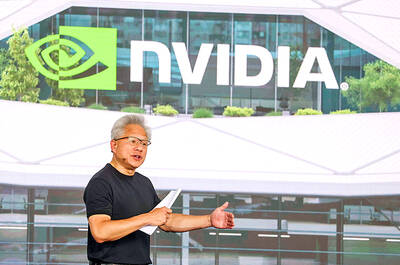
‘BOOMING’: ’ The number of partners we have here is incredible. You can see from their stock prices. They’re doing so well, they’re so happy,’ Jensen Huang said Nvidia Corp’s spending in Taiwan has ballooned to about US$150 billion a year, 10 times the US$10 billion to US$15 billion the company spent five years ago, Nvidia chief executive officer Jensen Huang (黃仁勳) said yesterday, suggesting Taiwan’s strategic importance in the global artificial intelligence (AI) supply chain. “Taiwan is the epicenter of the AI revolution. This is where the chips come, packaging comes. This is where the systems are made. This is where AI supercomputers were created,” Huang said at a meeting for the company’s employees in Beitou-Shilin Technology Park (北投士林科技園區) in Taipei, the planned site of Nvidia’s Taipei headquarters. “Taiwan


 RSS
RSS