


A large explosion yesterday rocked an area of Iran’s capital where thousands were gathered for the annual state-organized Quds Day to support the Palestinians and call for Israel’s demise.
Israel had earlier warned that it would target the area in central Tehran.
There were no immediate reports of casualties, but the decision to proceed with the mass demonstrations, and Israel’s threat to target the area, underscored the fierce determination on both sides nearly two weeks into a war that has rattled the global economy and shows no sign of letting up.
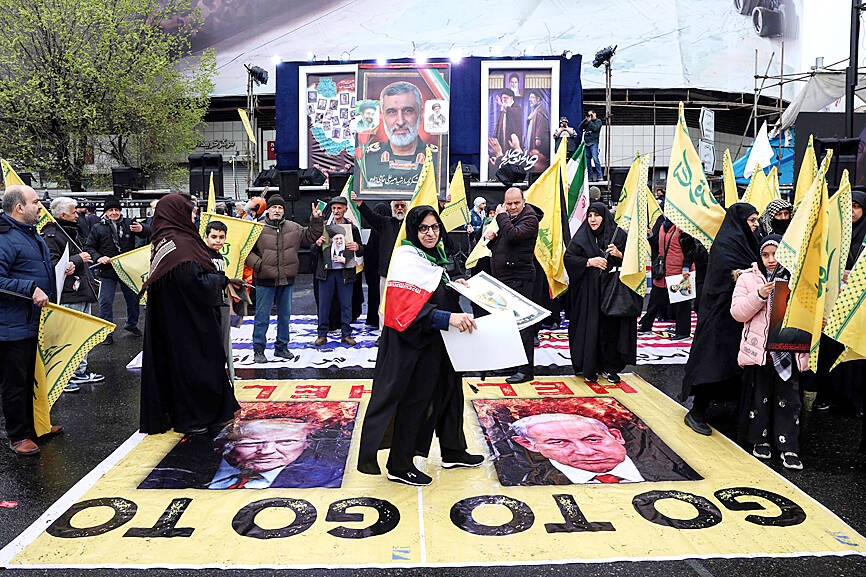
Photo: AFP
Iran has continued to launch widespread daily missile and drone attacks on Israel and neighboring Gulf states, and has effectively closed the Strait of Hormuz, through which one-fifth of the world’s traded oil passes, even as US and Israeli warplanes pummel military and other targets across Iran.
Iranian supreme leader Mojtaba Khamenei on Thursday vowed to continue the attacks and keep the strait closed in his first public statement since succeeding his father, who was killed on the opening day of the war. Khamenei has not been seen in public since taking over the leadership and the written statement was read by a state TV anchor.
With growing global concerns about a possible energy crisis and no end to the war in sight, the price of Brent crude oil, the international standard, remained more than US$100 per barrel. Brent prices have spiked as high as about US$120 per barrel and are about 40 percent higher than when Israel and the US launched the war on Feb. 28.
The explosion rocked the Ferdowsi Square area at midday, where thousands had gathered for an annual rally organized by the government in which they chanted “death to Israel” and “death to America.”
Israel had issued a warning on a Farsi-language social media account for people to clear the area shortly before the blast, but few Iranians would have seen it, as authorities have almost completely shut down the Internet since the start of the war.
Israel did not say what it was targeting, but Iranian leaders often attend the annual rallies.
The hard-liner who leads Iran’s judiciary, Gholamhossein Mohseni Ejei, had been giving an interview to a state television reporter at the demonstration when the strike happened.
His bodyguards encircled him, as he raised his fist and said Iran “under this rain and missiles will never withdraw.”
Senior security official Ali Larijani, who was also at the Quds Day demonstrations, told Iranian media covering the event that the suspected Israeli attack was a “sign of its desperation.”
Israel had earlier announced another wave of strikes in Iran targeting infrastructure and said its air force had hit more than 200 targets in the previous 24 hours, including missile launchers, defense systems and weapons production sites.
Iran has been attacking oil and other infrastructure around the Gulf region, and yesterday Saudi Arabia said that it had downed nearly 50 drones sent in multiple waves.
In Oman, two people were killed when two drones crashed in an industrial area in the region of Sohar, the Oman News Agency reported.
Sirens also sounded in Bahrain warning of incoming fire, and black smoke billowed from an industrial area in the business and tourism hub of Dubai, United Arab Emirates, after a blaze that authorities said was sparked by debris from an interception.
A building at the Dubai International Financial Center also sustained damage when hit with debris from what authorities described as a “successful interception.”
More than 600 people have been killed in Lebanon since the fighting began.
Iranian authorities say that more than 1,300 people have been killed there, and Israel has reported 12 deaths. The US has lost at least 11 soldiers, while another eight have suffered severe injuries.

‘NO SECURITY RISK’: The Railway Bureau reassured the public that the technicians’ activities were limited to technical guidance and did not involve sensitive systems The Railway Bureau yesterday said it had invited eight Chinese technicians to assist with an airport MRT construction project. The bureau issued the confirmation after an Internet user said Chinese nationals had entered the construction zone of Taiwan Taoyuan International Airport’s Terminal 3 project. They asked why “individuals from an enemy state” were allowed access to such a major national infrastructure project, which raised serious concerns over Taiwan’s industrial safety, sensitive systems and information security. The bureau’s Northern Region Engineering Branch Office said subcontractor Taiwan Handle Industrial Co (台灣手把工業) of the Taoyuan airport MRT’s “Contract No. CU05 Project A14 Station Civil, MEP &

A US uncrewed surface vessel (USV) encountered multiple Chinese warships during an autonomous transit of the Taiwan Strait, US defense company Seasats said in a statement on Wednesday. Seasats announced that a Lightfish USV had completed the first autonomous transit of the Taiwan Strait. Over five days, the USV traversed the entire length of the Strait while constantly monitoring surface vessel traffic, the company said. The Lightfish encountered multiple Chinese warships, one of which was a Chinese People’s Liberation Army Navy (PLAN) Type 056 corvette, it said. The Chinese vessels were operating “well within Taiwan’s exclusive economic zone without transmitting their identity via the

Taiwan is still in the process of assessing the possibility of recruiting workers from Eswatini, the Ministry of Foreign Affairs said yesterday, adding that its goal is to help Eswatini upgrade its vocational training centers. If there are plans to recruit workers from Eswatini, safeguarding national security, protecting public health and ensuring the employment rights of Taiwanese would be prerequisites, Department of West Asian and African Affairs Director-General Yen Chia-liang (顏嘉良) told a news conference. Key considerations would also include filling labor shortages in specific industries, and fostering bilateral professional and technical exchanges, he said. Yen was asked about the progress of labor
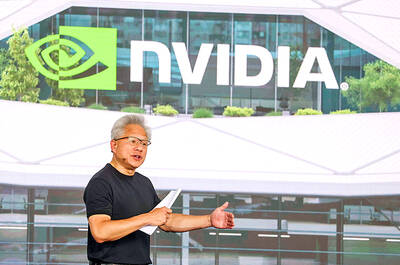
‘BOOMING’: ’ The number of partners we have here is incredible. You can see from their stock prices. They’re doing so well, they’re so happy,’ Jensen Huang said Nvidia Corp’s spending in Taiwan has ballooned to about US$150 billion a year, 10 times the US$10 billion to US$15 billion the company spent five years ago, Nvidia chief executive officer Jensen Huang (黃仁勳) said yesterday, suggesting Taiwan’s strategic importance in the global artificial intelligence (AI) supply chain. “Taiwan is the epicenter of the AI revolution. This is where the chips come, packaging comes. This is where the systems are made. This is where AI supercomputers were created,” Huang said at a meeting for the company’s employees in Beitou-Shilin Technology Park (北投士林科技園區) in Taipei, the planned site of Nvidia’s Taipei headquarters. “Taiwan


 RSS
RSS