


Nearly 60 percent of Taiwanese polled said they would be willing to resist “at all costs” if China attacks Taiwan and the US does not deploy forces to help, an Academia Sinica survey released yesterday found.
The Institute of European and American Studies’ “American Portrait” survey found that 58.7 percent of respondents would be willing to resist a Chinese invasion “at all costs,” even if the US does not deploy forces to help.
Among them, 41.2 percent said they would “definitely” resist, while 17.5 percent said they “probably” would.
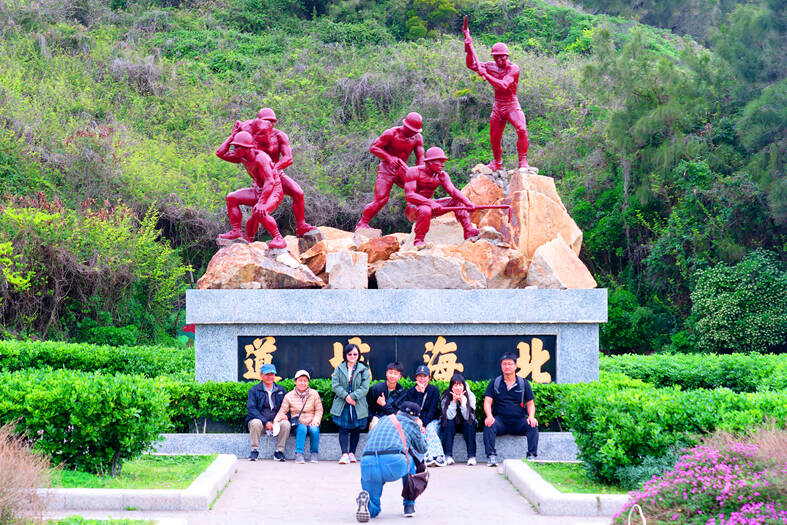
Photo: Jack Moore, AFP
The survey showed that 21.7 percent would “definitely not” resist, while 14.5 percent said “probably not.”
If the US were to deploy forces, 56.5 percent said they would be willing to “resist at all costs,” with 34.4 percent saying they would “definitely” resist, while 22.1 percent responded “probably.”
Meanwhile, 21.7 percent responded “definitely not,” while 13.1 percent said “probably not.”
Taiwanese willingness to fight has remained high in surveys since 1998, Soochow University associate professor of sociology Pan Hsin-hsin (潘欣欣) told a news conference yesterday at the Center for Strategic and International Studies.
The number of respondents willing to resist remains relatively high, largely driven by supporters of the Democratic Progressive Party (DPP), while supporters of the Chinese Nationalist Party (KMT) and the Taiwan People’s Party (TPP) tend to disagree, she said.
DPP supporters’ willingness to defend Taiwan remained unchanged regardless of US intervention, she said.
Asked which statement on cross-strait affairs most aligns with their viewpoint, the majority said they wanted to maintain the “status quo,” with 29.9 percent wishing to “maintain the status quo indefinitely.”
Meanwhile, 1.9 percent said “unification as soon as possible,” while 5.8 percent said “declare independence as soon as possible,” the survey showed.
Since 2021, American Portrait has asked the question: “Do you agree or disagree that the US is a credible country?”
Overall perceived credibility dropped from about 45 percent of respondents in 2021 to 34 percent this year, said Wu Wen-chin (吳文欽), a research fellow with the Institute of Political Science at Academia Sinica.
Meanwhile, Chinese credibility rose from 11.7 percent in 2021 to 17 percent this year, he said.
Taiwanese respondents view the US and China differently in terms of credibility, with far more people seeing the US as trustworthy than China, Wu said.
Respondents were also asked whether they agree with increasing the national defense budget to 3 percent of GDP, with 31.1 percent saying they disagree, including 16.9 percent who “strongly” disagreed and 14.2 percent who “probably” disagreed.
Of the 53.5 percent who said they agree, 25.9 percent said “probably agree” and 27.6 percent said “strongly agree.”
Asked if they would agree to increase defense spending “in response to a US request,” overall disagreement rose to 40 percent, while overall agreement fell to 49.7 percent.
Meanwhile, 69.5 percent of respondents said they supported Taiwan’s procurement of US weapons, while 24.7 percent did not.
Almost all DPP supporters support US weapon purchases, while about two-thirds of TPP supporters and fewer than half of KMT supporters expressed support, Pan said.
That position has created political deadlock, as the opposition parties together hold the legislative majority, leaving the procurement of US arms to continue at a “glacial speed,” she said.
The results came as the DPP’s proposed NT$1.25 trillion (US$39.25 billion) special defense budget has been stalled by the legislature for months.
The questionnaire was conducted from Jan. 20 to 26, garnering 1,206 valid telephone responses from respondents aged 20 or older, with a weighted sample against age, ethnicity, education and region to reflect the population.

‘NO SECURITY RISK’: The Railway Bureau reassured the public that the technicians’ activities were limited to technical guidance and did not involve sensitive systems The Railway Bureau yesterday said it had invited eight Chinese technicians to assist with an airport MRT construction project. The bureau issued the confirmation after an Internet user said Chinese nationals had entered the construction zone of Taiwan Taoyuan International Airport’s Terminal 3 project. They asked why “individuals from an enemy state” were allowed access to such a major national infrastructure project, which raised serious concerns over Taiwan’s industrial safety, sensitive systems and information security. The bureau’s Northern Region Engineering Branch Office said subcontractor Taiwan Handle Industrial Co (台灣手把工業) of the Taoyuan airport MRT’s “Contract No. CU05 Project A14 Station Civil, MEP &

A US uncrewed surface vessel (USV) encountered multiple Chinese warships during an autonomous transit of the Taiwan Strait, US defense company Seasats said in a statement on Wednesday. Seasats announced that a Lightfish USV had completed the first autonomous transit of the Taiwan Strait. Over five days, the USV traversed the entire length of the Strait while constantly monitoring surface vessel traffic, the company said. The Lightfish encountered multiple Chinese warships, one of which was a Chinese People’s Liberation Army Navy (PLAN) Type 056 corvette, it said. The Chinese vessels were operating “well within Taiwan’s exclusive economic zone without transmitting their identity via the
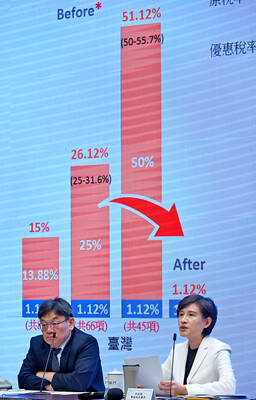
GREATER REACH? Auto parts and wood products would face tariffs of up to 15%, matching those targeting the EU, Japan and South Korea, Vice Premier said The US has announced that preferential tariff treatment for Taiwan’s non-semiconductor Section 232 goods would take effect retroactively from May 1, the Executive Yuan said yesterday. The US government yesterday posted a notice on the Federal Register’s public inspection Web site previewing tariff concessions for Taiwan under a memorandum of understanding (MOU) on Taiwan-US investment after two months of negotiations. The MOU signed on Jan. 15 stipulated three major preferential tariff arrangements: a 15 percent “reciprocal” tariff rate for Taiwan without stacking most-favored nation (MFN) rates; preferential Section 232 treatment for semiconductors and related products; and preferential Section 232 treatment for non-semiconductor

TIT-FOR-TAT: The US allegedly revoked the visa of a Chinese national working at Xinhua News Agency in the US in response to Beijing’s expulsion of Vivian Wang The Presidential Office yesterday condemned China for expelling a New York Times correspondent from Beijing following the newspaper’s interview with President William Lai (賴清德), saying the move highlighted Beijing’s suppression of press freedom and its threat to international news media. Taiwan has noted a series of recent incidents in which Beijing used similar tactics to “threaten and pressure international media outlets and journalists,” Presidential Office spokeswoman Karen Kuo (郭雅慧) said in a statement. “This concerns not only press freedom and freedom of expression, but also the safety of journalists, and Taiwan and relevant partners are paying close attention to the situation,” she


 RSS
RSS