


The three main political parties yesterday agreed to authorize the government to sign US agreements for four arms sales packages before the defense budget is passed, after officials warned that Taiwan would go to the back of the line if it missed the deadline.
President William Lai’s (賴清德) administration has urged the legislature to pass NT$1.25 trillion (US$39.25 billion) in extra defense spending over eight years, but the opposition parties, which together control the most seats, say the proposals are unclear, and they cannot be expected to pass a “blank check,” despite supporting defense.
The Chinese Nationalist Party (KMT) and the Taiwan People’s Party (TPP) have come up with their own, less expensive proposals, but the Ministry of National Defense has said that the letters of offer and acceptance for the weapons with the US have to be signed or Taiwan would lose its place in the production and delivery line.
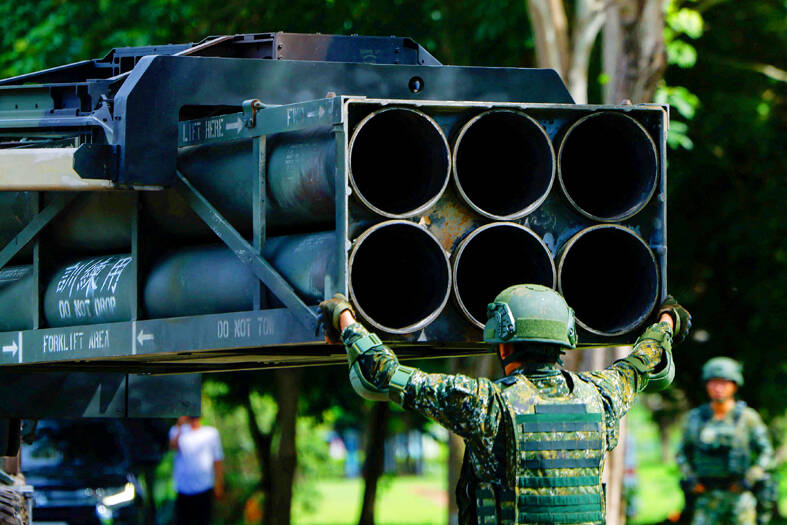
Photo: Ann Wang, Reuters
Lawmakers from both sides yesterday agreed during a meeting of the legislature’s Foreign Affairs and National Defense Committee that the government can still sign the agreements in advance, even if the reviews of the spending proposals are not approved in time.
The weapons to be signed for include tube-launched, optically tracked, wire command link guided anti-tank missiles, M109A7 self-propelled howitzers, Lockheed Martin Javelin missiles and the High Mobility Artillery Rocket Systems (HIMARS).
Minister of National Defense Wellington Koo (顧立雄) on Tuesday told reporters the HIMARS letter expires on March 26, for 82 systems the US announced in December last year as part of an US$11 billion arms sale package for Taiwan.
Ammunition would be removed from the package if Taiwan missed the deadline, Department of Strategic Planning Director Lieutenant General Huang Wen-chi (黃文啟) said.
Sunday is the deadline to sign for the other weapons systems, the ministry said.
The US$11 billion package also includes Altius-600 and Altius-700M drones, although letters of acceptance for those systems have yet to be issued.
Yesterday’s revised motion, which also directs the Cabinet to inform the legislature of the estimated delivery dates for the four systems, is expected to be approved at a plenary session.
A request by Democratic Progressive Party legislators to remove wording criticizing the ruling party’s “extremely opaque” handling of the government’s special defense budget was rejected.
KMT and TPP lawmakers also declined to grant the Cabinet prior approval to sign a letter of acceptance for the Altius drones.
Last month, a bipartisan group of 37 US lawmakers voiced concern to senior Taiwanese lawmakers about the stalled plans.
US President Donald Trump’s administration has pressed allies to increase defense spending, a plank Lai and his government have enthusiastically embraced.
Additional reporting by CNA

‘NO SECURITY RISK’: The Railway Bureau reassured the public that the technicians’ activities were limited to technical guidance and did not involve sensitive systems The Railway Bureau yesterday said it had invited eight Chinese technicians to assist with an airport MRT construction project. The bureau issued the confirmation after an Internet user said Chinese nationals had entered the construction zone of Taiwan Taoyuan International Airport’s Terminal 3 project. They asked why “individuals from an enemy state” were allowed access to such a major national infrastructure project, which raised serious concerns over Taiwan’s industrial safety, sensitive systems and information security. The bureau’s Northern Region Engineering Branch Office said subcontractor Taiwan Handle Industrial Co (台灣手把工業) of the Taoyuan airport MRT’s “Contract No. CU05 Project A14 Station Civil, MEP &

A US uncrewed surface vessel (USV) encountered multiple Chinese warships during an autonomous transit of the Taiwan Strait, US defense company Seasats said in a statement on Wednesday. Seasats announced that a Lightfish USV had completed the first autonomous transit of the Taiwan Strait. Over five days, the USV traversed the entire length of the Strait while constantly monitoring surface vessel traffic, the company said. The Lightfish encountered multiple Chinese warships, one of which was a Chinese People’s Liberation Army Navy (PLAN) Type 056 corvette, it said. The Chinese vessels were operating “well within Taiwan’s exclusive economic zone without transmitting their identity via the
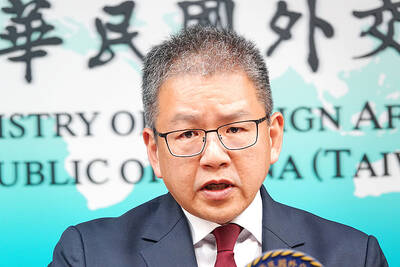
Taiwan is still in the process of assessing the possibility of recruiting workers from Eswatini, the Ministry of Foreign Affairs said yesterday, adding that its goal is to help Eswatini upgrade its vocational training centers. If there are plans to recruit workers from Eswatini, safeguarding national security, protecting public health and ensuring the employment rights of Taiwanese would be prerequisites, Department of West Asian and African Affairs Director-General Yen Chia-liang (顏嘉良) told a news conference. Key considerations would also include filling labor shortages in specific industries, and fostering bilateral professional and technical exchanges, he said. Yen was asked about the progress of labor
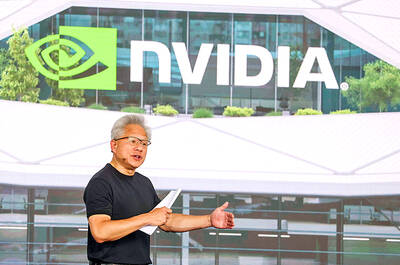
‘BOOMING’: ’ The number of partners we have here is incredible. You can see from their stock prices. They’re doing so well, they’re so happy,’ Jensen Huang said Nvidia Corp’s spending in Taiwan has ballooned to about US$150 billion a year, 10 times the US$10 billion to US$15 billion the company spent five years ago, Nvidia chief executive officer Jensen Huang (黃仁勳) said yesterday, suggesting Taiwan’s strategic importance in the global artificial intelligence (AI) supply chain. “Taiwan is the epicenter of the AI revolution. This is where the chips come, packaging comes. This is where the systems are made. This is where AI supercomputers were created,” Huang said at a meeting for the company’s employees in Beitou-Shilin Technology Park (北投士林科技園區) in Taipei, the planned site of Nvidia’s Taipei headquarters. “Taiwan


 RSS
RSS