


Iran yesterday named the hard-line Ayatollah Mojtaba Khamenei to succeed his late father as supreme leader, signaling no letup in the war launched by the US and Israel.
Oil prices surged as Iran attacked regional energy infrastructure and the US and Israel bombed targets across Iran.
With Iran’s theocracy under assault for more than a week, the country’s Assembly of Experts chose the secretive, 56-year-old cleric with close ties to the paramilitary Revolutionary Guard as the new supreme leader. The Guard has been firing missiles and drones at Israel and Gulf Arab states since Ayatollah Ali Khamenei, who had ruled Iran for 37 years, was killed during the war’s opening salvo.
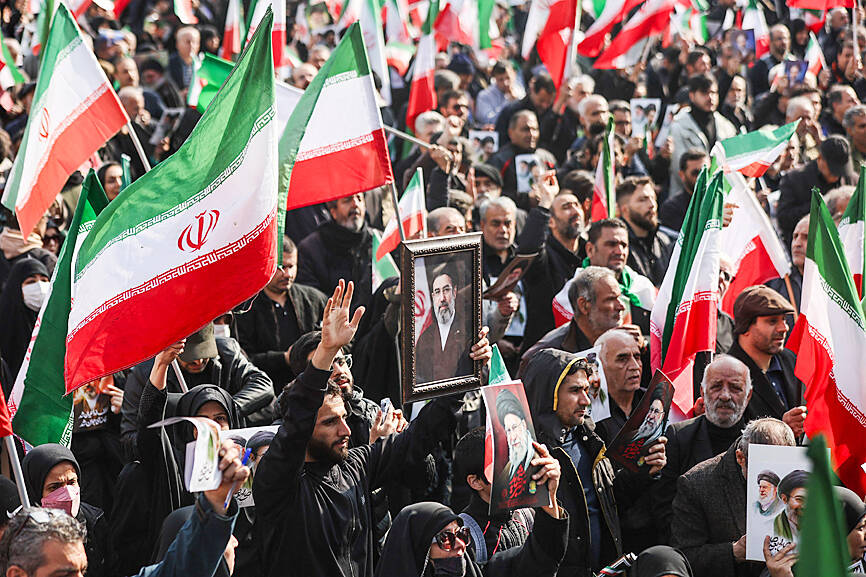
Photo: Reuters / West News Agency
The appointment marked a new sign of defiance by Iran’s embattled leadership after more than a week of heavy US and Israeli bombardment, suggesting that Tehran is not close to giving up on what it considers a fight for the nation’s existence.
World markets plummeted following the news, and Brent crude oil, the international standard, yesterday surged to nearly US$120 a barrel, about 65 percent higher than when the war started, before retreating.
Iran’s attacks in the Strait of Hormuz have also all but stopped tankers from using the key shipping lane through which one-fifth of the world’s oil is carried. Fire broke out at an oil facility that Iran attacked in the United Arab Emirates, while Bahrain’s only oil refinery was apparently also hit, and Saudi Arabia said it had intercepted several drones attacking its Shaybah oil field.
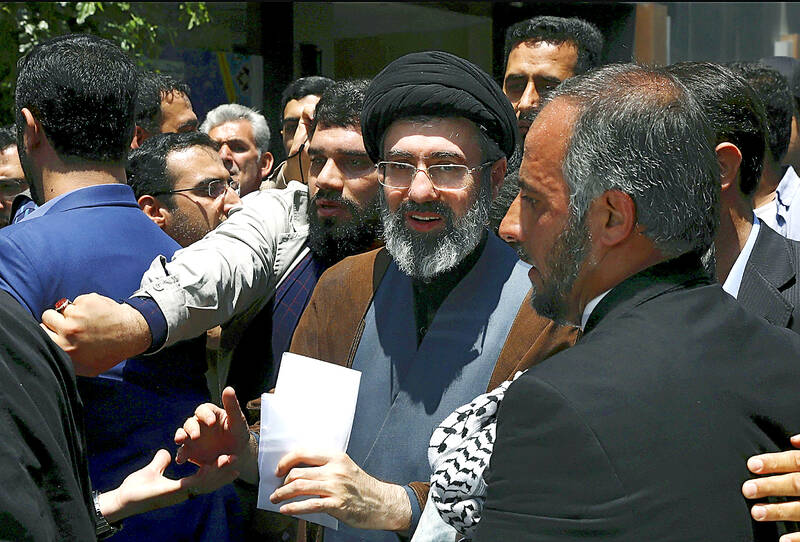
Photo: AP
In Israel, sirens blared multiple times, as Iran’s drones and missiles were unrelenting. A man was killed in central Israel in a missile strike, the first such death in Israel in a week, and a woman was wounded.
Israel said it struck the Iranian city of Isfahan, hitting command centers for the Revolutionary Guard and its volunteer Basij force, as well as a rocket engine production facility and missile launch sites. There was no immediate confirmation from Iran.
Turkey said NATO defenses had intercepted a ballistic missile that entered the country’s airspace for the second time since the start of the war.
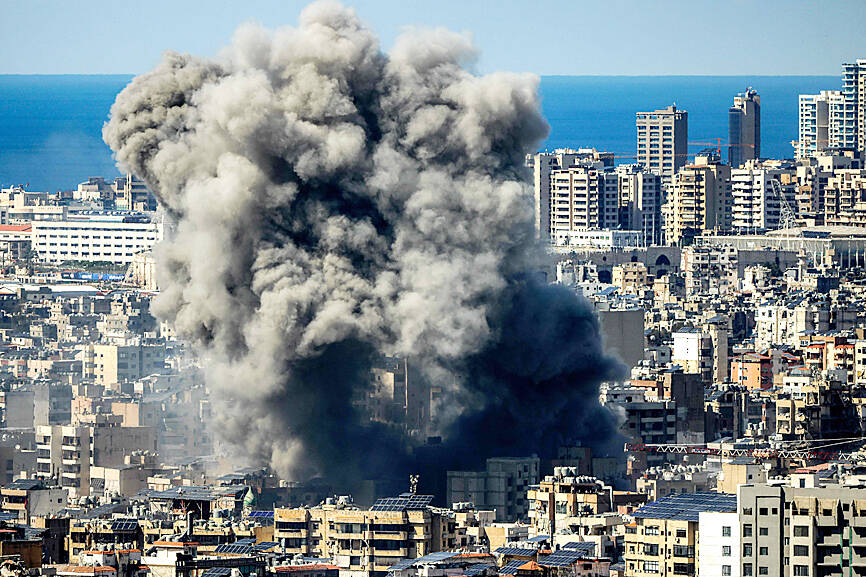
Photo: AFP
The younger Khamenei, who has not been seen in public since the war started, was long considered a potential successor — even before the Israeli strike killed his father. His wife, Zahra Haddad Adel, was killed in the same Israeli strike that killed the 86-year-old Ayatollah Ali Khamenei.
Political figures within Iran have criticized handing over the supreme leader’s title based on heredity, comparing it to the monarchy overthrown in the 1979 Islamic Revolution, but top clerics in the Assembly of Experts apparently voted for continuity.
Top Iranian security official Ali Larijani, speaking to Iranian state television, said the younger Khamenei had been trained by his father and “can handle this situation.”
While Iran’s key nuclear sites are in tatters after the US bombed them during the 12-day Israel-Iran war in June last year, it still has highly enriched uranium that is a technical step away from weapons-grade levels. Mojtaba Khamenei could choose to do what his father never did — build a nuclear bomb.
Israel has already described him as a potential target, while US President Donald Trump has called him “unacceptable” and dismissed him as a “lightweight.”
The Revolutionary Guard and the Iran-backed Lebanese militant group Hezbollah issued statements in support of Mojtaba Khamenei.

‘NO SECURITY RISK’: The Railway Bureau reassured the public that the technicians’ activities were limited to technical guidance and did not involve sensitive systems The Railway Bureau yesterday said it had invited eight Chinese technicians to assist with an airport MRT construction project. The bureau issued the confirmation after an Internet user said Chinese nationals had entered the construction zone of Taiwan Taoyuan International Airport’s Terminal 3 project. They asked why “individuals from an enemy state” were allowed access to such a major national infrastructure project, which raised serious concerns over Taiwan’s industrial safety, sensitive systems and information security. The bureau’s Northern Region Engineering Branch Office said subcontractor Taiwan Handle Industrial Co (台灣手把工業) of the Taoyuan airport MRT’s “Contract No. CU05 Project A14 Station Civil, MEP &

A US uncrewed surface vessel (USV) encountered multiple Chinese warships during an autonomous transit of the Taiwan Strait, US defense company Seasats said in a statement on Wednesday. Seasats announced that a Lightfish USV had completed the first autonomous transit of the Taiwan Strait. Over five days, the USV traversed the entire length of the Strait while constantly monitoring surface vessel traffic, the company said. The Lightfish encountered multiple Chinese warships, one of which was a Chinese People’s Liberation Army Navy (PLAN) Type 056 corvette, it said. The Chinese vessels were operating “well within Taiwan’s exclusive economic zone without transmitting their identity via the
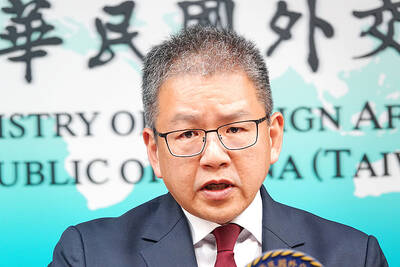
Taiwan is still in the process of assessing the possibility of recruiting workers from Eswatini, the Ministry of Foreign Affairs said yesterday, adding that its goal is to help Eswatini upgrade its vocational training centers. If there are plans to recruit workers from Eswatini, safeguarding national security, protecting public health and ensuring the employment rights of Taiwanese would be prerequisites, Department of West Asian and African Affairs Director-General Yen Chia-liang (顏嘉良) told a news conference. Key considerations would also include filling labor shortages in specific industries, and fostering bilateral professional and technical exchanges, he said. Yen was asked about the progress of labor
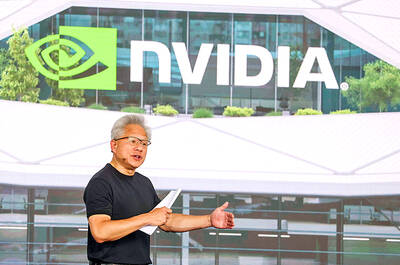
‘BOOMING’: ’ The number of partners we have here is incredible. You can see from their stock prices. They’re doing so well, they’re so happy,’ Jensen Huang said Nvidia Corp’s spending in Taiwan has ballooned to about US$150 billion a year, 10 times the US$10 billion to US$15 billion the company spent five years ago, Nvidia chief executive officer Jensen Huang (黃仁勳) said yesterday, suggesting Taiwan’s strategic importance in the global artificial intelligence (AI) supply chain. “Taiwan is the epicenter of the AI revolution. This is where the chips come, packaging comes. This is where the systems are made. This is where AI supercomputers were created,” Huang said at a meeting for the company’s employees in Beitou-Shilin Technology Park (北投士林科技園區) in Taipei, the planned site of Nvidia’s Taipei headquarters. “Taiwan


 RSS
RSS