


The government would take every measure to defend the rights of Taiwanese against Chinese oppression, the Mainland Affairs Council (MAC) said yesterday, after a Hong Kong-based publication reported that a relative of Minister of the Interior Liu Shyh-fang (劉世芳) sends her political donations obtained through investments in China.
The Ta Kung Pao (大公報) yesterday alleged that Liu’s nephew, Yen Wen-chun (顏文群), who holds senior management positions in three Chinese companies, gave Liu political donations.
One company netted 295 million yuan (US$43 million) last year, and received up to 100,000 yuan in Chinese subsidies, the report said.
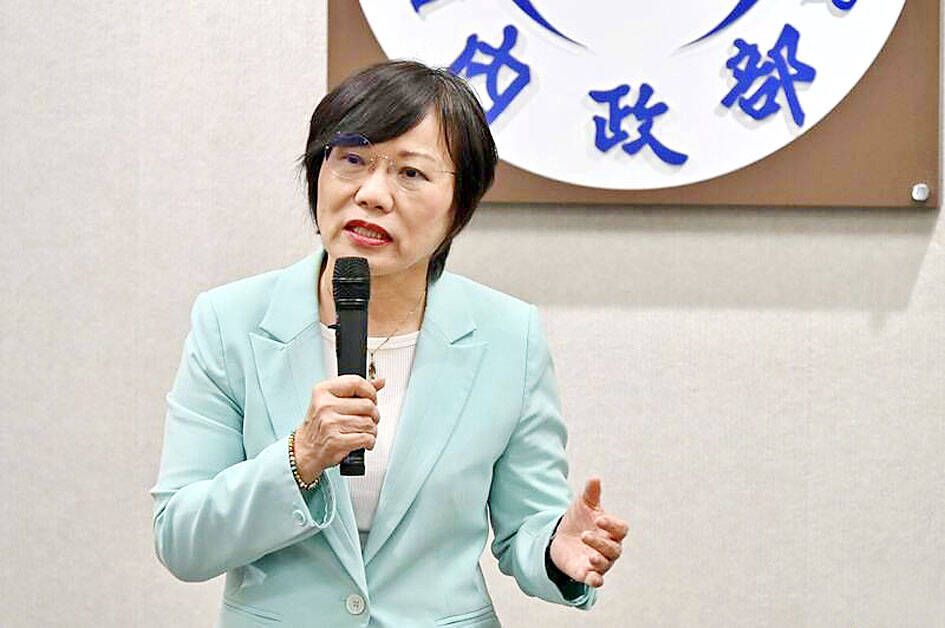
Photo: Chung Li-hua, Taipei Times
China’s Taiwan Affairs Office said it is looking into the issue.
Beijing would not allow those who support Taiwanese independence and ruin cross-strait relations to make money in China, then use those funds to undermine Beijing, the office said.
The office last month listed Liu as a “diehard Taiwanese independence separatist,” and banned her and their family from entering China and its territories.
The sanctions also ban businesses associated with “separatists” from operating in China, applicable for life.
The Chinese Communist Party (CCP) is using the state-owned Ta Kung Pao to spread fake news and attack Liu, the MAC said.
China irresponsibly implicated Liu’s nephew in a blatant attempt to oppress the Taiwan’s government, people and civil servants under the pretense of punitive action against pro-Taiwanese independence, it added.
China labeling people as “diehard Taiwanese independence separatists” and launching investigations into the businesses of their relatives shows that the CCP has no morals, it said, adding that such actions would only create fear among people who travel across the Taiwan Strait for business and would harm cross-strait interaction.
The government supports normal cross-strait interactions, as Taiwanese investors or jobseekers in China would bolster local economic development and facilitate cross-strait interactions, the MAC said.
However, constant threats leveled against these people by the CCP would only further antagonize Taiwanese against China, it added.
The council urged Taiwanese to consider the differences in political systems and risks to their personal safety if they wish to visit China for investment or business.
Vice Minister of the Interior Ma Shih-yuan (馬士元) said the ministry condemned the CCP’s attempts to politically pressure Taiwanese officials, adding that it was an attempt to intervene in the nation’s democratically elected government.
Taiwan would not shy away from rebuffing China’s attempts to enforce “long arm” jurisdiction, and the ministry would continue to uphold and protect the government and pursue its duties in accordance with the law, Ma said.
KMT caucus secretary-general Lin Pei-hsiang (林沛祥) said that the claims have yet to be verified, but that if it was true, it is not simply an extended family member involved in overseas investment and businesses.
This could have national security implications, to say nothing of the possibility of corruption and gaining political influence, he added.
The issue must be handled properly, regardless of one’s position in the government, he said, calling on Liu to issue a statement and subject herself to oversight.
Taiwan People’s Party Legislator Li Zhenxiu (李貞秀) said that whether a person is working in Taiwan or in China, their right to work and other basic human rights should be observed.
Li called on the CCP to be more friendly toward Taiwanese, and said government officials and representatives should know their boundaries and conduct their duties within the law.
Additional reporting by CNA

‘NO SECURITY RISK’: The Railway Bureau reassured the public that the technicians’ activities were limited to technical guidance and did not involve sensitive systems The Railway Bureau yesterday said it had invited eight Chinese technicians to assist with an airport MRT construction project. The bureau issued the confirmation after an Internet user said Chinese nationals had entered the construction zone of Taiwan Taoyuan International Airport’s Terminal 3 project. They asked why “individuals from an enemy state” were allowed access to such a major national infrastructure project, which raised serious concerns over Taiwan’s industrial safety, sensitive systems and information security. The bureau’s Northern Region Engineering Branch Office said subcontractor Taiwan Handle Industrial Co (台灣手把工業) of the Taoyuan airport MRT’s “Contract No. CU05 Project A14 Station Civil, MEP &

A US uncrewed surface vessel (USV) encountered multiple Chinese warships during an autonomous transit of the Taiwan Strait, US defense company Seasats said in a statement on Wednesday. Seasats announced that a Lightfish USV had completed the first autonomous transit of the Taiwan Strait. Over five days, the USV traversed the entire length of the Strait while constantly monitoring surface vessel traffic, the company said. The Lightfish encountered multiple Chinese warships, one of which was a Chinese People’s Liberation Army Navy (PLAN) Type 056 corvette, it said. The Chinese vessels were operating “well within Taiwan’s exclusive economic zone without transmitting their identity via the
Taiwan is still in the process of assessing the possibility of recruiting workers from Eswatini, the Ministry of Foreign Affairs said yesterday, adding that its goal is to help Eswatini upgrade its vocational training centers. If there are plans to recruit workers from Eswatini, safeguarding national security, protecting public health and ensuring the employment rights of Taiwanese would be prerequisites, Department of West Asian and African Affairs Director-General Yen Chia-liang (顏嘉良) told a news conference. Key considerations would also include filling labor shortages in specific industries, and fostering bilateral professional and technical exchanges, he said. Yen was asked about the progress of labor
‘BOOMING’: ’ The number of partners we have here is incredible. You can see from their stock prices. They’re doing so well, they’re so happy,’ Jensen Huang said Nvidia Corp’s spending in Taiwan has ballooned to about US$150 billion a year, 10 times the US$10 billion to US$15 billion the company spent five years ago, Nvidia chief executive officer Jensen Huang (黃仁勳) said yesterday, suggesting Taiwan’s strategic importance in the global artificial intelligence (AI) supply chain. “Taiwan is the epicenter of the AI revolution. This is where the chips come, packaging comes. This is where the systems are made. This is where AI supercomputers were created,” Huang said at a meeting for the company’s employees in Beitou-Shilin Technology Park (北投士林科技園區) in Taipei, the planned site of Nvidia’s Taipei headquarters. “Taiwan


 RSS
RSS