


The National Security Bureau (NSB) yesterday said it has completed the declassification of all political archives from the Martial Law period and transferred them to the National Archives Administration (NAA) to facilitate public access in line with the goal of promoting transitional justice.
Declassification work started in November 2024, with the bureau mobilizing all personnel to conduct a complete inventory, manually review the files and scan them for digital storage, the bureau said in a statement.
It is of critical importance to open these political archives for research and public access, to investigate what happened during the prosecution of political dissidents during the Martial Law era to set history straight, thereby enabling transitional justice and reconciliation in society, it said.
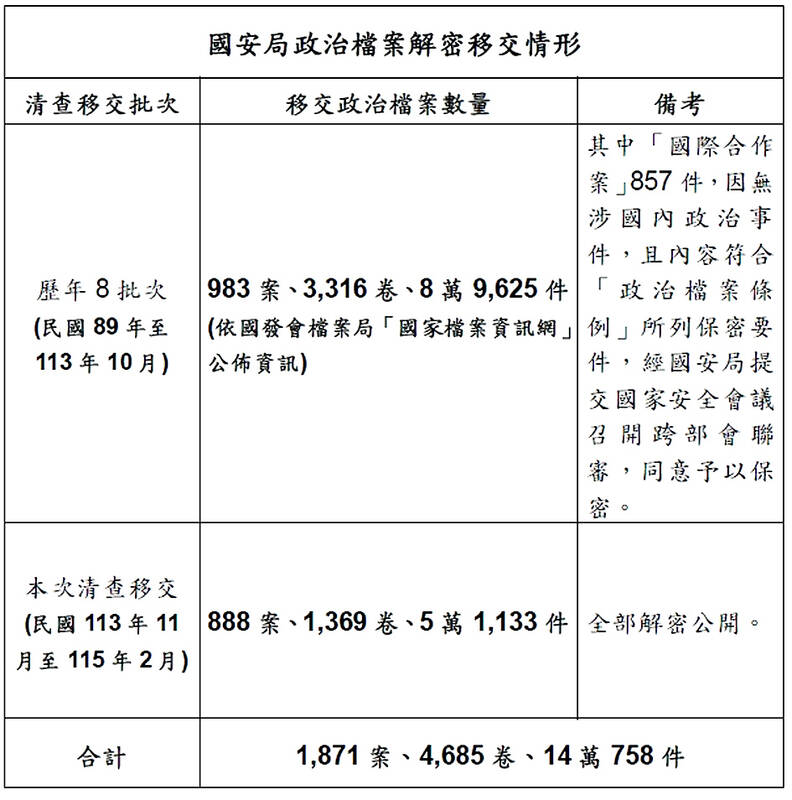
Photo: Screengrab from the National Security Bureau Web site
At last year’s 228 Incident memorial ceremony, President William Lai (賴清德) said that his administration would continue efforts to accelerate the declassification of political archives to shed light on history and restore justice to victims of political persecution and their families, the statement said.
NSB Directorate-General Tsai Ming-yen (蔡明彥) instructed all bureau personnel “to face history and to pursue the truth” and “to declassify and transfer all files in the political archives, leaving no redacted content behind,” it said.
The process of declassification and transfer was done in accordance with the provisions of the Political Archives Act (政治檔案條例) and the Principles and Priorities for the Review of Political Archives (政治檔案審定原則與重點) as presented by the National Archives Administration in 2024, it said.
In the first phase, NSB personnel carried out an internal inventory of archived materials in its possession prior to 1992, including those from the Martial Law era — during the Chinese Nationalist Party’s (KMT) 38-year military occupation of Taiwan, imposed on May 20, 1949, and lifted on July 14, 1987, it said.
“Altogether, 23,757 folders, equivalent to 566,415 items, were reviewed,” it said.
“The results of the review and the catalogued files were submitted to the NAA. A total of 1,369 folders comprising 51,133 items were determined to be political archives by the NAA in June last year,” it said.
In the second phase, the NSB reviewed the 51,133 files, manually conducting an item-by-item, page-by-page, folder-by-folder examination for the declassification process, and scanning them to create electronic files. All of them were contained in 94 boxes that were transferred to the NAA yesterday, it said.
The political archives transferred to the NAA cover a wide range of subjects, including public security and counterintelligence during the Martial Law period, records on surveillance and public security work conducted by intelligence agencies, investigations of publications and anonymous letters containing anti-authoritarian content, entry and exit control of Taiwanese nationals, activities of overseas Taiwan independence groups, and records and criminal judgements of people involved in rebellion cases, the statement said.
Meanwhile, the Taiwan Film and Audiovisual Institute is to offer free screenings of four films related to the “White Terror” during the 228 holiday. They are: Super Citizen Ko (超級大國民), March of Happiness (天馬茶房), the Argentine movie The Trial and the Brazilian film I’m Still Here.
Through these cross-century and cross-national stories, the institute hopes to spark dialogue and reflection on the history of the White Terror era and broader issues of human rights and transitional justice, it said.
Additional reporting by CNA

‘NO SECURITY RISK’: The Railway Bureau reassured the public that the technicians’ activities were limited to technical guidance and did not involve sensitive systems The Railway Bureau yesterday said it had invited eight Chinese technicians to assist with an airport MRT construction project. The bureau issued the confirmation after an Internet user said Chinese nationals had entered the construction zone of Taiwan Taoyuan International Airport’s Terminal 3 project. They asked why “individuals from an enemy state” were allowed access to such a major national infrastructure project, which raised serious concerns over Taiwan’s industrial safety, sensitive systems and information security. The bureau’s Northern Region Engineering Branch Office said subcontractor Taiwan Handle Industrial Co (台灣手把工業) of the Taoyuan airport MRT’s “Contract No. CU05 Project A14 Station Civil, MEP &

A US uncrewed surface vessel (USV) encountered multiple Chinese warships during an autonomous transit of the Taiwan Strait, US defense company Seasats said in a statement on Wednesday. Seasats announced that a Lightfish USV had completed the first autonomous transit of the Taiwan Strait. Over five days, the USV traversed the entire length of the Strait while constantly monitoring surface vessel traffic, the company said. The Lightfish encountered multiple Chinese warships, one of which was a Chinese People’s Liberation Army Navy (PLAN) Type 056 corvette, it said. The Chinese vessels were operating “well within Taiwan’s exclusive economic zone without transmitting their identity via the

Taiwan is still in the process of assessing the possibility of recruiting workers from Eswatini, the Ministry of Foreign Affairs said yesterday, adding that its goal is to help Eswatini upgrade its vocational training centers. If there are plans to recruit workers from Eswatini, safeguarding national security, protecting public health and ensuring the employment rights of Taiwanese would be prerequisites, Department of West Asian and African Affairs Director-General Yen Chia-liang (顏嘉良) told a news conference. Key considerations would also include filling labor shortages in specific industries, and fostering bilateral professional and technical exchanges, he said. Yen was asked about the progress of labor
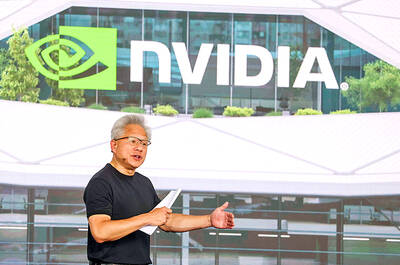
‘BOOMING’: ’ The number of partners we have here is incredible. You can see from their stock prices. They’re doing so well, they’re so happy,’ Jensen Huang said Nvidia Corp’s spending in Taiwan has ballooned to about US$150 billion a year, 10 times the US$10 billion to US$15 billion the company spent five years ago, Nvidia chief executive officer Jensen Huang (黃仁勳) said yesterday, suggesting Taiwan’s strategic importance in the global artificial intelligence (AI) supply chain. “Taiwan is the epicenter of the AI revolution. This is where the chips come, packaging comes. This is where the systems are made. This is where AI supercomputers were created,” Huang said at a meeting for the company’s employees in Beitou-Shilin Technology Park (北投士林科技園區) in Taipei, the planned site of Nvidia’s Taipei headquarters. “Taiwan


 RSS
RSS