


Taiwan and the US signed a reciprocal trade agreement in Washington yesterday, capping US tariffs on Taiwanese goods at 15 percent and granting preferential market access for US industrial and agricultural exports, including automobiles, beef and pork.
Under the US-Taiwan Agreement on Reciprocal Trade, the US tariff rate on Taiwanese imports would be maintained at 15 percent, while Taiwanese semiconductors and related products are to be granted the most favorable treatment under Section 232 of the Trade Expansion Act, the Executive Yuan said.
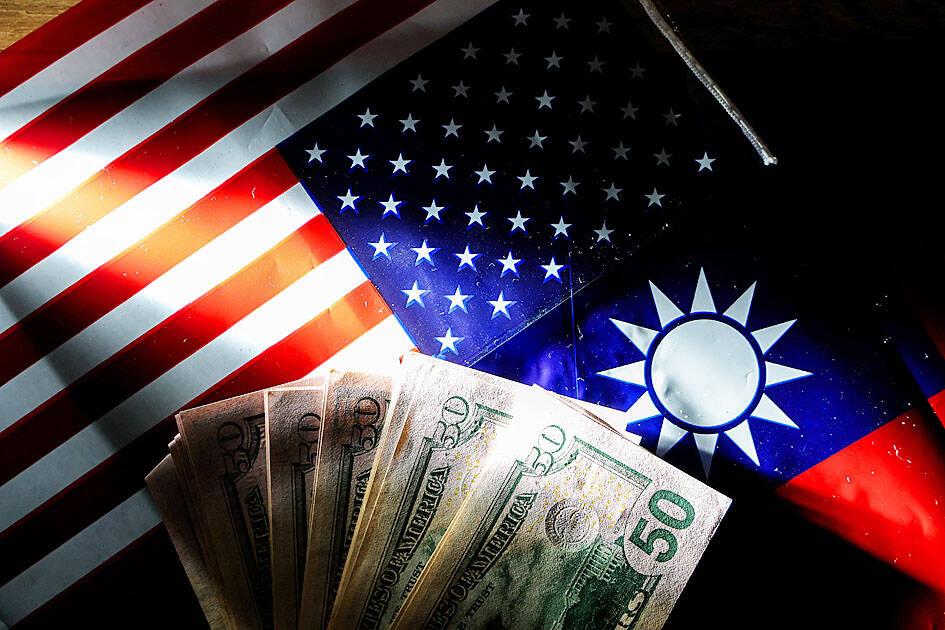
Photo: CNA
The 15 percent tariff matches the rates on goods from major US trade partners such as Japan, South Korea and the EU.
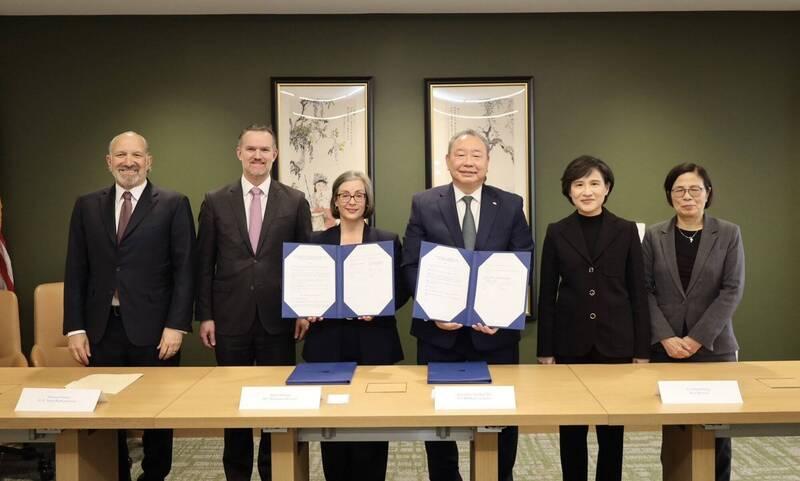
Photo courtesy of the Executive Yuan
An additional 2,072 Taiwanese items would also be exempt from reciprocal tariffs and would be subject only to the most-favored-nation tariff rate when imported into the US, the Cabinet said in a statement.
Of the 2,072 items, 261 are agricultural products such as Phalaenopsis orchids, tea, tapioca starch, coffee, pineapple cakes, guava, fruit juices and mangoes, the Cabinet said.
The 261 products account for 42 percent of Taiwan's agricultural export value to the US, bringing in US$374 million per year, it added.
The other 1,811 items are industrial products, with exports to the US valued at US$9.56 billion annually and accounting for 36 percent of Taiwan's total industrial exports to the US, it said.
They include radio navigation equipment, communications instruments, lithium-ion batteries, pharmaceuticals, fertilizers and light oil products, it added.
Meanwhile, Taiwan has agreed to eliminate or reduce 99 percent of its tariff barriers on US industrial and agricultural imports, the Office of the US Trade Representative said.
The list includes automobiles and auto parts, chemicals, seafood, machinery, health products, wheat, beef and beef products, dairy products, pork and pork products, lamb, ketchup and peanuts, the office said.
"The Agreement on Reciprocal Trade is a testament to the importance of the US-Taiwan relationship and reflects both sides' ambition to increase bilateral investment and commercial opportunities, deepen their high-tech strategic partnership, ensure supply chain resilience and jointly promote stability and prosperity," the office said.
The Cabinet said the trade agreement aims not only to establish a mutually beneficial economic and trade framework, but also to further build a "Taiwan-US high-tech strategic partnership" centered on "technological innovation, supply chain resilience and economic security."
The trade pact was signed in Washington by Representative to the US Alexander Yui (俞大㵢) and Ingrid Larson, managing director of the American Institute in Taiwan's (AIT) Washington office.
Vice Premier Cheng Li-chiun (鄭麗君), Taiwan's top trade negotiator Yang Jen-ni (楊珍妮), US Trade Representative Jamieson Greer and US Commerce Secretary Howard Lutnick presided over the signing ceremony.
Under the agreement, Taiwan has also agreed to remove quantitative restrictions on US motor vehicles and accept those that meet US safety and emissions standards, the office said.
Taiwan would also accept US Food and Drug Administration marketing authorizations for medical devices and pharmaceuticals manufactured in the US, without additional requirements for importation, the office said.
In addition, Taiwan would resolve and remove non-tariff barriers to US agricultural exports, including beef, pork, poultry and processed potatoes, and would complete the regulatory process to allow the importation of bison meat, it added.
The reciprocal trade agreement followed nearly a year of trade negotiations between Taiwan and the US, and builds on agreements reached last month.
The agreement would now be sent to Taiwan's legislature for review and approval.

‘NO SECURITY RISK’: The Railway Bureau reassured the public that the technicians’ activities were limited to technical guidance and did not involve sensitive systems The Railway Bureau yesterday said it had invited eight Chinese technicians to assist with an airport MRT construction project. The bureau issued the confirmation after an Internet user said Chinese nationals had entered the construction zone of Taiwan Taoyuan International Airport’s Terminal 3 project. They asked why “individuals from an enemy state” were allowed access to such a major national infrastructure project, which raised serious concerns over Taiwan’s industrial safety, sensitive systems and information security. The bureau’s Northern Region Engineering Branch Office said subcontractor Taiwan Handle Industrial Co (台灣手把工業) of the Taoyuan airport MRT’s “Contract No. CU05 Project A14 Station Civil, MEP &

A US uncrewed surface vessel (USV) encountered multiple Chinese warships during an autonomous transit of the Taiwan Strait, US defense company Seasats said in a statement on Wednesday. Seasats announced that a Lightfish USV had completed the first autonomous transit of the Taiwan Strait. Over five days, the USV traversed the entire length of the Strait while constantly monitoring surface vessel traffic, the company said. The Lightfish encountered multiple Chinese warships, one of which was a Chinese People’s Liberation Army Navy (PLAN) Type 056 corvette, it said. The Chinese vessels were operating “well within Taiwan’s exclusive economic zone without transmitting their identity via the
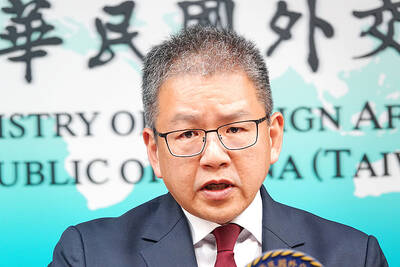
Taiwan is still in the process of assessing the possibility of recruiting workers from Eswatini, the Ministry of Foreign Affairs said yesterday, adding that its goal is to help Eswatini upgrade its vocational training centers. If there are plans to recruit workers from Eswatini, safeguarding national security, protecting public health and ensuring the employment rights of Taiwanese would be prerequisites, Department of West Asian and African Affairs Director-General Yen Chia-liang (顏嘉良) told a news conference. Key considerations would also include filling labor shortages in specific industries, and fostering bilateral professional and technical exchanges, he said. Yen was asked about the progress of labor
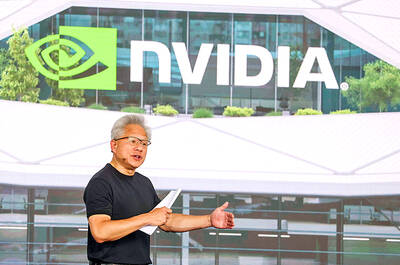
‘BOOMING’: ’ The number of partners we have here is incredible. You can see from their stock prices. They’re doing so well, they’re so happy,’ Jensen Huang said Nvidia Corp’s spending in Taiwan has ballooned to about US$150 billion a year, 10 times the US$10 billion to US$15 billion the company spent five years ago, Nvidia chief executive officer Jensen Huang (黃仁勳) said yesterday, suggesting Taiwan’s strategic importance in the global artificial intelligence (AI) supply chain. “Taiwan is the epicenter of the AI revolution. This is where the chips come, packaging comes. This is where the systems are made. This is where AI supercomputers were created,” Huang said at a meeting for the company’s employees in Beitou-Shilin Technology Park (北投士林科技園區) in Taipei, the planned site of Nvidia’s Taipei headquarters. “Taiwan


 RSS
RSS