


The death toll from a crackdown over Iran’s nationwide protests last month has reached at least 7,002 people killed, with many more still feared dead, activists said yesterday.
The slow rise in the number of dead from the demonstrations adds to the overall tensions facing Iran inside the country and abroad as it tries to negotiate with the US over its nuclear program.
A second round of talks remains up in the air, as Israeli Prime Minister Benjamin Netanyahu pressed his case directly with US President Donald Trump to intensify his demands on Tehran in the negotiations.
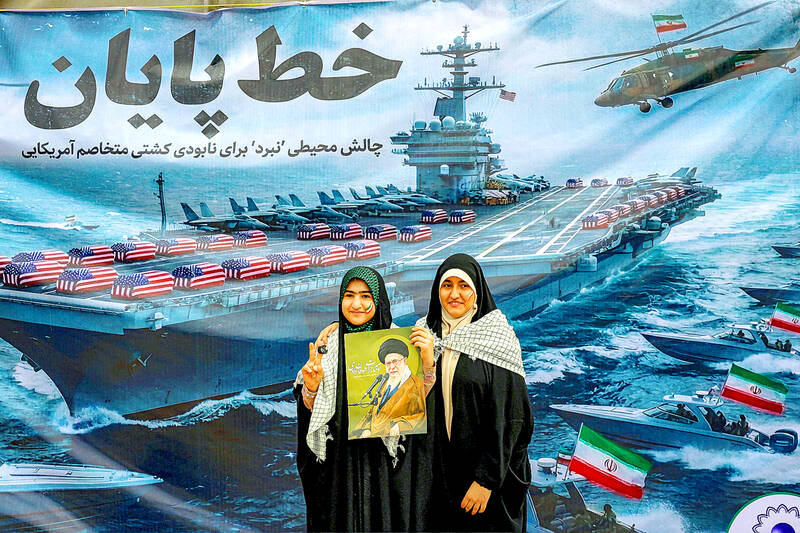
Photo: AFP
However, the US appears “willing” to tolerate some nuclear enrichment, Turkish Minister of Foreign Affairs Hakan Fidan told the Financial Times in an interview published yesterday.
“It is positive that the Americans appear willing to tolerate Iranian enrichment within clearly set boundaries,” Fidan, who has been involved in talks with Washington and Tehran, told the Financial Times.
Fidan said he believed Tehran “genuinely wants to reach a real agreement,” and would accept restrictions on enrichment levels and a strict inspection regime, as it did in the 2015 agreement with the US and others.
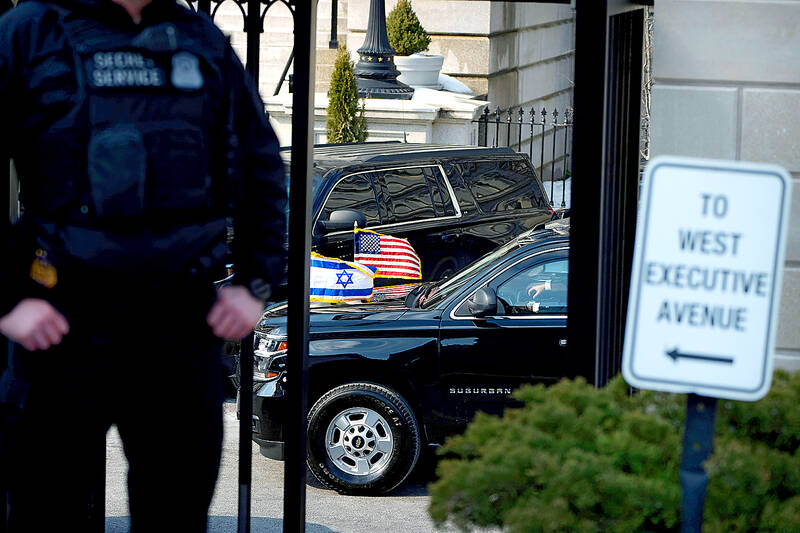
Photo: AP
Meanwhile, Iran at home faces still-simmering anger over its wide-ranging suppression of dissent in the Islamic republic.
That rage might intensify in the coming days as families of the dead begin marking the traditional 40-day mourning for the loved ones.
The US-based Human Rights Activists News Agency, which offered the latest figures, has been accurate in counting deaths during previous rounds of unrest in Iran and relies on a network of activists in Iran to verify deaths.
Iran’s government offered its only death toll on Jan. 21, saying 3,117 people were killed. Iran’s theocracy in the past has undercounted or not reported fatalities from past unrest.
Meanwhile, Iranian authorities have dismissed a provincial television director after a reporter appeared to call for the death of Iranian supreme leader Ayatollah Ali Khamenei.
The incident happened during Wednesday’s live broadcast of the 47th anniversary of the Islamic revolution in the southeastern Sistan-Baluchistan Province.
During the live feed, Musab Rasoulizad was describing the turnout at the rallies, and repeating chants heard in the crowd such as “Allahu Akbar” (“God is great”).
He then said “Marg bar Khamenei” (“death to Khamenei”), rather one of the chants typically heard at government-organized such rallies, which include “Death to America” and “Death to Israel.”
“The broadcast director of Hamoun provincial TV channel has been dismissed following an error that occurred on the provincial network,” state television said on Wednesday. “The transmission operator and broadcast supervisor were suspended. Other staff found at fault were also referred to the disciplinary committee.”
In a later video, Rasoulizad appeared to apologize for what he called a “slip of the tongue and a blunder which was broadcast and became a pretext for anti-revolutionaries.”
Additional reporting by Reuters and AFP

‘NO SECURITY RISK’: The Railway Bureau reassured the public that the technicians’ activities were limited to technical guidance and did not involve sensitive systems The Railway Bureau yesterday said it had invited eight Chinese technicians to assist with an airport MRT construction project. The bureau issued the confirmation after an Internet user said Chinese nationals had entered the construction zone of Taiwan Taoyuan International Airport’s Terminal 3 project. They asked why “individuals from an enemy state” were allowed access to such a major national infrastructure project, which raised serious concerns over Taiwan’s industrial safety, sensitive systems and information security. The bureau’s Northern Region Engineering Branch Office said subcontractor Taiwan Handle Industrial Co (台灣手把工業) of the Taoyuan airport MRT’s “Contract No. CU05 Project A14 Station Civil, MEP &

A US uncrewed surface vessel (USV) encountered multiple Chinese warships during an autonomous transit of the Taiwan Strait, US defense company Seasats said in a statement on Wednesday. Seasats announced that a Lightfish USV had completed the first autonomous transit of the Taiwan Strait. Over five days, the USV traversed the entire length of the Strait while constantly monitoring surface vessel traffic, the company said. The Lightfish encountered multiple Chinese warships, one of which was a Chinese People’s Liberation Army Navy (PLAN) Type 056 corvette, it said. The Chinese vessels were operating “well within Taiwan’s exclusive economic zone without transmitting their identity via the
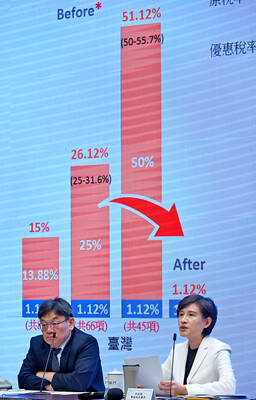
GREATER REACH? Auto parts and wood products would face tariffs of up to 15%, matching those targeting the EU, Japan and South Korea, Vice Premier said The US has announced that preferential tariff treatment for Taiwan’s non-semiconductor Section 232 goods would take effect retroactively from May 1, the Executive Yuan said yesterday. The US government yesterday posted a notice on the Federal Register’s public inspection Web site previewing tariff concessions for Taiwan under a memorandum of understanding (MOU) on Taiwan-US investment after two months of negotiations. The MOU signed on Jan. 15 stipulated three major preferential tariff arrangements: a 15 percent “reciprocal” tariff rate for Taiwan without stacking most-favored nation (MFN) rates; preferential Section 232 treatment for semiconductors and related products; and preferential Section 232 treatment for non-semiconductor

TIT-FOR-TAT: The US allegedly revoked the visa of a Chinese national working at Xinhua News Agency in the US in response to Beijing’s expulsion of Vivian Wang The Presidential Office yesterday condemned China for expelling a New York Times correspondent from Beijing following the newspaper’s interview with President William Lai (賴清德), saying the move highlighted Beijing’s suppression of press freedom and its threat to international news media. Taiwan has noted a series of recent incidents in which Beijing used similar tactics to “threaten and pressure international media outlets and journalists,” Presidential Office spokeswoman Karen Kuo (郭雅慧) said in a statement. “This concerns not only press freedom and freedom of expression, but also the safety of journalists, and Taiwan and relevant partners are paying close attention to the situation,” she


 RSS
RSS