


Countries in the region would be China’s next targets should Beijing seize Taiwan, President William Lai (賴清德) said in an interview published yesterday, as he insisted that Taiwan must dramatically shore up its defenses.
Lai said he was confident the legislature would approve a NT$1.25 trillion (US$39.73 billion) special defense budget to fund crucial defense purchases, including weapons from the US.
The US would stand by Taiwan and would not need to use it as a “bargaining chip” with Beijing, he said.
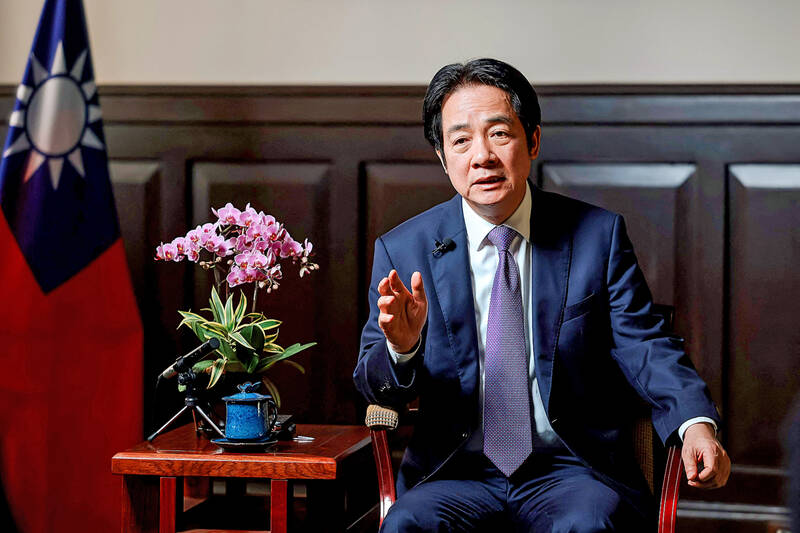
Photo: Yu Chen Cheng, AFP
If China were to take Taiwan, Beijing would become “more aggressive, undermining peace and stability in the Indo-Pacific region and the rules-based international order,” he said.
“If Taiwan were annexed by China, China’s expansionist ambitions would not stop there,” he said on Tuesday at the Presidential Office in Taipei.
“The next countries under threat would be Japan, the Philippines and others in the Indo-Pacific region, with repercussions eventually reaching the Americas and Europe,” he said.
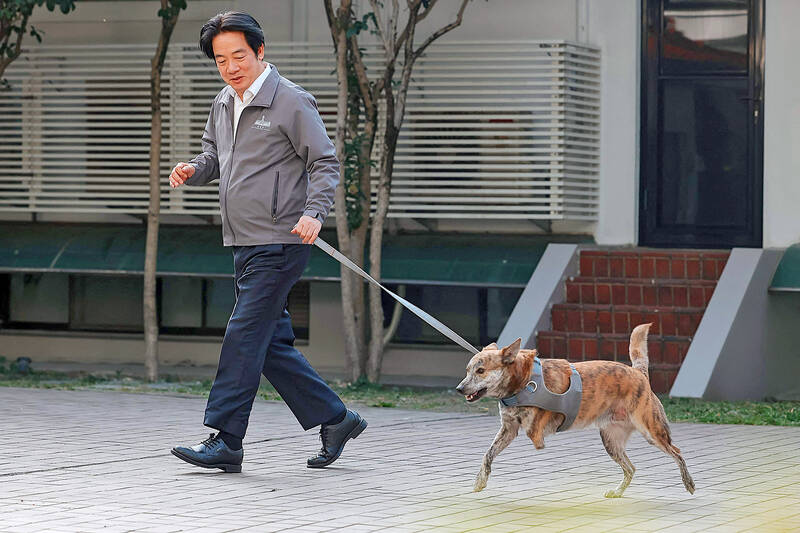
Photo: Yu Chen Cheng, AFP
Japanese Prime Minister Sanae Takaichi, whose country hosts several US bases and about 60,000 US troops, in November said that an attack on Taiwan could threaten Japan’s survival, triggering a military response, which drew a furious response from Beijing.
Philippine President Ferdinand Marcos Jr has also warned that the archipelago nation, where US troops have access to nine military bases, would “inevitably” be dragged into a war over Taiwan.
“In this changing world, nations belong to a global community — a situation in any one country would inevitably impact another,” Lai said.
Ahead of US President Donald Trump’s planned meeting with Chinese President Xi Jinping (習近平) in Beijing in April, Lai said Taiwan welcomed any talks that help maintain the “status quo.”
“We believe President Trump is undertaking a difficult peace-building effort, which entails safeguarding US interests and deterring Chinese expansionism in the short term,” he said, adding that the US does not need to “to frame Taiwan as a bargaining chip in any discussions with China.”
“In the context of US-China trade competition, China seeks far more from the US than the US does from China,” he said.
Xi’s recent purge of top generals has sparked speculation about what it might mean for Beijing’s timeline to potentially attack Taiwan, which some US officials have suggested could be next year.
While the removal of many generals was “indeed an unusual situation,” Lai said it did not change Taiwan’s need to be prepared.
“We must have the capability to deter China’s aggression at any time,” Lai said. “We want to ensure that, for China, there is never a day that is a good day to invade Taiwan.”
Trump’s efforts to force Taiwanese chipmakers to increase production capacity in the US and his insistence that Taipei spend more on defense have fueled concerns about his willingness to protect the nation.
Taiwan has invested billions upgrading its military and expanding its defense industry, but its forces would be outnumbered and outgunned in a conflict with China.
Under intense US pressure, Lai has vowed to increase Taiwan’s defense spending to more than 3 percent of GDP this year and 5 percent by 2030.
The Executive Yuan’s special defense budget would include spending over eight years that would fund, among other things, a multilayered air defense system dubbed the “T-Dome.”
However, legislation to enable the spending has been blocked 10 times since early December by opposition parties, which hold the most seats in the legislature.
Despite the delays, Lai expressed optimism that the budget would win approval.
“In a democratic society, every political party is ultimately accountable to the people,” he said. “I am therefore confident that this budget will win their support.”
“Taiwan is responsible for safeguarding our own country,” Lai said, adding that Taiwan-US relations are “rock solid.”
Taiwan, which makes nearly all of the world’s most advanced chips, is also eager to “work with Europe on joint development in AI [artificial intelligence] and usher in an era of comprehensive smart transformation,” he said.
However, for Taiwan to remain indispensable in the global supply chain, the nation’s semiconductor industry needs to keep its “centers for research and development, the most advanced manufacturing processes and the largest production capacity,” he said.
“No single country in this supply chain can be missing,” Lai said. “For this reason, the Taiwanese government supports the semiconductor industry’s investments in Japan, the US and Europe.”
Beijing condemned Lai’s remarks, calling him a “peace disruptor, crisis creator and war instigator.”
“Seeking independence through external means and resisting reunification by force is like an ant trying to shake a tree — doomed to failure,” Chinese Ministry of Foreign Affairs spokesman Lin Jian (林劍) told a regular briefing.

‘NO SECURITY RISK’: The Railway Bureau reassured the public that the technicians’ activities were limited to technical guidance and did not involve sensitive systems The Railway Bureau yesterday said it had invited eight Chinese technicians to assist with an airport MRT construction project. The bureau issued the confirmation after an Internet user said Chinese nationals had entered the construction zone of Taiwan Taoyuan International Airport’s Terminal 3 project. They asked why “individuals from an enemy state” were allowed access to such a major national infrastructure project, which raised serious concerns over Taiwan’s industrial safety, sensitive systems and information security. The bureau’s Northern Region Engineering Branch Office said subcontractor Taiwan Handle Industrial Co (台灣手把工業) of the Taoyuan airport MRT’s “Contract No. CU05 Project A14 Station Civil, MEP &

A US uncrewed surface vessel (USV) encountered multiple Chinese warships during an autonomous transit of the Taiwan Strait, US defense company Seasats said in a statement on Wednesday. Seasats announced that a Lightfish USV had completed the first autonomous transit of the Taiwan Strait. Over five days, the USV traversed the entire length of the Strait while constantly monitoring surface vessel traffic, the company said. The Lightfish encountered multiple Chinese warships, one of which was a Chinese People’s Liberation Army Navy (PLAN) Type 056 corvette, it said. The Chinese vessels were operating “well within Taiwan’s exclusive economic zone without transmitting their identity via the
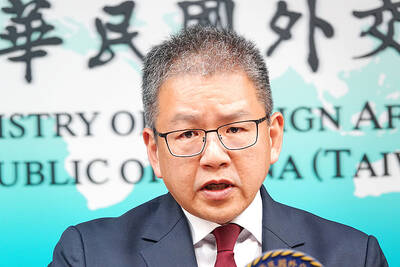
Taiwan is still in the process of assessing the possibility of recruiting workers from Eswatini, the Ministry of Foreign Affairs said yesterday, adding that its goal is to help Eswatini upgrade its vocational training centers. If there are plans to recruit workers from Eswatini, safeguarding national security, protecting public health and ensuring the employment rights of Taiwanese would be prerequisites, Department of West Asian and African Affairs Director-General Yen Chia-liang (顏嘉良) told a news conference. Key considerations would also include filling labor shortages in specific industries, and fostering bilateral professional and technical exchanges, he said. Yen was asked about the progress of labor
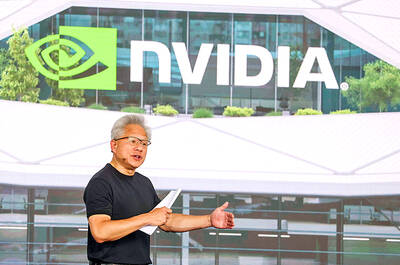
‘BOOMING’: ’ The number of partners we have here is incredible. You can see from their stock prices. They’re doing so well, they’re so happy,’ Jensen Huang said Nvidia Corp’s spending in Taiwan has ballooned to about US$150 billion a year, 10 times the US$10 billion to US$15 billion the company spent five years ago, Nvidia chief executive officer Jensen Huang (黃仁勳) said yesterday, suggesting Taiwan’s strategic importance in the global artificial intelligence (AI) supply chain. “Taiwan is the epicenter of the AI revolution. This is where the chips come, packaging comes. This is where the systems are made. This is where AI supercomputers were created,” Huang said at a meeting for the company’s employees in Beitou-Shilin Technology Park (北投士林科技園區) in Taipei, the planned site of Nvidia’s Taipei headquarters. “Taiwan


 RSS
RSS