


If the opposition-controlled Legislative Yuan continues to block a proposed NT$1.25 trillion (US$39.6 billion) special defense budget, the international community could misunderstand Taiwan’s determination to defend itself, President William Lai (賴清德) said yesterday.
Pressure from politicians in the US — Taiwan’s most important international backer and arms supplier despite a lack of formal diplomatic ties — has grown on the Legislative Yuan not to hold up defense spending.
US Senator Ruben Gallego yesterday shared on X a Bloomberg report that “Taiwan’s opposition parties have advanced a bill that would slash a special military budget, potentially jeopardizing the purchases of billions of dollars of US weapons aimed at deterring the threat of invasion by China.”
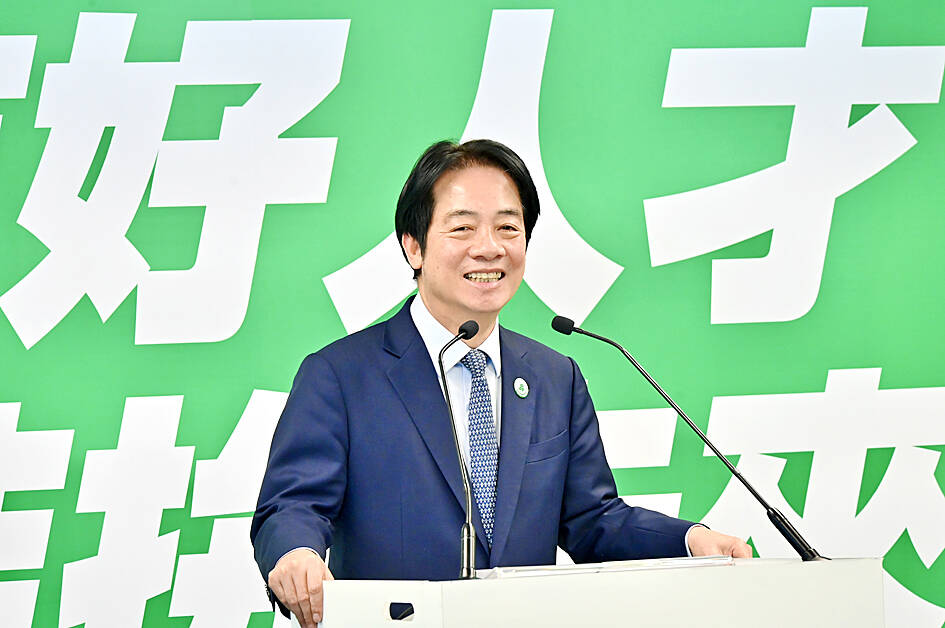
Photo: George Tsorng, Taipei Times
Commenting on the report, Gallego wrote: “Now is not the time to weaken Taiwan’s defenses. Cutting their defense budget undermines investments in essential weapons systems just as China’s threats are intensifying. Taiwan’s parliament should reconsider this move.”
Gallego’s move follows that of his colleagues in the US Senate.
On Monday, US Senator Roger Wicker, chairman of the Senate Committee on Armed Services and one of the strongest advocates for Taiwan in the US Congress, wrote on X that he was “disappointed” to see Taiwan’s opposition parties slash Lai’s defense budget.
Another US lawmaker, Republican Senator Dan Sullivan, a staunch supporter of US President Donald Trump’s administration, directly criticized the Chinese Nationalist Party (KMT), whose senior officials are visiting Beijing.
“It doesn’t take a genius to figure out what’s going on here,” he wrote on X, in reference to the visit. “I’ve warned before — short changing Taiwan’s defense to kowtow to the CCP [Chinese Communist Party] is playing with fire.”
Following their critiques, Lai said at a meeting at the Democratic Progressive Party’s headquarters in Taipei that if the opposition continued blocking the Executive Yuan’s proposed defense spending and presses on with its own version, “this is bound to delay improvements to [Taiwan’s] defense capabilities.”
That “could lead the international community to misunderstand Taiwan’s determination to defend itself and to safeguard peace in the Indo-Pacific” region, the party quoted the president as saying.
The opposition-dominated legislature has blocked the Cabinet’s budget plan, including missiles and drones as well as the new “T-Dome” air defense system, pushing instead for a proposal to fund only certain US arms, rather than the entire package.
The KMT has said that while it supports strengthening Taiwan’s defenses, it has a right to fully scrutinize government spending plans and would not sign “blank checks.”
“We thank members of the US Senate for their valuable input,” it said in an English-language statement.
“The KMT remains fully committed to safeguarding Taiwan’s security, strengthening our defense capabilities, and also engaging constructively through dialogue to advance peace and stability across the Strait,” it said.
China regularly stages military exercises around Taiwan, and refuses to talk to Lai, calling him a “separatist.”
Lai says only Taiwanese can decide their future.
“We should uphold the concept that the ‘two sides of the Strait are one family,’” Wang Huning (王滬寧), China’s top official in charge of Taiwan policy, told KMT Vice Chairman Hsiao Hsu-tsen (蕭旭岑) during a meeting in Beijing earlier yesterday.
Both the KMT and the CCP must “resolutely oppose Taiwan independence separatism and interference by external forces, and jointly safeguard peace and stability in the Taiwan Strait,” state media quoted Wang as saying.

‘NO SECURITY RISK’: The Railway Bureau reassured the public that the technicians’ activities were limited to technical guidance and did not involve sensitive systems The Railway Bureau yesterday said it had invited eight Chinese technicians to assist with an airport MRT construction project. The bureau issued the confirmation after an Internet user said Chinese nationals had entered the construction zone of Taiwan Taoyuan International Airport’s Terminal 3 project. They asked why “individuals from an enemy state” were allowed access to such a major national infrastructure project, which raised serious concerns over Taiwan’s industrial safety, sensitive systems and information security. The bureau’s Northern Region Engineering Branch Office said subcontractor Taiwan Handle Industrial Co (台灣手把工業) of the Taoyuan airport MRT’s “Contract No. CU05 Project A14 Station Civil, MEP &

A US uncrewed surface vessel (USV) encountered multiple Chinese warships during an autonomous transit of the Taiwan Strait, US defense company Seasats said in a statement on Wednesday. Seasats announced that a Lightfish USV had completed the first autonomous transit of the Taiwan Strait. Over five days, the USV traversed the entire length of the Strait while constantly monitoring surface vessel traffic, the company said. The Lightfish encountered multiple Chinese warships, one of which was a Chinese People’s Liberation Army Navy (PLAN) Type 056 corvette, it said. The Chinese vessels were operating “well within Taiwan’s exclusive economic zone without transmitting their identity via the
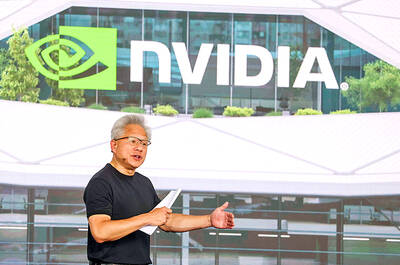
‘BOOMING’: ’ The number of partners we have here is incredible. You can see from their stock prices. They’re doing so well, they’re so happy,’ Jensen Huang said Nvidia Corp’s spending in Taiwan has ballooned to about US$150 billion a year, 10 times the US$10 billion to US$15 billion the company spent five years ago, Nvidia chief executive officer Jensen Huang (黃仁勳) said yesterday, suggesting Taiwan’s strategic importance in the global artificial intelligence (AI) supply chain. “Taiwan is the epicenter of the AI revolution. This is where the chips come, packaging comes. This is where the systems are made. This is where AI supercomputers were created,” Huang said at a meeting for the company’s employees in Beitou-Shilin Technology Park (北投士林科技園區) in Taipei, the planned site of Nvidia’s Taipei headquarters. “Taiwan
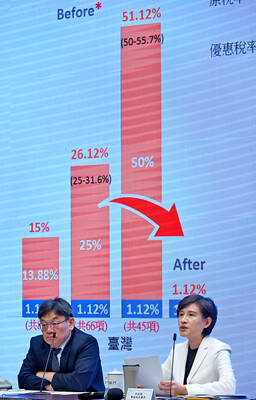
GREATER REACH? Auto parts and wood products would face tariffs of up to 15%, matching those targeting the EU, Japan and South Korea, Vice Premier said The US has announced that preferential tariff treatment for Taiwan’s non-semiconductor Section 232 goods would take effect retroactively from May 1, the Executive Yuan said yesterday. The US government yesterday posted a notice on the Federal Register’s public inspection Web site previewing tariff concessions for Taiwan under a memorandum of understanding (MOU) on Taiwan-US investment after two months of negotiations. The MOU signed on Jan. 15 stipulated three major preferential tariff arrangements: a 15 percent “reciprocal” tariff rate for Taiwan without stacking most-favored nation (MFN) rates; preferential Section 232 treatment for semiconductors and related products; and preferential Section 232 treatment for non-semiconductor


 RSS
RSS