


The US Department of the Treasury yesterday kept Taiwan on its watch list of trade partners whose currency practices "merit close attention.”
The department said it was strengthening scrutiny of countries' foreign-exchange practices, including their interventions to resist both depreciation and appreciation against the US dollar.
No major trading partner met all three criteria for enhanced analysis of currency practices during the last half of 2024 and the first six months of last year, the report said.
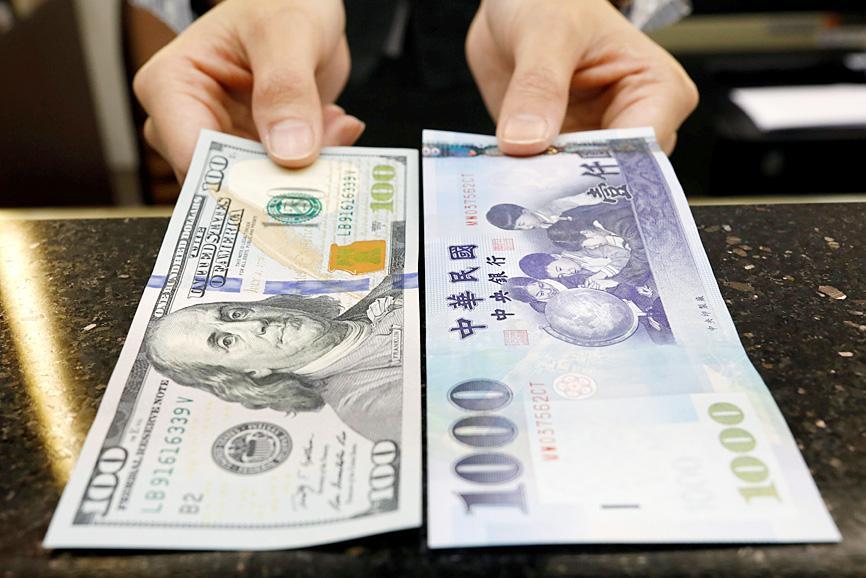
Photo: Reuters
Traditionally, the department’s three main criteria for analyzing foreign exchange and determining manipulation are a trade surplus with the US of at least US$15 billion, a global current account surplus above 3 percent of GDP and persistent, one-way net foreign-exchange purchases that reach 2 percent of GDP.
Countries that meet two of these are automatically added to the list.
In its latest report, the department added Thailand to its "monitoring list" of countries warranting close attention due to the growth of the country's global current account surplus and its trade surplus with the US.
The addition brings the monitoring list to 10 economies, with Taiwan, China, Japan, South Korea, Singapore, Vietnam, Germany, Ireland and Switzerland remaining on the list.
Taiwan recorded a trade surplus of US$100 billion with the US during the report period (US$94.1 billion according to Taiwan government statistics), while its current account surplus was 15 percent of GDP, the report said.
However, its net purchases of foreign exchange in the reporting period, totaling US$5.9 billion, represented only 0.7 percent of GDP, the report said.
Taiwan's "extremely large current account surplus" has persisted largely because of elevated demand for technology products, the report said, describing the bilateral trade surplus with the US as having "grown considerably," continuing a five-year trend.
On foreign-exchange intervention, the department said that Taiwan's central bank made small net purchases of foreign currency during the period, mostly in May last year amid heightened market volatility.
Despite this, the New Taiwan dollar appreciated 11.2 percent against the US dollar during the report period before partially retreating in the following months, it said.
The report also highlighted Taiwan's Nov. 14 joint statement with the US Treasury committing to publicly disclose information on foreign-exchange interventions at least quarterly.
Traditionally, the report has focused on whether countries are engaging in one-sided currency intervention or other manipulation to resist appreciation against the US dollar to keep their exports cheaper.
However, going forward, the department said it "is now monitoring more broadly the extent to which economies that choose to smooth exchange rate movements do so to resist depreciation pressure in the same manner as they do to resist appreciation pressure."
In particular, it would be looking to see whether countries' interventions to resist depreciation against the US dollar are symmetrical with their efforts to resist appreciation, or less aggressive, a treasury official said.
The department also said that for countries on the monitoring list, it would analyze whether other government policies are influencing foreign-exchange markets, such as capital controls, macroprudential measures or the use of government investment vehicles or pension funds.
It would also study countries' use of foreign-exchange swaps to sterilize or offset spot interventions to minimize their impacts on domestic monetary conditions, as well as trading partners' net forward positions.
The department did not label China a currency manipulator, despite what it called "depreciation pressure" facing the yuan.
However, it said that China "stands out among our major trading partners in its lack of transparency around its exchange rate policies and practices," repeating language from its previous report in June last year.
CREDIT-GRABBER: China said its coast guard rescued the crew of a fishing vessel that caught fire, who were actually rescued by a nearby Taiwanese boat and the CGA Maritime search and rescue operations do not have borders, and China should not use a shipwreck to infringe upon Taiwanese sovereignty, the Coast Guard Administration (CGA) said yesterday. The coast guard made the statement in response to the China Coast Guard (CCG) saying it saved a Taiwanese fishing boat. The Chuan Yu No. 6 (全漁6號), a fishing vessel registered in Keelung, on Thursday caught fire and sank in waters northeast of Diaoyutai Islands (釣魚台). The vessel left Keelung’s Badouzih Fishing Harbor (八斗子漁港) at 3:35pm on Sunday last week, with seven people on board — a 62-year-old Taiwanese captain surnamed Chang (張) and six
RISKY BUSINESS: The ‘incentives’ include initiatives that get suspended for no reason, creating uncertainty and resulting in considerable losses for Taiwanese, the MAC said China’s “incentives” failed to sway sentiment in Taiwan, as willingness to work in China hit a record low of 1.6 percent, a Ministry of Labor survey showed. The Directorate-General of Budget, Accounting and Statistics (DGBAS) also reported that the number of Taiwanese workers in China has nearly halved from a peak of 430,000 in 2012 to an estimated 231,000 in 2024. That marked a new low in the proportion of Taiwanese going abroad to work. The ministry’s annual survey on “Labor Life and Employment Status” includes questions respondents’ willingness to seek employment overseas. Willingness to work in China has steadily declined from

The Legislative Yuan’s Finance Committee yesterday approved proposed amendments to the Amusement Tax Act (娛樂稅法) that would abolish taxes on films, cultural activities and competitive sporting events, retaining the fee only for dance halls and golf courses. The proposed changes would set the maximum tax rate for dance halls and golf courses at 50 and 20 percent respectively, with local governments authorized to suspend the levies. Article 2 of the act says that “amusement tax shall be levied on tickets sold or fees charged by amusement places, facilities or activities” in six categories: “Cinema; professional singing, story-telling, dancing, circus, magic show, acrobatics
INFLATION UP? The IMF said CPI would increase to 1.5 percent this year, while the DGBAS projected it would rise to 1.68 percent, with GDP per capita of US$44,181 The IMF projected Taiwan’s real GDP would grow 5.2 percent this year, up from its 2.1 percent outlook in January, despite fears of global economic disruptions sparked by the US-Iran conflict. Taiwan’s consumer price index (CPI) is projected to increase to 1.5 percent, while unemployment would be 3.4 percent, roughly in line with estimates for Asia as a whole, the international body wrote in its Global Economic Outlook Report published in the US on Monday. The figures are comparatively better than the IMF outlook for the rest of the world, which pegged real GDP growth at 3.1 percent, down from 3.3 percent


 RSS
RSS