


British Prime Minister Keir Starmer and Chinese President Xi Jinping (習近平) yesterday hailed a reset of ties, pledging to build an economic partnership with deals including a major investment by AstraZeneca that they said would benefit both countries.
On the key day of his four-day visit to China, the first by a British prime minister in eight years, Starmer spent about three hours with Xi at a formal summit and a lunch, as their nations try to improve ties after several years of acrimony. Relations have deteriorated over allegations of Chinese spying in the UK, China’s support for Russia in Moscow’s war on Ukraine and the crackdown on freedoms in Hong Kong.
Starmer is the latest Western leader to head to China, as nations hedge against the unpredictability of US President Donald Trump, and yesterday’s talks also included security issues, the war in Ukraine and human rights.
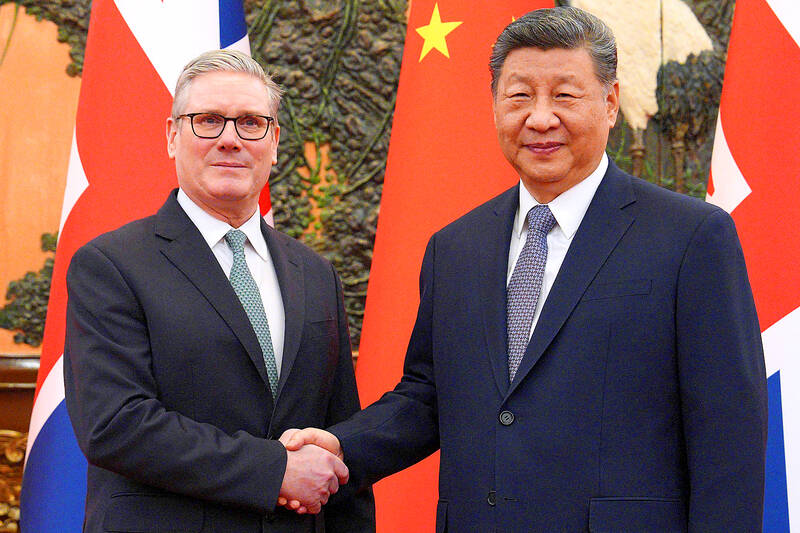
Photo: AFP
The British prime minister’s visit, which ends tomorrow, has yielded a raft of business announcements and government agreements, including a deal allowing British tourists and business visitors visa-free stays in China for up to 30 days.
He also announced a plan by AstraZeneca to pioneer new medicines by investing US$15 billion in its Chinese operations as proof of the benefits that could flow to both countries.
However, he also said the closer ties would enable the UK to engage in “frank dialogue” when there was disagreement.
Starmer, whose center-left Labour government has struggled to deliver the economic growth it promised, has made improving relations with the world’s second-largest economy a priority, despite misgivings about espionage and human rights.
“China is a vital player on the global stage, and it’s vital that we build a more sophisticated relationship where we can identify opportunities to collaborate, but of course, also allow a meaningful dialogue on areas where we disagree,” Starmer told Xi at the start of their meeting.
Xi said that “China-UK relations experienced twists and turns in previous years, which was not in the interests of either country.”
“In the current turbulent and ever-changing international situation ... China and the UK need to strengthen dialogue and cooperation to maintain world peace and stability,” he said.
State-run China Central Television said Xi had stressed, without mentioning the US directly, that “major powers” must adhere to international law or the world would regress into a “jungle.”
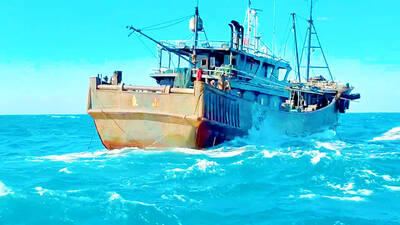
MAKING WAVES: China’s maritime militia could become a nontraditional threat in war, clogging up shipping lanes to prevent US or Japanese intervention, a report said About 1,900 Chinese ships flying flags of convenience and fishing vessels that participated in China’s military exercises around Taiwan last month and in January last year have been listed for monitoring, Coast Guard Administration (CGA) Deputy Director-General Hsieh Ching-chin (謝慶欽) said yesterday. Following amendments to the Commercial Port Act (商港法) and the Law of Ships (船舶法) last month, the CGA can designate possible berthing areas or deny ports of call for vessels suspected of loitering around areas where undersea cables can be accessed, Oceans Affairs Council Minister Kuan Bi-ling (管碧玲) said. The list of suspected ships, originally 300, had risen to about
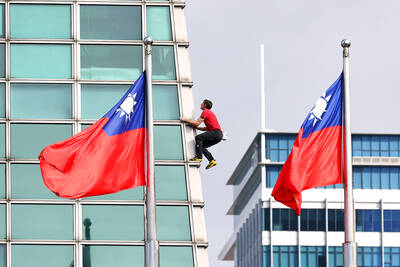
DAREDEVIL: Honnold said it had always been a dream of his to climb Taipei 101, while a Netflix producer said the skyscraper was ‘a real icon of this country’ US climber Alex Honnold yesterday took on Taiwan’s tallest building, becoming the first person to scale Taipei 101 without a rope, harness or safety net. Hundreds of spectators gathered at the base of the 101-story skyscraper to watch Honnold, 40, embark on his daredevil feat, which was also broadcast live on Netflix. Dressed in a red T-shirt and yellow custom-made climbing shoes, Honnold swiftly moved up the southeast face of the glass and steel building. At one point, he stepped onto a platform midway up to wave down at fans and onlookers who were taking photos. People watching from inside
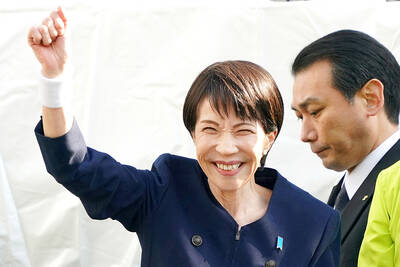
Japan’s strategic alliance with the US would collapse if Tokyo were to turn away from a conflict in Taiwan, Japanese Prime Minister Sanae Takaichi said yesterday, but distanced herself from previous comments that suggested a possible military response in such an event. Takaichi expressed her latest views on a nationally broadcast TV program late on Monday, where an opposition party leader criticized her for igniting tensions with China with the earlier remarks. Ties between Japan and China have sunk to the worst level in years after Takaichi said in November that a hypothetical Chinese attack on Taiwan could bring about a Japanese
STREAMLINED: The dedicated funding would allow the US to transfer equipment to Taiwan when needed and order upgraded replacements for stockpiles, a source said The US House of Representatives on Thursday passed a defense appropriations bill totaling US$838.7 billion, of which US$1 billion is to be allocated to reinforcing security cooperation with Taiwan and US$150 million to replace defense articles provided to the nation. These are part of the Consolidated Appropriation Act, which the US House yesterday passed with 341 votes in favor and 88 against. The act must be passed by the US Senate before Friday next week to avoid another government shutdown. The US House Committee on Appropriations on Monday unveiled the act, saying that it allocates US$1 billion for the Taiwan Security Cooperation Initiative


 RSS
RSS