


Taiwan’s first indigenous submarine, the Hai Kun (海鯤), or Narwhal, yesterday departed from Kaohsiung to start its first submerged sea trial, where it was expected to dive to at least 50m.
CSBC Corp, Taiwan (台灣國際造船) on Wednesday announced the trial, marking the first time the shipbuilder has publicly disclosed the submarine’s testing schedule.
The submerged trials would proceed in stages, beginning with snorkel-depth testing at depths of 10m to 20m to verify watertight integrity, underwater balance and stability, as well as the functionality and integration of all onboard systems, CSBC said.
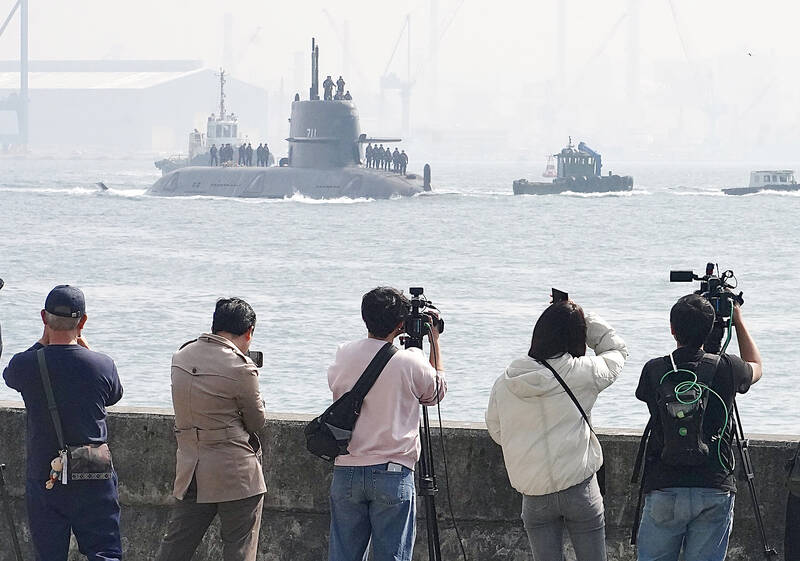
Photo: CNA
That would be followed by shallow-water submerged trials at depths of 50m to 100m, it said.
Deep-water submerged trials would be conducted from 100m to the submarine’s maximum design depth, again testing watertightness and balance stability, with pressure resistance evaluated progressively from shallow to deeper waters, it said.
After the submerged trials are completed, the submarine would enter the evaluation testing phase, the first stage of which involves technical evaluations conducted by the shipbuilder to verify that the platform and combat systems meet operational requirements, CSBC said.
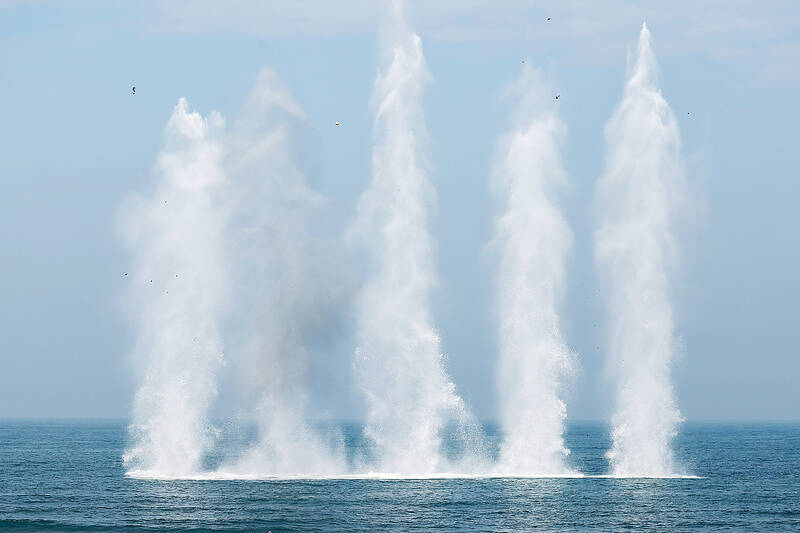
Photo: RITCHIE B. TONGO, EPA
Test items would include endurance, underwater noise levels, sonar performance, combat systems and simulated weapons launches, it added.
After completing the tests, the submarine would be delivered to the navy for tactical evaluation, it said.
The submarine would operate in designated exercise areas to conduct technical and tactical assessments to verify overall combat capability, CSBC said, adding that test items would include live weapons firing, single-vessel tactical employment, multivessel coordinated operations and long-duration patrol maturity testing.
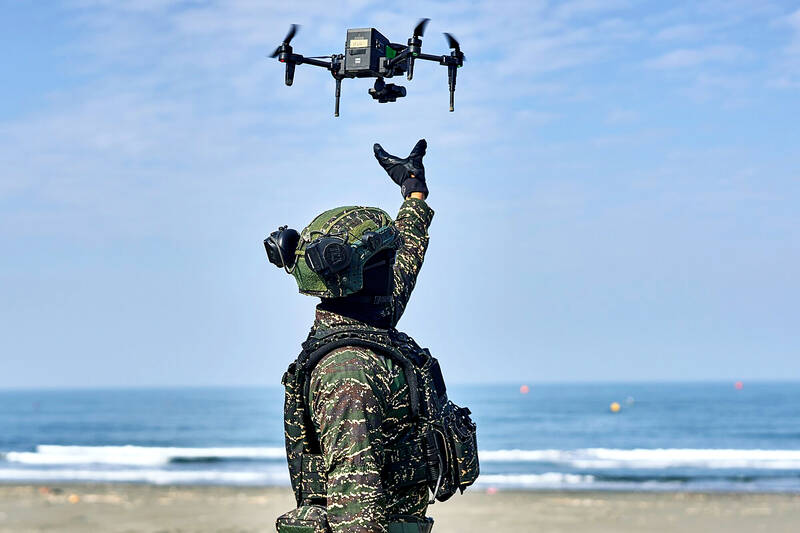
Photo: An Rong Xu, Bloomberg
Separately, the military yesterday simulated repelling a Chinese assault from the sea, integrating shore-launched missiles and drones with fast patrol boats to stop an attempted invasion.
An invasion of Taiwan is thought to be extremely difficult given that the Chinese People’s Liberation Army (PLA) would have to first cross the Taiwan Strait and attack the limited number of beaches on Taiwan proper that are suitable for amphibious landing.
The drill, which took place on a beach that forms part of the Zuoying naval base in Kaohsiung, simulated a scenario in which Taiwan detects an unknown boat loitering off the coast and sends drones to investigate. Taiwanese attack drones and fast, missile-armed patrol boats are then pressed into action.
Snipers engaged enemy forces and Taiwan-made anti-ship Hsiung Feng (雄風, “Brave Wind”) missiles took aim from concealed mobile launchers on the beach.
Republic of China Marine Corps officer, speaking anonymously for security reasons, told reporters that the near-shore exercise with coordinated strike missions built a “kill chain and effectively executed joint interceptions.”
“That demonstrated the navy’s multilayered, multi-wave defensive combat effectiveness, as well as the marine’s combat power and resilience in rapidly taking control from both the sea and the land,” he added.
The military routinely holds drills ahead of the Lunar New Year holiday.
Earlier this week, the military showed how its US-made High Mobility Artillery Rocket System (HIMARS) would be used to hit Penghu County should Chinese forces seize the islands and use them as a base to launch strikes on Taiwan proper.
The HIMARS, one of Taiwan’s newest and most precise strike weapons, has been used extensively by Ukraine against Russian forces.

‘NO SECURITY RISK’: The Railway Bureau reassured the public that the technicians’ activities were limited to technical guidance and did not involve sensitive systems The Railway Bureau yesterday said it had invited eight Chinese technicians to assist with an airport MRT construction project. The bureau issued the confirmation after an Internet user said Chinese nationals had entered the construction zone of Taiwan Taoyuan International Airport’s Terminal 3 project. They asked why “individuals from an enemy state” were allowed access to such a major national infrastructure project, which raised serious concerns over Taiwan’s industrial safety, sensitive systems and information security. The bureau’s Northern Region Engineering Branch Office said subcontractor Taiwan Handle Industrial Co (台灣手把工業) of the Taoyuan airport MRT’s “Contract No. CU05 Project A14 Station Civil, MEP &

The National Chungshan Institute of Science and Technology yesterday showcased its locally developed variants of the Vision 60 robotic patrol dog, which it plans to deploy on the nation’s outlying territories in the South China Sea. The variants were produced under the Joint Lab project — created by the institute and domestic companies — and assembled with domestically produced motors, lenses and artificial intelligence (AI) systems alongside licensed tech from the US, Missile and Rocket Systems Research Division deputy director Jen Kuo-kang (任國光) told the media event at a military base in Taipei’s Dazhi (大直) area. Taiwan has built up its strengths

TIT-FOR-TAT: The US allegedly revoked the visa of a Chinese national working at Xinhua News Agency in the US in response to Beijing’s expulsion of Vivian Wang The Presidential Office yesterday condemned China for expelling a New York Times correspondent from Beijing following the newspaper’s interview with President William Lai (賴清德), saying the move highlighted Beijing’s suppression of press freedom and its threat to international news media. Taiwan has noted a series of recent incidents in which Beijing used similar tactics to “threaten and pressure international media outlets and journalists,” Presidential Office spokeswoman Karen Kuo (郭雅慧) said in a statement. “This concerns not only press freedom and freedom of expression, but also the safety of journalists, and Taiwan and relevant partners are paying close attention to the situation,” she

NOT IMMEDIATE: Taiwan has a chance to appeal the proposed 10 percent tariff before it starts, while other countries face a 12.5 percent tariff from the trade office Taiwan is among 60 economies determined by the US to have failed to impose or enforce a ban on the importation of goods produced with forced labor, according to a notice released on Tuesday by the Office of the US Trade Representative (USTR), which proposed imposing an additional 10 percent or more tariff on them. The USTR in a statement said that following an investigation, it had determined under Section 301 of the Trade Act of 1974 that the failure of the 60 economies to impose and effectively enforce a prohibition on the importation of goods produced with forced labor is


 RSS
RSS