


Australian politicians yesterday voted in favor of tougher hate crime and gun laws, weeks after gunmen targeting Jewish people on Bondi Beach killed 15 people.
Lawmakers in the House of Representatives backed the legislation in response to the Dec. 14 shooting at the famous Sydney beach.
Sajid Akram and his son, Naveed, allegedly targeted a Jewish Hanukkah celebration in the nation’s worst mass shooting in 30 years.
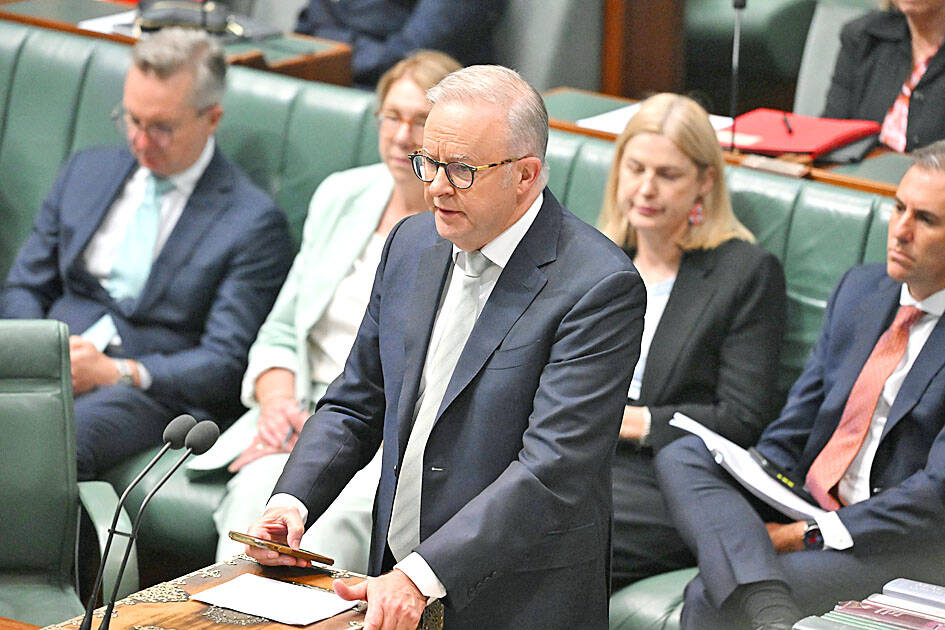
Photo: AAP / Mick Tsikas via Reuters
The attack has sparked national soul-searching about anti-Semitism, anger over the failure to shield Jewish Australians from harm and promises to protect the nation with stiffer legislation.
Both bills passed the House, and the firearms bill had been passed by the Senate by late yesterday. The anti-hate speech bill is expected to pass into law today.
“The terrorists had hate in their hearts, but they also had high-powered rifles in their hands,” Australian Prime Minister Anthony Albanese told parliament.
“We’re taking action on both — tackling anti-Semitism, tackling hate, and getting dangerous guns off our streets.”
Legislative reforms on guns and hate speech were voted on separately.
The hate speech legislation would toughen laws and penalties for people seeking to spread hate and radicalization, or to promote violence.
It creates aggravated offenses for offenders who are preachers, other leaders or adults seeking to radicalize children.
The reform would also make it easier to reject or cancel visas for people suspected of terrorism or espousing hatred on the basis of race, color or origin.
On firearms, Australia would set up a national gun buyback scheme, tighten rules on imports of firearms and expand background checks for gun permits to allow input from the intelligence services.
The legislation was debated in a special session of parliament, ahead of a day of mourning tomorrow for the Bondi Beach victims.
Sajid Akram, 50, was shot and killed by police during the Bondi Beach attack. An Indian national, he entered Australia on a visa in 1998.
His 24-year-old son, Naveed Akram, an Australian-born citizen who remains in prison, has been charged with terrorism and 15 murders.
Police and intelligence agencies are facing difficult questions about whether they could have acted earlier.
Naveed Akram was flagged by Australia’s intelligence agency in 2019, but he slipped off the radar after it was decided that he posed no imminent threat.

The Taiwanese passport ranked 33rd in a global listing of passports by convenience this month, rising three places from last month’s ranking, but matching its position in January last year. The Henley Passport Index, an international ranking of passports by the number of designations its holder can travel to without a visa, showed that the Taiwan passport enables holders to travel to 139 countries and territories without a visa. Singapore’s passport was ranked the most powerful with visa-free access to 192 destinations out of 227, according to the index published on Tuesday by UK-based migration investment consultancy firm Henley and Partners. Japan’s and

NATIONAL SECURITY THREAT: An official said that Guan Guan’s comments had gone beyond the threshold of free speech, as she advocated for the destruction of the ROC China-born media influencer Guan Guan’s (關關) residency permit has been revoked for repeatedly posting pro-China content that threatens national security, the National Immigration Agency said yesterday. Guan Guan has said many controversial things in her videos posted to Douyin (抖音), including “the red flag will soon be painted all over Taiwan” and “Taiwan is an inseparable part of China,” while expressing hope for expedited “reunification.” The agency received multiple reports alleging that Guan Guan had advocated for armed reunification last year. After investigating, the agency last month issued a notice requiring her to appear and account for her actions. Guan Guan appeared as required,

Japan and the Philippines yesterday signed a defense pact that would allow the tax-free provision of ammunition, fuel, food and other necessities when their forces stage joint training to boost deterrence against China’s growing aggression in the region and to bolster their preparation for natural disasters. Japan has faced increasing political, trade and security tensions with China, which was angered by Japanese Prime Minister Sanae Takaichi’s remark that a Chinese attack on Taiwan would be a survival-threatening situation for Japan, triggering a military response. Japan and the Philippines have also had separate territorial conflicts with Beijing in the East and South China
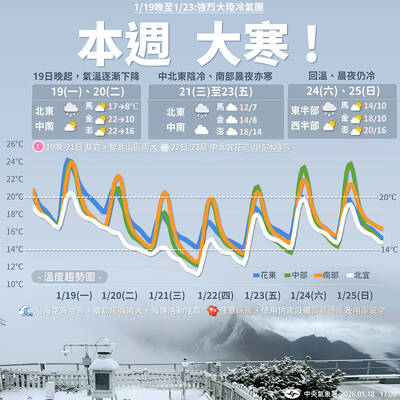
A strong cold air mass is expected to arrive tonight, bringing a change in weather and a drop in temperature, the Central Weather Administration (CWA) said. The coldest time would be early on Thursday morning, with temperatures in some areas dipping as low as 8°C, it said. Daytime highs yesterday were 22°C to 24°C in northern and eastern Taiwan, and about 25°C to 28°C in the central and southern regions, it said. However, nighttime lows would dip to about 15°C to 16°C in central and northern Taiwan as well as the northeast, and 17°C to 19°C elsewhere, it said. Tropical Storm Nokaen, currently


 RSS
RSS