


The Kaohsiung branch of the High Court yesterday sentenced a Chinese immigrant to eight years in prison for creating immigrant associations sponsored by Chinese “united front” groups, overturning a previous acquittal after the Supreme Court remanded the case for retrial.
The court sentenced Zhou Manzhi (周滿芝) to eight years for contravening the National Security Act (國家安全法).
The ruling can be appealed.

Photo: CNA
As chair of the Taiwan New Residents Care Association, Zhou was accused of acting at the direction of Chinese organizations — including the Shaanxi Patriotic Volunteer Association — to develop organizations in Taiwan.
The Kaohsiung branch of the High Court previously acquitted Zhou due to insufficient evidence.
Zhou obtained residency in Taiwan in 2004 after marrying a Taiwanese man.
She was a member of the Shaanxi Patriotic Volunteer Association and the China Patriotic Volunteer Association, civilian groups commissioned by the United Front Work Department of the Chinese Communist Party Central Committee, the court said.
She established the Kaohsiung New Residents Sisters Care Association in 2016 and the Taiwan New Residents Care Association in 2019, it said.
As a member of the committee and the Shaanxi Patriotic Volunteer Association, she became acquainted with its chief executive, Cui Guowei (崔國衛), who instructed her to form the auxiliary organizations in Taiwan, the court said.
Zhou in 2017 traveled to China to meet with Huang Lanxiang (黃蘭香), head of the committee’s Hunan Province division, to seek assistance and sponsorship to form the organizations, although her request for a meeting was denied, it said.
She again in 2018 traveled to China to meet with Cui and signed a declaration to promote “one country, two systems” in Taiwan and promote “united front” work, it added.
The Ciaotou District Prosecutors’ Office opened an investigation into Zhou and Hsu Shao-tung (徐少東), former vice chair of the For Public Good Party, a Chinese nationalist right-wing party in Taiwan, who has since become a fugitive.
The two were suspected of contravening the Anti-infiltration Act (反滲透法) and other laws.
Prosecutors suspected Zhou of forming “united front” organizations and transferred the case to the Kaohsiung High Prosecutors’ Office.
The Kaohsiung branch of the High Court then consulted the Ministry of Justice’s Investigation Bureau, which initially found that there was no evidence of substantive control or direct links between Chinese authorities and the organizations.
Prosecutors also previously failed to prove that Zhou had directly or indirectly received funds or sponsorship from China, or that she had meetings with “united front” officials, so there was insufficient evidence for a conviction, the court said.
In its second ruling, the court cited evidence from the National Security Bureau as proving that the Shaanxi Patriotic Volunteer Association is under the control of China’s “united front” apparatus.
It said that Zhou formed the organizations in Taiwan under the instruction of these Chinese organizations, and “actively planned and implemented activities with clear ‘united front’ objectives,” posing a threat to national security and social stability.

The Ministry of Transportation and Communications yesterday inaugurated the Danjiang Bridge across the Tamsui River in New Taipei City, saying that the structure would be an architectural icon and traffic artery for Taiwan. Feted as a major engineering achievement, the Danjiang Bridge is 920m long, 211m tall at the top of its pylon, and is the longest single-pylon asymmetric cable-stayed bridge in the world, the government’s Web site for the structure said. It was designed by late Iraqi-British architect Zaha Hadid. The structure, with a maximum deck of 70m, accommodates road and light rail traffic, and affords a 200m navigation channel for boats,
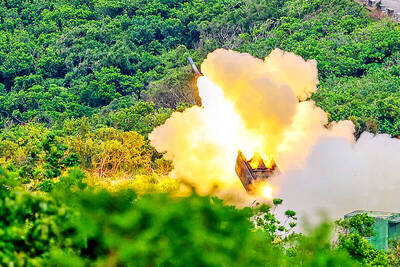
PRECISION STRIKES: The most significant reason to deploy HIMARS to outlying islands is to establish a ‘dead zone’ that the PLA would not dare enter, a source said A High Mobility Artillery Rocket System (HIMARS) would be deployed to Penghu County and Dongyin Island (東引) in Lienchiang County (Matsu) to force the Chinese military to retreat at least 100km from the coastline, a military source said yesterday. Taiwan has been procuring HIMARS and Army Tactical Missile Systems (ATACMS) from the US in batches. Once all batches have been delivered, Taiwan would possess 111 HIMARS units and 504 ATACMS, which have a range of 300km. Considering that “offense is the best defense,” the military plans to forward-deploy the systems to outlying islands such as Penghu and Dongyin so that

WHAT WAS ALL THAT FOR? Jaw Shaw-kong said that Cheng Li-wen had pushed for more drastic cuts and attacked him, just for the outcome to be nearly identical to his bill The legislature yesterday passed a supplementary budget bill to fund the purchase of separate packages of US military equipment, with the combined amount of spending capped at NT$780 billion (US$24.8 billion). The Chinese Nationalist Party (KMT) and Taiwan People’s Party (TPP) used their legislative majority to pass the bill, which runs until 2033 and has two main funding provisions. One was for NT$300 billion of arms sales already approved by the US for Taiwan on Dec. 17 last year, the other was for NT$480 billion for another arms package expected to be announced by Washington. The bill, which fell short of the NT$1.25

‘CLEAR MESSAGE’: The bill would set up an interagency ‘tiger team’ to review sanctions tools and other economic options to help deter any Chinese aggression toward Taiwan US Representative Young Kim has introduced a bill to deter Chinese aggression against Taiwan, calling for an interagency “tiger team” to preplan coordinated sanctions and economic measures in response to possible Chinese military or political action against Taiwan. “[Chinese President] Xi Jinping [習近平] has directed the People’s Liberation Army to be ready to invade Taiwan by 2027. China has a plan. America should have one too,” Kim said in a news release on Thursday last week. She introduced the “Deter PRC [People’s Republic of China] aggression against Taiwan act” to “ensure the US has a coordinated sanctions strategy ready should


 RSS
RSS