


The “Taiwan model” trade agreement reached with Washington is not about relocating supply chains, but expanding industrial capabilities in the US, Vice Premier Cheng Li-chiun (鄭麗君) said today.
Taiwan and the US last week reached an agreement in tariff negotiations with Taiwan securing most-favored-nation treatment, which is expected to boost the competitiveness of traditional industries expanding to the US, Cheng told a news conference in Taipei about the trade talks.
"This is not supply-chain relocation. Rather, it is support for Taiwan's high-tech industries to extend their strength abroad — through addition, and even multiplication — to expand a strong international footprint in the US," she said.
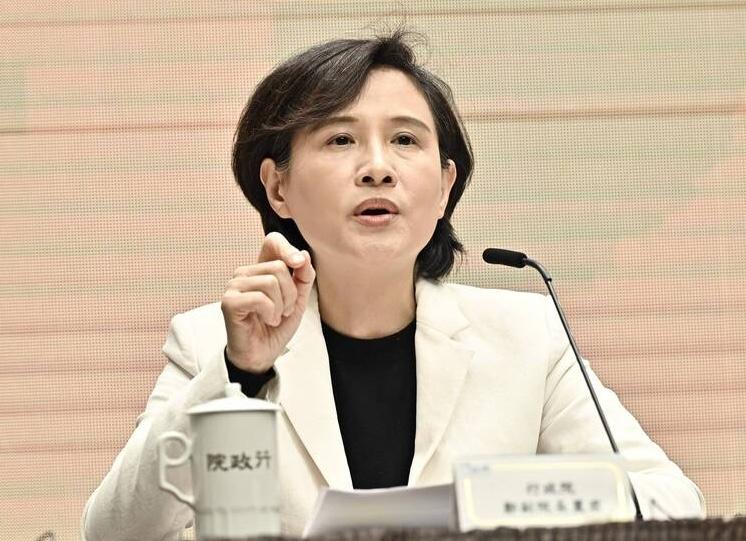
Photo: Tu Chien-jung, Taipei Times
The two sides are expected to sign a reciprocal trade agreement in the coming weeks, completing the “final mile” of the negotiations, she said.
Under the terms of the long-negotiated deal, chipmakers that expand US production would incur a lower tariff on semiconductors or related manufacturing equipment and products they import into the US, and would be able to import some items duty-free.
Broad tariffs that apply to most other Taiwanese exports to the US would fall from 20 to 15 percent.
Taiwan companies would also invest US$250 billion to boost production of semiconductors, energy and artificial intelligence (AI) in the US, while Taiwan would also guarantee an additional US$250 billion in credit to facilitate further investment.
Although the tariffs have not yet been finalized, the US has committed to granting Taiwan most-favorable treatment globally, Cheng said.
Taiwan would be the first nation to receive semiconductor tariff exemptions within quotas, as well as the most-favorable tariff rates for exports exceeding the quota, she said.
If the preferential rate ends up below 15 percent, a “whichever is lower” clause would apply, she added.
Under the agreement, chipmakers that expand in the US would be able to import up to two-and-a-half times their new capacity of semiconductors and wafers with no extra tariffs during an approved construction period.
The government aims to manage uncertainty with stability for Taiwan’s high-tech industries, ensuring the most-favorable treatment under any future tax rate, Cheng said.
Taiwan has also secured preferential treatment for products including auto parts, wooden furniture and aviation components, she said, describing these as significant benefits for suppliers.
To address potential future expansions of Section 232 tariff items and ongoing investigations, Taiwan and the US have agreed to establish a continuous consultation mechanism that would provide Taiwan with preferential terms: “Zero tariffs within the quota and preferential tariffs even outside the quota,” she said.
Taiwan has already signed an investment cooperation memorandum of understanding with the US Department of Commerce and has confirmed with the Office of the US Trade Representative that the reciprocal trade agreement would be signed in the coming weeks, she said.
Once both agreements are completed, the negotiations would reach their final stage, she added.
The agreements cover tariffs, non-tariff trade barriers, trade facilitation, economic security, labor protections, environmental safeguards and business opportunities, as well as two-way investment, she said.
Washington has also pledged to increase its investment in Taiwan, she added.
"In the past we said: 'Taiwan can help,'" Cheng said, referring to Taiwan's efforts to help the international community during the COVID-19 pandemic and other crises.
"We hope in the future it will be: ‘Taiwan-US can lead,' with the two sides joining forces and, under the wave of AI, working together to build a high-tech supply chain for the democratic camp. This is our strategic objective," she added.

‘NO SECURITY RISK’: The Railway Bureau reassured the public that the technicians’ activities were limited to technical guidance and did not involve sensitive systems The Railway Bureau yesterday said it had invited eight Chinese technicians to assist with an airport MRT construction project. The bureau issued the confirmation after an Internet user said Chinese nationals had entered the construction zone of Taiwan Taoyuan International Airport’s Terminal 3 project. They asked why “individuals from an enemy state” were allowed access to such a major national infrastructure project, which raised serious concerns over Taiwan’s industrial safety, sensitive systems and information security. The bureau’s Northern Region Engineering Branch Office said subcontractor Taiwan Handle Industrial Co (台灣手把工業) of the Taoyuan airport MRT’s “Contract No. CU05 Project A14 Station Civil, MEP &

The National Chungshan Institute of Science and Technology yesterday showcased its locally developed variants of the Vision 60 robotic patrol dog, which it plans to deploy on the nation’s outlying territories in the South China Sea. The variants were produced under the Joint Lab project — created by the institute and domestic companies — and assembled with domestically produced motors, lenses and artificial intelligence (AI) systems alongside licensed tech from the US, Missile and Rocket Systems Research Division deputy director Jen Kuo-kang (任國光) told the media event at a military base in Taipei’s Dazhi (大直) area. Taiwan has built up its strengths

NOT IMMEDIATE: Taiwan has a chance to appeal the proposed 10 percent tariff before it starts, while other countries face a 12.5 percent tariff from the trade office Taiwan is among 60 economies determined by the US to have failed to impose or enforce a ban on the importation of goods produced with forced labor, according to a notice released on Tuesday by the Office of the US Trade Representative (USTR), which proposed imposing an additional 10 percent or more tariff on them. The USTR in a statement said that following an investigation, it had determined under Section 301 of the Trade Act of 1974 that the failure of the 60 economies to impose and effectively enforce a prohibition on the importation of goods produced with forced labor is

TIT-FOR-TAT: The US allegedly revoked the visa of a Chinese national working at Xinhua News Agency in the US in response to Beijing’s expulsion of Vivian Wang The Presidential Office yesterday condemned China for expelling a New York Times correspondent from Beijing following the newspaper’s interview with President William Lai (賴清德), saying the move highlighted Beijing’s suppression of press freedom and its threat to international news media. Taiwan has noted a series of recent incidents in which Beijing used similar tactics to “threaten and pressure international media outlets and journalists,” Presidential Office spokeswoman Karen Kuo (郭雅慧) said in a statement. “This concerns not only press freedom and freedom of expression, but also the safety of journalists, and Taiwan and relevant partners are paying close attention to the situation,” she


 RSS
RSS