


Japanese Prime Minister Sanae Takaichi yesterday said that she would dissolve parliament this week ahead of a snap election on Feb. 8, hoping for a stronger mandate to push through her ambitious policy agenda.
The nation’s first female leader is banking on her high poll numbers to lead the unpopular ruling Liberal Democratic Party (LDP) to victory.
“Is Sanae Takaichi fit to be prime minister? I wanted to ask the sovereign people to decide,” she told a news conference. “Following the dissolution of the lower house on Jan. 23, the schedule will be set for campaigning to start on Jan. 27, and voting and counting held on Feb. 8.”
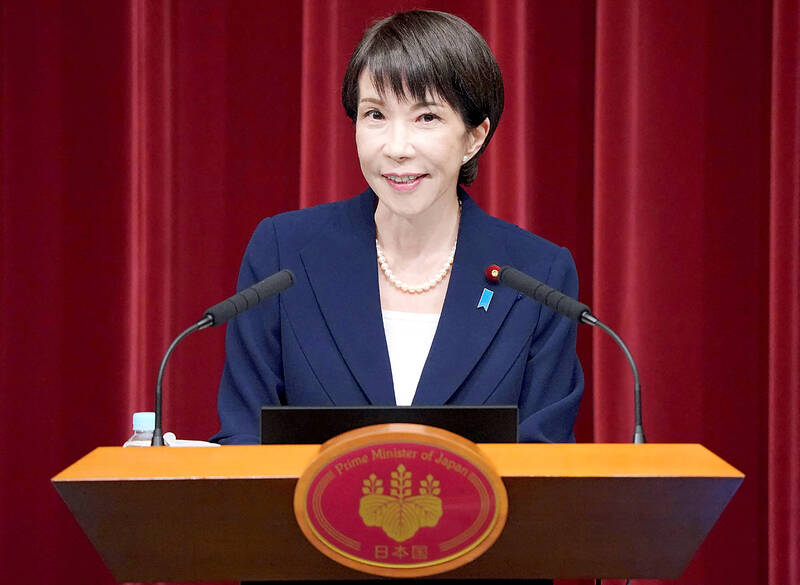
Photo AFP
The LDP has governed Japan almost uninterrupted for decades, albeit with frequent leader changes.
Takaichi was appointed prime minister in October last year and her Cabinet is riding high in the polls despite her party’s flagging popularity.
The ruling bloc — which includes coalition partner the Japan Innovation Party — has only a slim majority in the powerful lower house of parliament.
That could hamper the passage of her policy agenda, including “proactive” fiscal spending and boosting the defense budget.
“If the LDP can get a majority by itself in the lower house, that will help her pursue policies” without concessions to other parties, said Sadafumi Kawato, professor emeritus at the University of Tokyo.
Takaichi’s Cabinet approved a record ¥122.3 trillion (US$775 billion) budget for the fiscal year from April, and she has vowed to get parliamentary approval as soon as possible to address inflation and shore up the world’s fourth-largest economy, but opposition parties say Takaichi’s plan to dissolve the lower house risks delaying its passage, with Jun Azumi of the main opposition Constitutional Democratic Party of Japan saying it would “sacrifice livelihoods.”
Masaaki Tokuno, a 64-year-old bicycle lot manager, said that “carrying out policies to tackle inflation should be first, before holding the election.”
The LDP is weighing campaigning on a possible cut to tax on food, to ease the pain of soaring costs at the grocery store, reports said.
A snap election might also help Takaichi break the deadlock in a spat with China, increasing her leverage by showing she has strong support at home, analysts said.
Ties between Tokyo and Beijing have deteriorated since Takaichi suggested in November last year that Japan could intervene militarily if China ever launched an attack on Taiwan.
However, Mikitaka Masuyama, dean of the National Graduate Institute for Policy Studies, said that if she wins, China could further intensify pressure on Takaichi.
Beijing might want to send voters “the message that supporting a hawkish leader could lead to pain” through more trade controls or other means, Masuyama said.
China announced a broad ban on exports to Japan of “dual-use” goods with potential military applications and has reportedly been choking off exports of rare earths crucial for making everything from electric vehicles to missiles.
According to a poll by the Asahi, 60 percent of people surveyed said that they were worried about the impact of a worsening Japan-China relations on the economy.

A signaling system malfunction disrupted high-speed rail (HSR) services beginning at 8am today, with trains temporarily reduced to three northbound and three southbound trains per hour as authorities conduct inspections. The malfunction occurred on a section of track in Miaoli County during pre-operation checks early this morning, forcing northbound and southbound trains to use a single track, the HSR operator said. The regular schedule has been replaced with three hourly trains offering only nonreserved seating in each direction, stopping at every station, it said, adding that business class cars would still have reserved seating. Departures from terminal stations are scheduled at the top
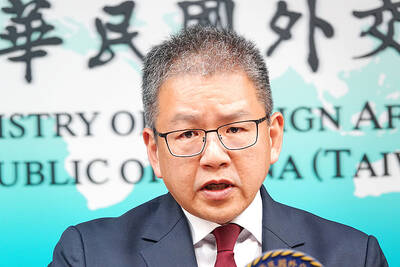
Taiwan is still in the process of assessing the possibility of recruiting workers from Eswatini, the Ministry of Foreign Affairs said yesterday, adding that its goal is to help Eswatini upgrade its vocational training centers. If there are plans to recruit workers from Eswatini, safeguarding national security, protecting public health and ensuring the employment rights of Taiwanese would be prerequisites, Department of West Asian and African Affairs Director-General Yen Chia-liang (顏嘉良) told a news conference. Key considerations would also include filling labor shortages in specific industries, and fostering bilateral professional and technical exchanges, he said. Yen was asked about the progress of labor
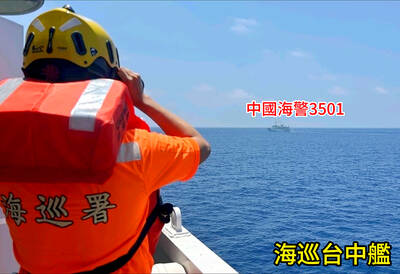
VERBOSE VESSELS: A CGA cutter and a China Coast Guard exchanged verbal barbs for more than a day in Taiwanese-controlled waters before the Chinese vessel left The Taiwanese and Chinese coast guards had a standoff near the strategically located Pratas Islands (Dongsha Islands, 東沙群島) in the north of the South China Sea, the Coast Guard Administration (CGA) said yesterday. The two sides engaged in intense radio exchanges over sovereignty claims during the 33-hour standoff. China Coast Guard vessel 3501 eventually left the restricted waters, 26.6 nautical miles (49.2km) west of the Pratas Islands, at 5pm yesterday, the CGA said. Lying approximately between southern Taiwan and Hong Kong, the Taiwan-controlled Pratas are seen by some security experts as vulnerable to Chinese attack due to their distance — more than

A US uncrewed surface vessel (USV) encountered multiple Chinese warships during an autonomous transit of the Taiwan Strait, US defense company Seasats said in a statement on Wednesday. Seasats announced that a Lightfish USV had completed the first autonomous transit of the Taiwan Strait. Over five days, the USV traversed the entire length of the Strait while constantly monitoring surface vessel traffic, the company said. The Lightfish encountered multiple Chinese warships, one of which was a Chinese People’s Liberation Army Navy (PLAN) Type 056 corvette, it said. The Chinese vessels were operating “well within Taiwan’s exclusive economic zone without transmitting their identity via the


 RSS
RSS