


A high-speed train derailed and was hit by another in southern Spain, killing at least 39 people and injuring more than 120, authorities said yesterday.
It was the deadliest train accident since 2013, when 80 people died after a train veered off a curved section of track outside the northwestern city of Santiago de Compostela.
The crash happened on Sunday evening when a train operated by rail company Iryo traveling from Malaga to Madrid derailed near Adamuz in Andalucia.
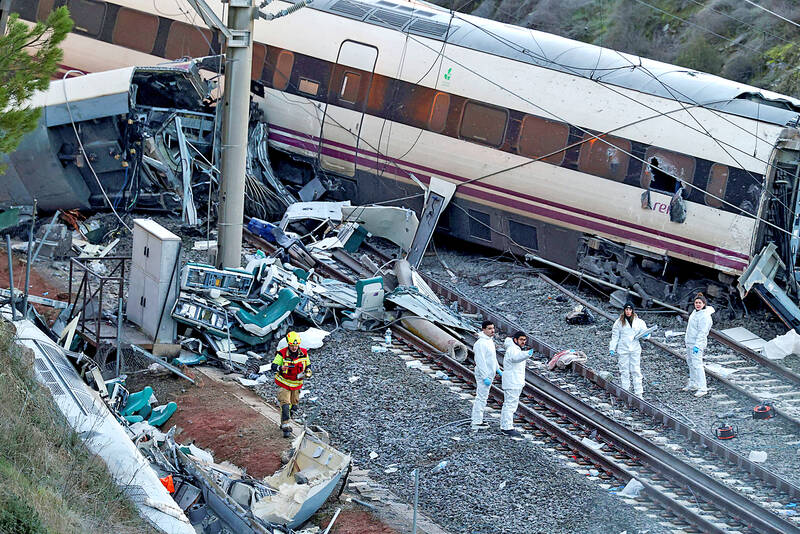
Photo: Reuters
It crossed onto the other track, where it crashed into an oncoming train, which also derailed.
Spanish Minister of Transport and Sustainable Mobility Oscar Puente said at least 39 people died, warning that the toll was “not definitive” and could still rise.
“I want to express my deepest gratitude for the tremendous work of the rescue teams throughout the night, under very difficult circumstances,” he said on social media.
About 123 other people were injured, including five very seriously and 24 seriously, the Spanish Ministry of the Interior said.
Unlike the 2013 accident, the derailment took place on a straight part of the track which had been completely renovated, Puente said.
The first train to derail was “practically new,” making the accident “extremely strange” and “very difficult to explain,” he said.
Rail experts “are very surprised by this accident,” he added.
Iryo said that the locomotive was built in 2022 and last inspected on Thursday last week, adding that it “veered onto the adjacent track for still unknown reasons.”
About 300 people were on board its service from Malaga to Madrid, the company said.
Renfe, the operator of the second train, has not said how many passengers were on the service, which was traveling to Huelva.
Emergency services said they struggled to free the hundreds of passengers trapped in the wreckage.
“The problem is that the carriages are twisted, so the metal is twisted with the people inside,” Francisco Carmona, head of firefighters in Cordoba, told public broadcaster RTVE.
“We have even had to remove a dead person to be able to reach someone alive. It is hard, tricky work,” he said.
A passenger on the second train who gave only her first name, Montse, told Spanish public television that the train jolted, “came to a complete stop and everything went dark.”
She described being thrown around in the carriage at the back end of the train and seeing luggage tumble onto other passengers.
“The attendant behind me hit her head and was bleeding. There were children crying,” she said. “Luckily, I was in the last car. I feel like I was given a second chance at life.”
In Taipei, the government yesterday expressed its condolences to Spain.
The Ministry of Foreign Affairs said that its representative office in Madrid had so far found no Taiwanese injured or killed in the accident.
The ministry said that it has also asked the office to convey the condolences of Taiwanese and the government and concern over the incident to Spain.
Meanwhile, the ministry advised Taiwanese in Spain who require emergency assistance to call the representative office at 639-384-883, or ask family members in Taiwan to contact the ministry’s all-hours toll-free emergency hotline at 0800-085-095.
Additional reporting by CNA

PROVOCATIVE: Chinese Deputy Ambassador to the UN Sun Lei accused Japan of sending military vessels to deliberately provoke tensions in the Taiwan Strait China denounced remarks by Japan and the EU about the South China Sea at a UN Security Council meeting on Monday, and accused Tokyo of provocative behavior in the Taiwan Strait and planning military expansion. Ayano Kunimitsu, a Japanese vice foreign minister, told the Council meeting on maritime security that Tokyo was seriously concerned about the situation in the East China and South China seas, and reiterated Japan’s opposition to any attempt to change the “status quo” by force, and obstruction of freedom of navigation and overflight. Stavros Lambrinidis, head of the EU delegation to the UN, also highlighted South China Sea
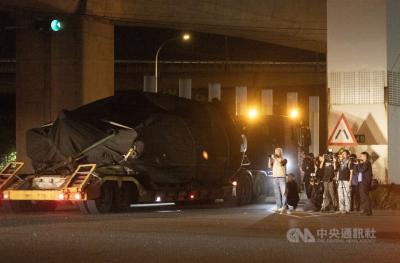
The final batch of 28 M1A2T Abrams tanks purchased from the US arrived at Taipei Port last night and were transported to the Armor Training Command in Hsinchu County’s Hukou Township (湖口), completing the military’s multi-year procurement of 108 of the tanks. Starting at 12:10am today, reporters observed more than a dozen civilian flatbed trailers departing from Taipei Port, each carrying an M1A2T tank covered with black waterproof tarps. Escorted by military vehicles, the convoy traveled via the West Coast Expressway to the Armor Training Command, with police implementing traffic control. The army operates about 1,000 tanks, including CM-11 Brave Tiger
Taiwan Semiconductor Manufacturing Co (TSMC, 台積電), the world’s largest contract chipmaker, said it expects its 2-nanometer (2nm) chip capacity to grow at a compound annual rate of 70 percent from this year to 2028. The projection comes as five fabs begin volume production of 2-nanometer chips this year — two in Hsinchu and three in Kaohsiung — TSMC senior vice president and deputy cochief operating officer Cliff Hou (侯永清) said at the company’s annual technology symposium in Silicon Valley, California, last week. Output in the first year of 2-nanometer production, which began in the fourth quarter of last year, is expected to

Taiwan’s drone exports surged past US$100 million in the first quarter, exceeding last year’s full-year total, with the Czech Republic emerging as the largest buyer, the Ministry of Economic Affairs said. Exports of complete drones reached US$115.85 million in the period, about 1.2 times the total recorded for all of last year, the ministry said in a report. Exports to the Czech Republic accounted for about US$100 million, far outpacing other markets. Poland, last year’s top destination, recorded about US$11.75 million in the first quarter. Taiwan’s drone exports have expanded rapidly in the past few years, with last year’s total


 RSS
RSS