


Military police have strengthened garrison defense capabilities in Taipei as part of a force-structure adjustment to address enemy threats, the 202nd Military Police Command said yesterday.
The command said it has added a new air-defense company under the 228th Battalion stationed in Taipei’s Shilin District (士林) for the purpose.
The unit — its only artillery unit — has been equipped with Stinger anti-air missiles and anti-tank Javelin systems, it added.
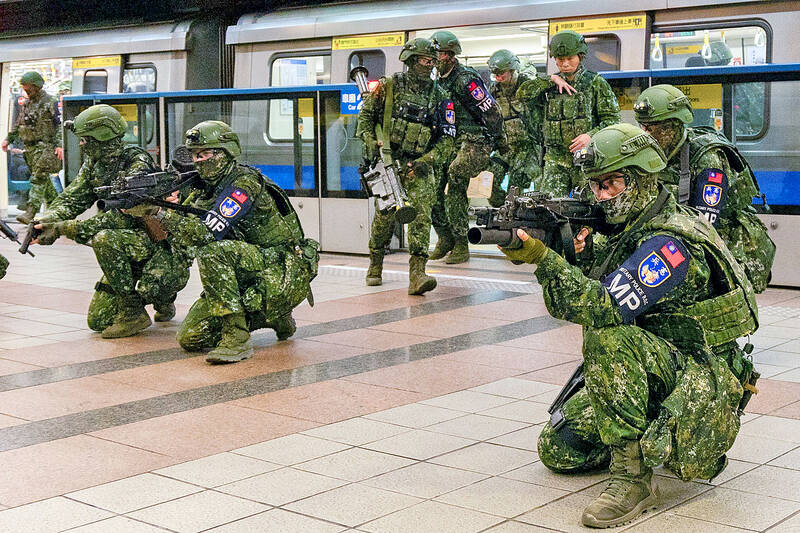
Photo: MINISTRY OF NATIONAL DEFENSE via AFP
Beijing has increasingly waged cognitive warfare and military intimidation against Taiwan — including frequent incursions by aircraft and vessels into Taiwan’s air defense identification zone, and repeated crossings of the median line of the Taiwan Strait — severely undermining regional peace and stability, it said.
The command has responded to these threats in the past few years by bolstering counter-decapitation capabilities and protection of critical infrastructure, it said.
It increased the number of active duty officers from 5,000 to 10,000 in 2024, coordinating with one-year mandatory military service units to guard key infrastructure, it said.
The command oversees seven battalions, which guard facilities across Taipei, it said.
Those battalions are the 211th Battalion, responsible for Presidential Office security; the 332nd Battalion, which handles security for the president’s and vice president’s residences; the 229th Battalion, which guards the Ministry of National Defense; the 239th Battalion, the military police’s only armored unit; the 228th Artillery Battalion in Shilin; the 261st Battalion, which is dispersed across multiple locations including Songnan Camp at Songshan Airport and Zhongzhen Camp at the Military Police Command; and the 262nd Battalion, which has yet to be fully formed.
Su Tzu-yun (蘇紫雲), a research fellow at the Institute for National Defense and Security Research, said that artillery units have historically had air-defense artillery, so providing the Taipei garrison with surface-to-air missiles is not without precedent.
“Deploying short-range, man-portable Stinger missiles enhances mobile air defense, while Javelin missiles can counter Chinese Communist Party landing craft attempting surprise assaults at the Tamsui River estuary,” he said. “Together, the two systems serve to strengthen both counter-surprise and counter-decapitation capabilities.”
Taiwan could draw lessons from other countries’ air-defense deployments in capital no-fly zones, he said.
For example, Washington has the National Capital Region Air Defense, with rotating deployments of air defense artillery regiments, he said.
Sentinel A4 radars, National Advanced Surface-to-Air Missile Systems, Avenger systems and Stinger missiles are routinely deployed on surrounding buildings to protect the White House, the Eisenhower Executive Office Building — which houses the vice president and the US National Security Council — and the Pentagon, he added.
South Korea’s 1st Air Defense Brigade is responsible for Seoul’s P-73 zone, covering a radius of 3.7km that includes the city’s Seocho, Dongjak and Jung districts, Su said, adding that short-range Mistral missiles and domestically produced KM167A3 air defense guns are routinely deployed on nearby high-rise buildings.
Su suggested that the government also consider permanent deployments in Taipei’s Boai Special Zone (博愛特區) surrounding the Presidential Office.
Although designated a no-fly area, it lacks sufficient physical deployments during peacetime, he said.
Permanent deployments could strengthen resilience against surprise attacks, he added.

‘NO SECURITY RISK’: The Railway Bureau reassured the public that the technicians’ activities were limited to technical guidance and did not involve sensitive systems The Railway Bureau yesterday said it had invited eight Chinese technicians to assist with an airport MRT construction project. The bureau issued the confirmation after an Internet user said Chinese nationals had entered the construction zone of Taiwan Taoyuan International Airport’s Terminal 3 project. They asked why “individuals from an enemy state” were allowed access to such a major national infrastructure project, which raised serious concerns over Taiwan’s industrial safety, sensitive systems and information security. The bureau’s Northern Region Engineering Branch Office said subcontractor Taiwan Handle Industrial Co (台灣手把工業) of the Taoyuan airport MRT’s “Contract No. CU05 Project A14 Station Civil, MEP &

A US uncrewed surface vessel (USV) encountered multiple Chinese warships during an autonomous transit of the Taiwan Strait, US defense company Seasats said in a statement on Wednesday. Seasats announced that a Lightfish USV had completed the first autonomous transit of the Taiwan Strait. Over five days, the USV traversed the entire length of the Strait while constantly monitoring surface vessel traffic, the company said. The Lightfish encountered multiple Chinese warships, one of which was a Chinese People’s Liberation Army Navy (PLAN) Type 056 corvette, it said. The Chinese vessels were operating “well within Taiwan’s exclusive economic zone without transmitting their identity via the

Taiwan is still in the process of assessing the possibility of recruiting workers from Eswatini, the Ministry of Foreign Affairs said yesterday, adding that its goal is to help Eswatini upgrade its vocational training centers. If there are plans to recruit workers from Eswatini, safeguarding national security, protecting public health and ensuring the employment rights of Taiwanese would be prerequisites, Department of West Asian and African Affairs Director-General Yen Chia-liang (顏嘉良) told a news conference. Key considerations would also include filling labor shortages in specific industries, and fostering bilateral professional and technical exchanges, he said. Yen was asked about the progress of labor
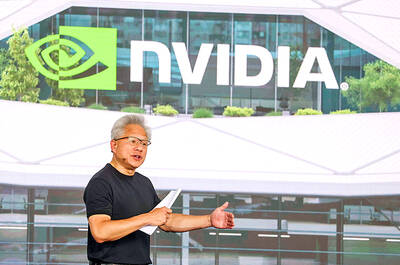
‘BOOMING’: ’ The number of partners we have here is incredible. You can see from their stock prices. They’re doing so well, they’re so happy,’ Jensen Huang said Nvidia Corp’s spending in Taiwan has ballooned to about US$150 billion a year, 10 times the US$10 billion to US$15 billion the company spent five years ago, Nvidia chief executive officer Jensen Huang (黃仁勳) said yesterday, suggesting Taiwan’s strategic importance in the global artificial intelligence (AI) supply chain. “Taiwan is the epicenter of the AI revolution. This is where the chips come, packaging comes. This is where the systems are made. This is where AI supercomputers were created,” Huang said at a meeting for the company’s employees in Beitou-Shilin Technology Park (北投士林科技園區) in Taipei, the planned site of Nvidia’s Taipei headquarters. “Taiwan


 RSS
RSS