


The Mainland Affairs Council (MAC) yesterday urged lawmakers to approve proposed amendments to the Anti-Infiltration Act (反滲透法) given the light punishments meted out to offenders under current regulations.
Speaking at a meeting of the legislature’s Internal Administration Committee reviewing the changes proposed by several Democratic Progressive Party legislators, MAC Deputy Minister and spokesman Liang Wen-chieh said it was urgent and necessary to pass the amendments to deter China’s intensifying intervention in politics in Taiwan and “gray zone” harassment.
Government data show that prosecutors have indicted 127 people since the act was implemented in 2020, but only five people have been convicted, with the sentences averaging between three and six months.
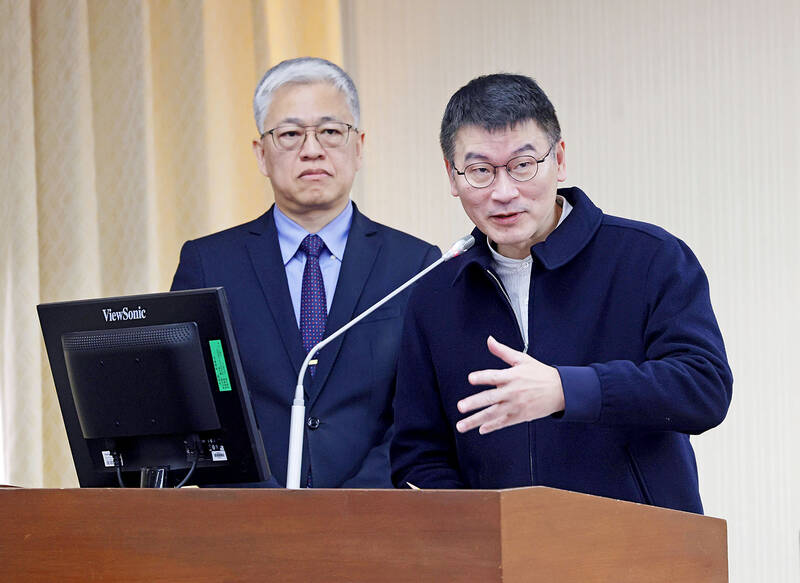
Photo: CNA
The draft amendments to the act would address several issues, including disseminating disinformation, regulating potential candidates, managing Internet service providers that set up databases in Taiwan, establishing national security courts, stipulating harsher penalties for people contravening anti-infiltration laws and regulating “gray zone” actors.
DPP Legislator Wang Ting-yu (王定宇) said that the act stipulates a maximum sentence, but sets no minimum.
“Prosecutors have encountered great difficulties in investigating national security cases that could cause tremendous damage to the country. Without a minimum sentence, judges can close cases by holding summary trials, granting defendants probation and asking them to pay damages,” he said.
“There should be a minimum criminal sentence in the act for those who help hostile nations infiltrate Taiwan. This would raise infiltration costs for regimes that threaten our national security,” he said.
DPP legislators Lee Po-yi (李柏毅) and Wang Mei-hui (王美惠) proposed adding those who participate in primaries for public offices to the list of people who must abide by the act.
“China’s intervention in elections in Taiwan — whether it is the presidential election or local elections — has intensified. It even funds China-friendly candidates to destroy democracy,” Wang Mei-hui said.
“The problem is that some of them start campaigning long before officially registering as candidates. There should be laws in place to regulate this kind of situation,” she said.
If it were not for the Anti-Infiltration Act, former MAC deputy chairman Chang Hsien-yao (張顯耀) would not have been investigated and indicted on allegations of following Beijing’s instructions to attempt to persuade Hon Hai Precision Industry Co founder Terry Gou (郭台銘) to accept a peace agreement and publishing a fake opinion poll where Gou led then-Chinese Nationalist Party (KMT) presidential candidate Hou You-yi (侯友宜), Liang said.
“Without the act, Chang would have been considered to be merely having a discussion with China’s Taiwan Affairs Office about who was fit to be president,” Liang said.
“The act is necessary, because there needs to be a law in Taiwan to hold those who work with China to meddle in Taiwanese elections accountable. A court would decide if they should be convicted,” he added.
While the Judicial Yuan has said the court system already has jurisdiction over national security issues, given the light punishments rendered to offenders, lawmakers should deliberate on whether there needs to be changes to the “status quo,” he said.
The Ministry of the Interior and Ministry of Justice said the act must have a clear definition of prospective candidates for elections if they are to be regulated as proposed.
The interior ministry said that the government can reference the definition of prospective candidates in the Political Donations Act (政治獻金法), which refers to people who have already been registered in accordance with the law during a specific period or who intend to run for office.
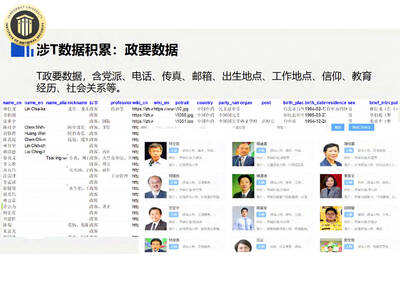
NETWORK-MAPPING PROJECT: The database contains 170 detailed files of Taiwanese politicians and about 23 million records of household registration data in Taiwan China has developed a network-mapping project targeting political figures and parties in Taiwan to monitor public opinion during elections and to craft tailored influence campaigns aimed at dividing Taiwanese society, according to documents leaked by Chinese technology firm GoLaxy (中科天璣). The documents, collected by Taipei-based Doublethink Lab, showed a database was specifically created to gather detailed information on Taiwanese political figures, including their political affiliations, job histories, birthplaces, residences, education, religion and a brief biography about them. Several notable Taiwanese politicians are in the database, including President William Lai (賴清德), former president Tsai Ing-wen (蔡英文), Minister of Foreign Affairs Lin Chia-lung (林佳龍),

RECOGNITION: Former Fijian prime minister Mahendra Chaudhry said that Taiwan’s New Southbound Policy serves as a stabilizing force in the Indo-Pacific region Taiwan can lead the unification of the Chinese people, Nobel Peace Prize laureate and former Polish president Lech Walesa said in Taipei yesterday, adding that as the world order is changing, peaceful discussion would find good solutions, and that the use of force and coercion would always fail. Walesa made the remarks during his keynote address at a luncheon of the Yushan Forum in Taipei, titled “Indo-Pacific Partnership Prospects: Taiwan’s Values, Technology and Resilience,” organized by the Taiwan-Asia Exchange Foundation with the Ministry of Foreign Affairs. Walesa said that he had been at the forefront of a big peaceful revolution and “if
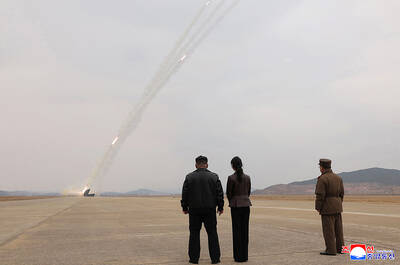
North Korea tested nuclear-capable rocket launchers, state media reported yesterday, a day after Seoul detected the launch of about 10 ballistic missiles. The test comes after South Korean and US forces launched their springtime military drills, due to run until Thursday. North Korean leader Kim Jong-un on Saturday oversaw the testing of the multiple rocket launcher system (MRLS), the Korean Central News Agency (KCNA) said. The test involved 12 600mm-caliber ultra-precision multiple rocket launchers and two artillery companies, it said. Kim said the drill gave Pyongyang’s enemies, within the 420km striking range, a sense of “uneasiness” and “a deep understanding

North Korea yesterday fired about 10 ballistic missiles to the sea toward Japan, the South Korean Joint Chiefs of Staff (JCS) said, days after Pyongyang warned of “terrible consequences” over ongoing South Korea-US military drills. Pyongyang recently dashed hopes of a diplomatic thaw with Seoul, Washington’s security ally, describing its latest peace efforts as a “clumsy, deceptive farce.” Seoul’s military detected “around 10 ballistic missiles launched from the Sunan area in North Korea toward the East Sea [Sea of Japan] at around 1:20pm,” JCS said in a statement, referring to South Korea’s name for the body of water. The missiles


 RSS
RSS