

Chinese President Xi Jinping (習近平) yesterday called on his visiting South Korean counterpart to join Beijing in making the “right strategic choices” in a world that is “becoming more complex and turbulent,” Chinese state media reported.
South Korean President Lee Jae-myung is the first South Korean leader to visit the Chinese capital in six years and his meeting with Xi came a day after nuclear-armed North Korea fired two ballistic missiles into the Sea of Japan.
It also followed a shock US military operation in Caracas that deposed Venezuelan president Nicolas Maduro — a raid condemned by Beijing and Pyongyang.
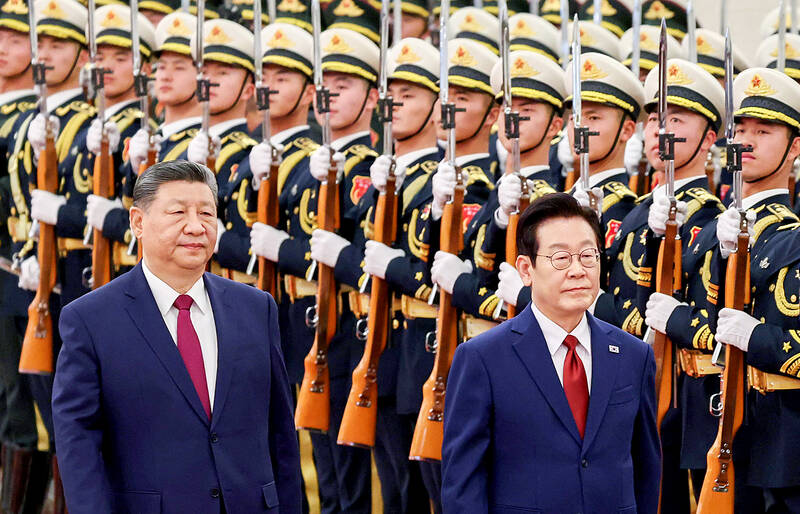
Photo: EPA / Yonhap
Xi yesterday warned that “the world is currently undergoing accelerated changes unseen in a century, and the international situation is becoming more complex and turbulent,” Xinhua news agency reported.
Beijing and Seoul “bear important responsibilities” in upholding peace in the region, Xi said, adding that the sides “have broad common interests.”
“They should firmly stand on the right side of history and make the right strategic choices,” he said.
The South Korean leader said he wished to open a “new phase” in relations, “based on the trust” between himself and Xi.
He vowed to “seek feasible alternatives together for peace on the Korean Peninsula,” footage broadcast by Seoul’s Yonhap news agency showed.
The leaders then witnessed the signing of “15 cooperation documents” spanning technological innovation, the environment, transportation and trade, Xinhua reported.
A state banquet followed the signing of the agreements, the report added.
Lee, accompanied by a delegation of business and tech leaders, hopes to secure pledges to expand economic cooperation with his nation’s largest trading partner.
He has called for South Korea and China to work toward “more horizontal and mutually beneficial” trade.
Lee also met with top executives from both South Korean and Chinese firms at Beijing’s Diaoyutai State Guesthouse, Yonhap reported.
South Korea and China “have helped each other grow through interconnected industrial supply chains and led the global economy,” he told them.
Earlier, Irish Prime Minister Micheal Martin urged “open trade” in talks with Xi in Beijing during a five-day visit aimed at strengthening economic ties with the world’s second-largest economy.
Martin’s China trip, the first by an Irish Taoiseach since 2012, comes against the backdrop of trade tensions between China and the EU, of which Ireland is to assume the rotating presidency in July.
“We believe in open trade, in open relationships and in particular in terms of our trading relationship, we believe it’s fundamental that we try and work towards open trade,” Martin told Xi during talks at Beijing’s Great Hall of the People. “We all to one degree or another depend on each other, and I think if we can maintain that spirit into the future, our relationship will continue to grow and will continue to strengthen.”
Xi hailed growing bilateral trade and investment between the two nations and called for the “long-term, stable development” of ties.
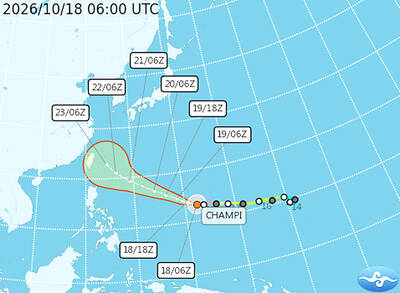
A sea warning for Typhoon Champi could be issued as early as Wednesday night, possibly followed by a land warning on Thursday night or Friday, as the storm approaches Taiwan, the Central Weather Administration (CWA) said yesterday. The typhoon is expected to have its greatest impact on Taiwan on Friday and Saturday, bringing heavy rain to central and northern Taiwan and to Yilan and Hualien counties in the east, CWA forecaster Liu Pei-teng (劉沛滕) said. As of 2pm yesterday, Champi was about 2,470km east-southeast of Oluanpi (鵝鑾鼻), Taiwan’s southernmost tip, moving westnorthwest at 20kph. It had maximum sustained winds of 191kph and a
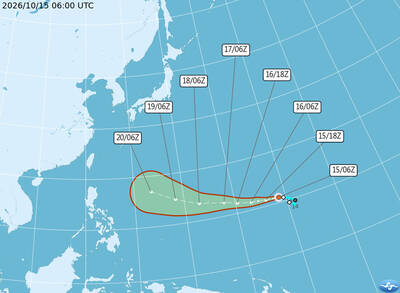
EAST OF GUAM: Tropical Storm Champi is forecast to strengthen into a typhoon, but its effect on Taiwan is uncertain due to the presence of a high-pressure system Tropical Storm Champi formed yesterday and has the potential to increase in strength, the Central Weather Administration (CWA) said yesterday. Forecasters are closely monitoring a Pacific high-pressure system that would dictate whether the storm turns north or moves toward Taiwan next week, the CWA said. The most likely scenario is that it turns northward after passing the Ryukyu Islands, CWA forecaster Cheng Chieh-jen (鄭傑仁) said. As of 8pm yesterday, Champi was east of Guam moving west-northwest at 20kph, CWA data showed. It had maximum sustained winds near the center of 72kph and gusts of up to 101kph, the data showed. If the Pacific high-pressure system
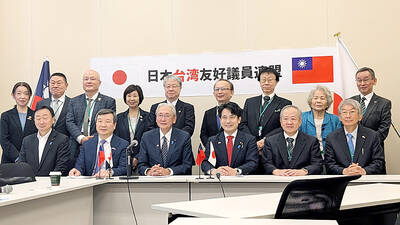
ORIGINS: A Taiwanese doctor practicing in Japan said he no longer needed to cover the nationality label on his license with a sticker, as it used to confuse his patients Starting this month, Taiwanese professionals working in Japan can list “Taiwan” as their place of origin following Tokyo’s easing of rules on “nationality” in official licensing documents. The change was announced yesterday by the Japan-Taiwan Friendship Parliamentarians’ League in Tokyo. The license revision covers 322 professions, including doctors and nurses. Previously, Taiwanese had to list “China” as their nationality on professional certifications and licenses, but the new rules updated the “nationality” to “nationality and region” or “nationality, etc,” allowing Taiwanese to use the name “Taiwan.” The league held a meeting about the revision at the House of Representatives Members’ Office Building in Tokyo
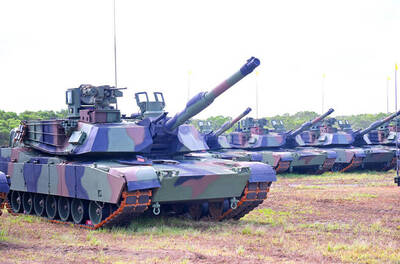
US-made M1A2T Abrams tanks are to participate in a major military exercise for the second time, when the Lien Yung exercise (聯勇操演) begin next month, a military source said yesterday. The army’s 584th Armored Brigade, which operates the US-built tanks, has already transported them to the Joint Operations Training Base in Pingtung County for the drills from late next month to December, the source said. During the month-long joint military exercise in southern Taiwan, the tanks’ crew would test their combat coordination, said the source, who asked not to be named. The M1A2T Abrams tanks were included in a major Taiwanese military exercise


 RSS
RSS