


The Centers for Disease Control (CDC) said it is planning to expand eligibility for publicly funded HIV treatment for foreign nationals next year, but has not revealed details of the plan.
CDC Director-General Philip Lo (羅一鈞) on Monday last week said that subsidy regulations are being revised and eligibility for publicly funded treatment for foreign residents would be expanded.
Lo at the time said the expansion would initially prioritize foreign nationals holding permanent residency and those younger than 18, but he offered no other details.
Photo: Lin Huei-chin, Taipei Times
When the CDC was asked last week about how many more foreign nationals would become eligible for publicly funded treatment, it said it was still assessing the potential impact and “has no clear figure yet.”
Under the existing support program, the CDC covers costs for an HIV patient’s first two years on medication, after which expenses are covered by the National Health Insurance (NHI) system.
As of late last month, 36,494 Taiwanese nationals and 615 foreign nationals in Taiwan were HIV-positive, the CDC said on Friday last week.
Of the 615 foreign nationals, 343 were already covered under the NHI system, while the others have been on medication for less than two years and were not yet eligible for NHI coverage, but some have received financial help in other ways, it said.
Those on medication are treated with highly active antiretroviral therapy, commonly known as “cocktail therapy” combining at least two to three antiretroviral drugs, with monthly medication costs capped at NT$13,200.
The enrollment quota for the publicly funded HIV pre-exposure prophylaxis (PrEP) program would also be increased next year to 9,500 people from 8,000 this year, Lo said.
The program, designed to prevent the incidence of HIV, is open to Taiwanese and their foreign spouses who meet the criteria and are assessed by physicians, the CDC said.
Taiwan was expected to record about 850 new HIV cases this year, the lowest level since 2003 and down about 11 percent to 12 percent from last year, in part because of the PrEP program, Lo said.
Meanwhile, other new measures to take effect starting next year include the expansion of fertility subsidies, which would apply to women who are enrolled in social insurance (including foreign spouses of Taiwanese) and mothers of newborns who are not enrolled in social insurance.
The subsidy amount would be NT$100,000 per child, which would increase based on the number of babies, such as twins or multiple births.
The adult pneumococcal vaccine program would be launched on Jan. 15 next year. It would cover people aged 65 or older, indigenous people aged 55 to 64, and people aged 19 to 64 at high risk for invasive pneumococcal disease. The vaccine would be provided in two phases under the public subsidy program, allowing people to save about NT$4,500 in out-of-pocket costs.
From Thursday to Feb. 28 next year, the scope of free public COVID-19 vaccinations would also be expanded. Anyone aged six months or older who has not yet received the vaccine would be eligible for a free shot. The cost of the COVID-19 vaccine when paid privately is at least NT$4,000.
Nationwide gastric cancer screening would also be introduced next year, offering a one-time Helicobacter pylori screening for people aged 45 to 79.

The Taiwanese passport ranked 33rd in a global listing of passports by convenience this month, rising three places from last month’s ranking, but matching its position in January last year. The Henley Passport Index, an international ranking of passports by the number of designations its holder can travel to without a visa, showed that the Taiwan passport enables holders to travel to 139 countries and territories without a visa. Singapore’s passport was ranked the most powerful with visa-free access to 192 destinations out of 227, according to the index published on Tuesday by UK-based migration investment consultancy firm Henley and Partners. Japan’s and

NATIONAL SECURITY THREAT: An official said that Guan Guan’s comments had gone beyond the threshold of free speech, as she advocated for the destruction of the ROC China-born media influencer Guan Guan’s (關關) residency permit has been revoked for repeatedly posting pro-China content that threatens national security, the National Immigration Agency said yesterday. Guan Guan has said many controversial things in her videos posted to Douyin (抖音), including “the red flag will soon be painted all over Taiwan” and “Taiwan is an inseparable part of China,” while expressing hope for expedited “reunification.” The agency received multiple reports alleging that Guan Guan had advocated for armed reunification last year. After investigating, the agency last month issued a notice requiring her to appear and account for her actions. Guan Guan appeared as required,

Japan and the Philippines yesterday signed a defense pact that would allow the tax-free provision of ammunition, fuel, food and other necessities when their forces stage joint training to boost deterrence against China’s growing aggression in the region and to bolster their preparation for natural disasters. Japan has faced increasing political, trade and security tensions with China, which was angered by Japanese Prime Minister Sanae Takaichi’s remark that a Chinese attack on Taiwan would be a survival-threatening situation for Japan, triggering a military response. Japan and the Philippines have also had separate territorial conflicts with Beijing in the East and South China
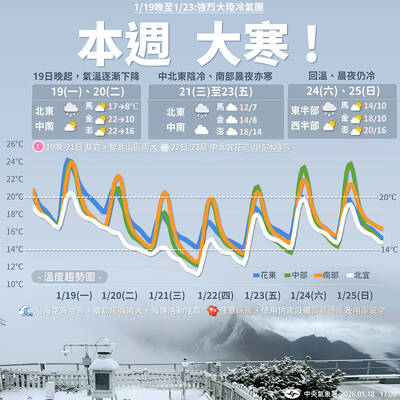
A strong cold air mass is expected to arrive tonight, bringing a change in weather and a drop in temperature, the Central Weather Administration (CWA) said. The coldest time would be early on Thursday morning, with temperatures in some areas dipping as low as 8°C, it said. Daytime highs yesterday were 22°C to 24°C in northern and eastern Taiwan, and about 25°C to 28°C in the central and southern regions, it said. However, nighttime lows would dip to about 15°C to 16°C in central and northern Taiwan as well as the northeast, and 17°C to 19°C elsewhere, it said. Tropical Storm Nokaen, currently


 RSS
RSS