


Voters yesterday trickled to Myanmar’s heavily restricted polls, with the ruling junta touting the exercise as a return to democracy five years after it ousted the last elected government and triggered a civil war.
Former civilian leader Aung San Suu Kyi remains jailed, while her hugely popular party has been dissolved and was not taking part.
Campaigners, Western diplomats and the UN rights chief have condemned the phased month-long vote, citing a ballot stacked with military allies and a stark crackdown on dissent.
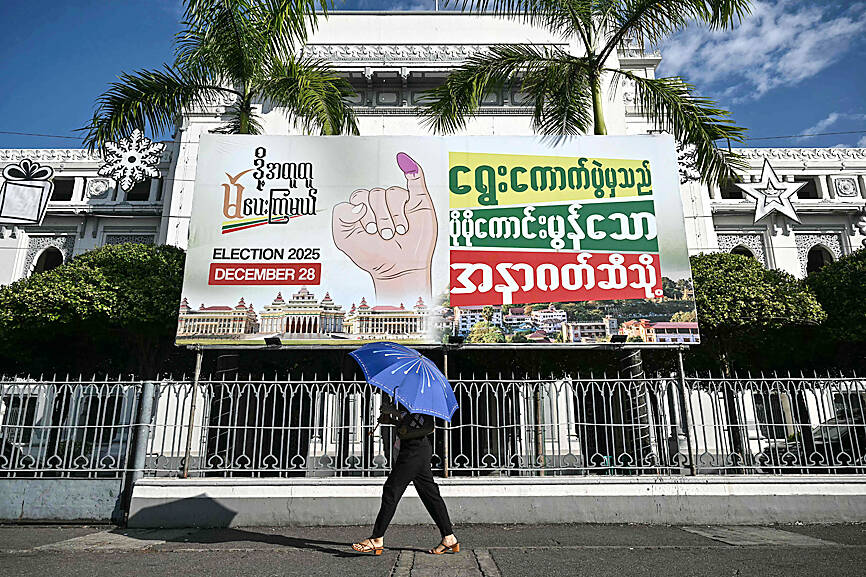
Photo: AFP
The pro-military Union Solidarity and Development Party is widely expected to emerge as the largest bloc, in what critics say would be a rebranding of martial rule.
“We guarantee it to be a free and fair election,” junta chief Min Aung Hlaing told reporters after casting his ballot in the capital, Naypyidaw.
“It’s organized by the military, we can’t let our name be tarnished,” he said.
The Southeast Asian nation of about 50 million people is riven by civil war, and there would be no voting in areas controlled by rebel factions that have risen up to challenge military rule.
While opposition factions threatened to attack the election, there were no reports of violence against polling day activities by the time voting ended at 4pm.
Snaking queues of voters formed for the previous election in 2020, which the military declared void a few months later when it ousted Aung San Suu Kyi and seized power.
However, when a polling station near her vacant home closed yesterday, only about 470 of its roughly 1,700 registered voters had cast ballots, an election official said — a turnout of less than 28 percent.
Its first voter, Bo Saw, 63, said the election “will bring the best for the country.”
“The first priority should be restoring a safe and peaceful situation,” he said.
At a downtown Yangon station near the gleaming Sule Pagoda — the site of huge pro-democracy protests after the 2021 coup — 45-year-old Swe Maw dismissed international criticism.
“There are always people who like and dislike,” he said at a polling station that later reported a turnout of below 37 percent.
The run-up saw none of the feverish public rallies that Aung San Suu Kyi once commanded, and the junta has waged a withering prevote offensive to claw back territory.
“I don’t think this election will change or improve the political situation in this country,” said 23-year-old Hman Thit, displaced by the post-coup conflict.
“I think the airstrikes and atrocities on our hometowns will continue,” he said in a rebel-held area of Pekon township in Shan state.
The military ruled Myanmar for most of its post-independence history, before a 10-year interlude saw a civilian government take the reins in a burst of optimism and reform.
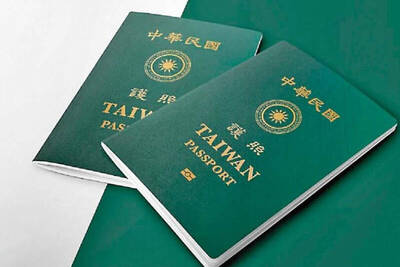
The Taiwanese passport ranked 33rd in a global listing of passports by convenience this month, rising three places from last month’s ranking, but matching its position in January last year. The Henley Passport Index, an international ranking of passports by the number of designations its holder can travel to without a visa, showed that the Taiwan passport enables holders to travel to 139 countries and territories without a visa. Singapore’s passport was ranked the most powerful with visa-free access to 192 destinations out of 227, according to the index published on Tuesday by UK-based migration investment consultancy firm Henley and Partners. Japan’s and

NATIONAL SECURITY THREAT: An official said that Guan Guan’s comments had gone beyond the threshold of free speech, as she advocated for the destruction of the ROC China-born media influencer Guan Guan’s (關關) residency permit has been revoked for repeatedly posting pro-China content that threatens national security, the National Immigration Agency said yesterday. Guan Guan has said many controversial things in her videos posted to Douyin (抖音), including “the red flag will soon be painted all over Taiwan” and “Taiwan is an inseparable part of China,” while expressing hope for expedited “reunification.” The agency received multiple reports alleging that Guan Guan had advocated for armed reunification last year. After investigating, the agency last month issued a notice requiring her to appear and account for her actions. Guan Guan appeared as required,
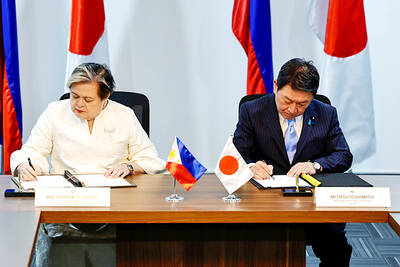
Japan and the Philippines yesterday signed a defense pact that would allow the tax-free provision of ammunition, fuel, food and other necessities when their forces stage joint training to boost deterrence against China’s growing aggression in the region and to bolster their preparation for natural disasters. Japan has faced increasing political, trade and security tensions with China, which was angered by Japanese Prime Minister Sanae Takaichi’s remark that a Chinese attack on Taiwan would be a survival-threatening situation for Japan, triggering a military response. Japan and the Philippines have also had separate territorial conflicts with Beijing in the East and South China
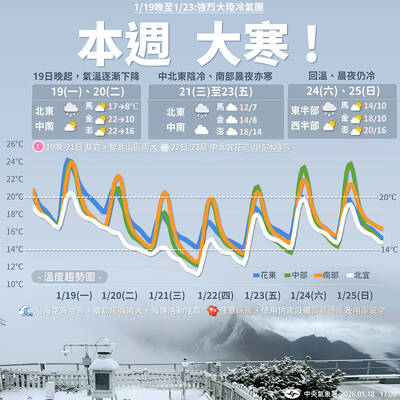
A strong cold air mass is expected to arrive tonight, bringing a change in weather and a drop in temperature, the Central Weather Administration (CWA) said. The coldest time would be early on Thursday morning, with temperatures in some areas dipping as low as 8°C, it said. Daytime highs yesterday were 22°C to 24°C in northern and eastern Taiwan, and about 25°C to 28°C in the central and southern regions, it said. However, nighttime lows would dip to about 15°C to 16°C in central and northern Taiwan as well as the northeast, and 17°C to 19°C elsewhere, it said. Tropical Storm Nokaen, currently


 RSS
RSS