


The number of households with elderly members has increased by 1.15 million over the past decade, creating a growing scene of aging families across the nation, Ministry of the Interior data showed.
The latest data from the ministry’s Real Estate Information platform showed that as of September, the number of registered households nationwide exceeded 9.83 million, of which more than 3.42 million included at least one elderly resident or 34.79 percent.
The figure represented an increase of about 1.15 million households with elderly residents, compared with about 2.27 million such households, or 26.61 percent, in September 2016 — an increase of more than 8 percentage points over the past decade.

Photo: Hsu Yi-ping, Taipei Times
Post-World War II baby boomers are gradually entering the silver-haired generation, Sinyi Realty Inc (信義房屋) research manager Tseng Ching-der (曾敬德) said.
Common scenarios include adult children moving out to start their own families, parents requiring care, or living with their children, he said.
As the population ages, the elderly dependency ratio is rising, he added.
The elderly dependency ratio stood at about 27.76 percent last year, up from 17.96 percent in 2016 — an increase of 9.8 percentage points over 10 years, data showed.
The youth dependency ratio fell to about 16.96 percent last year from 18.17 percent in 2016 — a decline of 1.21 percentage points, they showed.
As more young people delay, or forgo marriage or having children, and increasingly live with their parents, households with one or more elderly members are becoming more common than those with children, real-estate industry analysts said.
The average number of people per registered household has remained below three for three consecutive quarters, ministry data showed.
The trend reflects not only the decline of extended families, but also a drop in the number of households headed by married couples with children, property market analysts said.
Taiwan’s low birthrate has driven household structures to shift from multigenerational families to single-generation households, housing researcher Ho Shih-chang (何世昌) said.
There is a growing number of childless households, he added, calling it a national security crisis.
Meanwhile, as separate household registrations become more common, the total number of registered households is expected to continue increasing even as the population enters negative growth, likely surpassing 10 million, he said.
Taiwan’s household size is expected to continue declining and gradually approach two people per household, he said, adding that homes would become smaller, a trend he said would be difficult to reverse.
The underlying causes extend beyond high housing prices to include complex changes in family values, and attitudes toward marriage and childbearing, making the issue unlikely to be resolved through any single policy measure, he said.
Family structures have been rapidly evolving alongside urbanization and broader social trends, driving a continued decline in the average household size, Tseng said.
The population is divided into three age groups: children younger than 14, working-age people from 15 to 64 years old, and people aged 65 or above, Colliers International Taiwan director Huang Shu-wei (黃舒衛) said.
In 2000, children accounted for 21 percent of the population, while elderly people made up 9 percent, he said.
However, by 2016, the share of elderly people had risen to 14 percent, overtaking the proportion of children at 13 percent, he said.
By last year, the elderly accounted for 20 percent of the population, meaning one in every five people was aged 65 or older, while the share of children fell to just 12 percent, he added.
Over the years, the number of children has dropped from 4.7 million to 2.74 million — a decline of 42 percent, while the elderly population has surged from 1.92 million to 4.49 million — an increase of 134 percent, Huang said.
Meanwhile, the working-age population has also been shrinking year by year since 2015, with insufficient new entrants to bolster the workforce, and even the core working-age group beginning to shrink, he said.
A super-aged society is exerting gradual, but profound effects on labor supply, family caregiving, intergenerational equity, insurance system stability and asset distribution, he said, adding that these pressures would eventually converge on housing-related issues.
As Taiwan moves toward a super-aged society, older homes can no longer rely solely on redevelopment for renewal, he said.
The slow pace of urban renewal and dangerous building reconstruction projects cannot meet the demands of societal changes, he said.
Addressing elderly residents’ safety and accessibility issues through renovation, rehabilitation and maintenance would become a key focus in the market, Huang said.
The urgency of introducing artificial intelligence and smart building technologies is likely to grow under mounting labor shortages, potentially becoming an even more critical housing issue than green buildings or renewable energy in the future, he added.

The Taiwanese passport ranked 33rd in a global listing of passports by convenience this month, rising three places from last month’s ranking, but matching its position in January last year. The Henley Passport Index, an international ranking of passports by the number of designations its holder can travel to without a visa, showed that the Taiwan passport enables holders to travel to 139 countries and territories without a visa. Singapore’s passport was ranked the most powerful with visa-free access to 192 destinations out of 227, according to the index published on Tuesday by UK-based migration investment consultancy firm Henley and Partners. Japan’s and

NATIONAL SECURITY THREAT: An official said that Guan Guan’s comments had gone beyond the threshold of free speech, as she advocated for the destruction of the ROC China-born media influencer Guan Guan’s (關關) residency permit has been revoked for repeatedly posting pro-China content that threatens national security, the National Immigration Agency said yesterday. Guan Guan has said many controversial things in her videos posted to Douyin (抖音), including “the red flag will soon be painted all over Taiwan” and “Taiwan is an inseparable part of China,” while expressing hope for expedited “reunification.” The agency received multiple reports alleging that Guan Guan had advocated for armed reunification last year. After investigating, the agency last month issued a notice requiring her to appear and account for her actions. Guan Guan appeared as required,

Japan and the Philippines yesterday signed a defense pact that would allow the tax-free provision of ammunition, fuel, food and other necessities when their forces stage joint training to boost deterrence against China’s growing aggression in the region and to bolster their preparation for natural disasters. Japan has faced increasing political, trade and security tensions with China, which was angered by Japanese Prime Minister Sanae Takaichi’s remark that a Chinese attack on Taiwan would be a survival-threatening situation for Japan, triggering a military response. Japan and the Philippines have also had separate territorial conflicts with Beijing in the East and South China
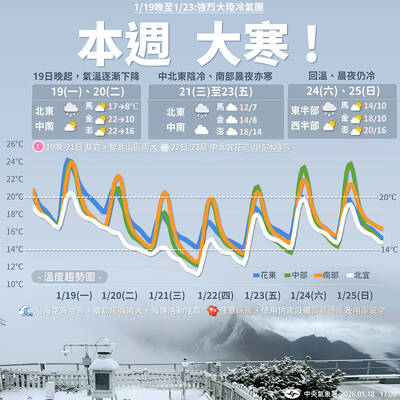
A strong cold air mass is expected to arrive tonight, bringing a change in weather and a drop in temperature, the Central Weather Administration (CWA) said. The coldest time would be early on Thursday morning, with temperatures in some areas dipping as low as 8°C, it said. Daytime highs yesterday were 22°C to 24°C in northern and eastern Taiwan, and about 25°C to 28°C in the central and southern regions, it said. However, nighttime lows would dip to about 15°C to 16°C in central and northern Taiwan as well as the northeast, and 17°C to 19°C elsewhere, it said. Tropical Storm Nokaen, currently


 RSS
RSS