


Thailand and Cambodia yesterday ended weeks of fierce border clashes with a second ceasefire in the worst fighting in years between the Southeast Asian nations.
The ceasefire was holding, Thai Ministry of Defense spokesperson Surasant Kongsiri said about two hours after it went into effect at noon.
“So far there’s been no report of gunfire,” he said.
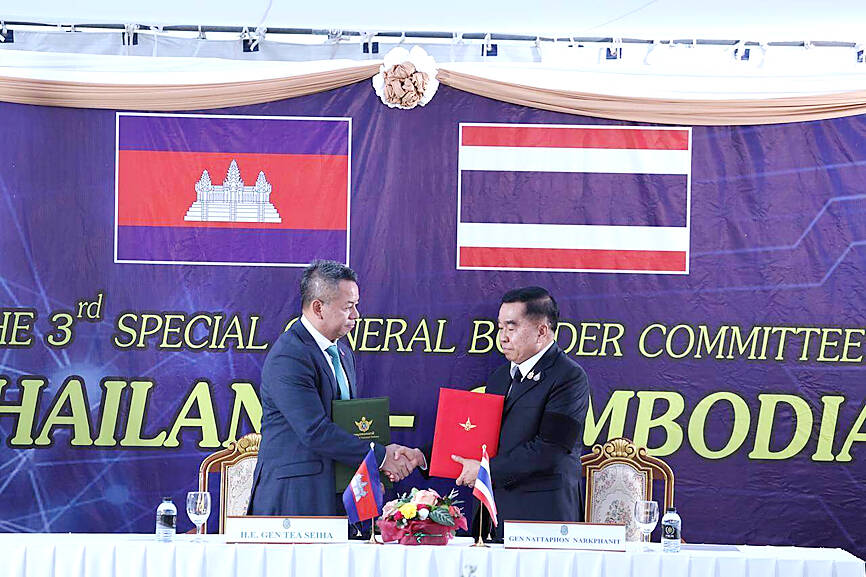
Photo: AKP via AP
The Cambodian Ministry of National Defense did not report any clashes after what it said had been a Thai airstrike earlier in the day, before the ceasefire announcement.
The agreement, signed by Thai Minister of Defense Natthaphon Narkphanit and his Cambodian counterpart Tea Seiha, ended 20 days of fighting that killed at least 101 people and displaced more than half a million on both sides, and included fighter-jet sorties, exchanges of rocket fire and artillery barrages.
“Both sides agree to maintain current troop deployments without further movement,” the ministers said in a joint statement. “Any reinforcement would heighten tensions and negatively affect long-term efforts to resolve the situation.”
Cambodia’s top diplomat, Prak Sokhonn, and his Thai counterpart, Sihasak Phuangketkeow, are to meet with Chinese Minister of Foreign Affairs Wang Yi (王毅) in China today and tomorrow to discuss the border situation, the Cambodian Ministry of Foreign Affairs and a Thai official said.
The new ceasefire would be monitored by an observer team from the ASEAN bloc as well as direct coordination between both countries, Natthaphon said.
“At the same time, at the policy level, there will be direct communication between the minister of defense and chief of the armed forces of both sides,” he said.
An earlier ceasefire broke down this month, with each side accusing the other of moves that led to clashes. The new ceasefire came after a special meeting on Monday of ASEAN foreign ministers in Kuala Lumpur, followed by three days of talks between the warring sides at a border checkpoint, where the two defense ministers met yesterday.
They agreed on the return of people displaced from affected border areas, while underlining that neither side would use any force against civilians.
Thailand would also return 18 Cambodian soldiers in its custody since the July clashes if the ceasefire is fully maintained for 72 hours, according to the agreement.
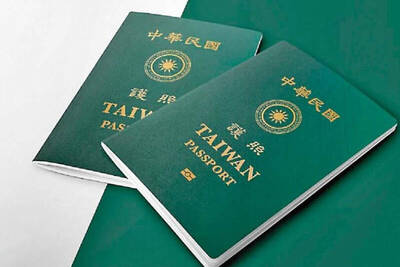
The Taiwanese passport ranked 33rd in a global listing of passports by convenience this month, rising three places from last month’s ranking, but matching its position in January last year. The Henley Passport Index, an international ranking of passports by the number of designations its holder can travel to without a visa, showed that the Taiwan passport enables holders to travel to 139 countries and territories without a visa. Singapore’s passport was ranked the most powerful with visa-free access to 192 destinations out of 227, according to the index published on Tuesday by UK-based migration investment consultancy firm Henley and Partners. Japan’s and

NATIONAL SECURITY THREAT: An official said that Guan Guan’s comments had gone beyond the threshold of free speech, as she advocated for the destruction of the ROC China-born media influencer Guan Guan’s (關關) residency permit has been revoked for repeatedly posting pro-China content that threatens national security, the National Immigration Agency said yesterday. Guan Guan has said many controversial things in her videos posted to Douyin (抖音), including “the red flag will soon be painted all over Taiwan” and “Taiwan is an inseparable part of China,” while expressing hope for expedited “reunification.” The agency received multiple reports alleging that Guan Guan had advocated for armed reunification last year. After investigating, the agency last month issued a notice requiring her to appear and account for her actions. Guan Guan appeared as required,
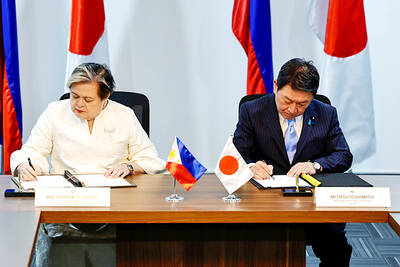
Japan and the Philippines yesterday signed a defense pact that would allow the tax-free provision of ammunition, fuel, food and other necessities when their forces stage joint training to boost deterrence against China’s growing aggression in the region and to bolster their preparation for natural disasters. Japan has faced increasing political, trade and security tensions with China, which was angered by Japanese Prime Minister Sanae Takaichi’s remark that a Chinese attack on Taiwan would be a survival-threatening situation for Japan, triggering a military response. Japan and the Philippines have also had separate territorial conflicts with Beijing in the East and South China
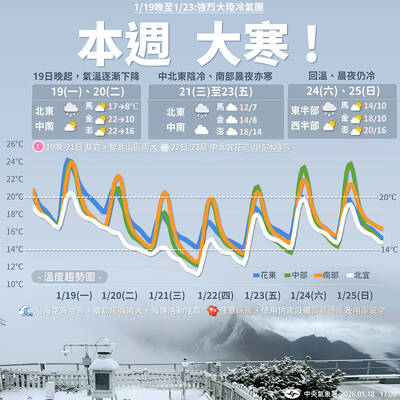
A strong cold air mass is expected to arrive tonight, bringing a change in weather and a drop in temperature, the Central Weather Administration (CWA) said. The coldest time would be early on Thursday morning, with temperatures in some areas dipping as low as 8°C, it said. Daytime highs yesterday were 22°C to 24°C in northern and eastern Taiwan, and about 25°C to 28°C in the central and southern regions, it said. However, nighttime lows would dip to about 15°C to 16°C in central and northern Taiwan as well as the northeast, and 17°C to 19°C elsewhere, it said. Tropical Storm Nokaen, currently


 RSS
RSS