


The Executive Yuan yesterday approved amendments to the Act Governing Relations Between the People of the Taiwan Area and the Mainland Area (臺灣地區與大陸地區人民關係條例) that would require legislators to obtain approval before traveling to China.
Under the draft amendments, civil servants ranked below “grade 10” who are not involved in classified work would be required to obtain approval from their agencies before traveling to China.
Legislators and personnel who are aware of or possess state secrets would be required to obtain approval from a joint review committee composed of members from the Ministry of the Interior, the National Security Bureau, the Ministry of Justice, the Mainland Affairs Council and other agencies.
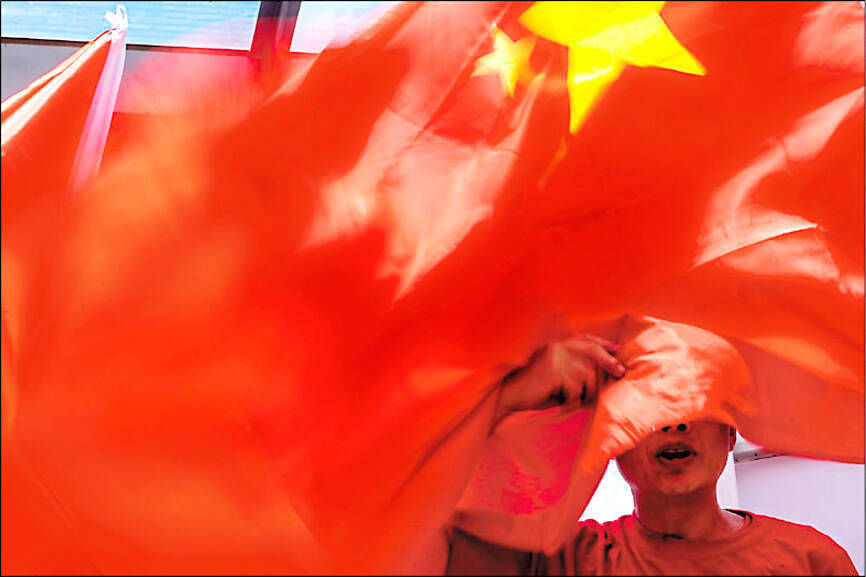
Photo: Bloomberg
The amendments also mandate elected public officials to publicly disclose all contact with the Chinese Communist Party (CCP), or the Chinese government, military, administrative or other politically affiliated agencies during their trips.
Upon returning to Taiwan, they must submit the details of their contacts, including the time, location, purpose and content of the meeting, to the authorities, which would then publicly disclose the information.
Meanwhile, those who previously held certain positions would be prohibited from attending Chinese government or military ceremonies, activities that undermine national dignity and events organized by CCP entities that advocate eliminating or downgrading Taiwanese sovereignty.
People who handle classified information, or who learn of, possess or safeguard state secrets would face fines ranging from NT$2 million to NT$10 million (US$63,583 to US$317,914) for unauthorized travel to China, in accordance with the Classified National Security Information Protection Act (國家機密保護法).
The changes aim to counter the CCP’s intensified “united front” efforts and infiltration targeting Taiwan, thereby safeguarding national security and stability, the Cabinet said.
Existing regulations on public servants’ travel to China are insufficient, especially for those involved in national security or who have access to classified information, it said.
Contacts between elected public officials and China also lack transparency, limiting public oversight, it added.
The proposed amendments are to be submitted to the Legislative Yuan for deliberation.
Chinese Nationalist Party (KMT) Legislator Chen Yu-jen (陳玉珍) yesterday asked whether the government has already made up its mind and wanted to go to war, and added that only more communication could bring about goodwill.
“What we need to do is engage in more exchanges and better understanding, so we can know what the government and the people on the other side of the Strait are thinking,” she said. “By understanding their public opinion, we can also influence the overall social atmosphere.”
The ruling party should focus more on people’s livelihoods and do things that benefit the nation and the people, and less on ideological matters, she added.
Democratic Progressive Party Legislator Puma Shen (沈伯洋) said lawmakers are the highest risk, as they are easily exposed to state secrets, as well as local leaders, adding that they could easily travel to China without scrutiny.
It is impossible to know how many times a legislator visits China or who they meet, he said.
It is not that they cannot go, but there needs to be transparency, so that they could be accountable to the public, Shen said, adding that current regulations apply to government officials, but when the law was enacted, it did not include elected representatives, which is a legal oversight.
Additional reporting by Lin Hsin-han and Chen Cheng-yu
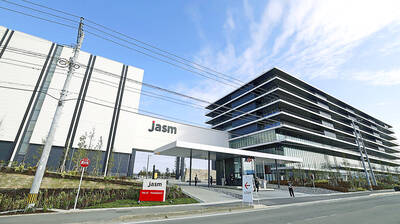
The subsidiary of Taiwan Semiconductor Manufacturing Co (TSMC, 台積電) in Kumamoto, Japan, turned a profit in the first quarter of this year, marking the first time the first fab of the unit has become profitable since mass production started at the end of 2024. According to the contract chipmaker’s financial statement released on Friday, Japan Advanced Semiconductor Manufacturing Inc (JASM), a joint venture running the fab in Kumamoto, posted NT$951 million (US$30.19 million) in profit in the January-to-March period, compared with a loss of NT$1.39 billion in the previous quarter, and a loss of NT$3.25 billion in the first quarter of

DRONE CENTRAL: Taiwan aims to become Asia’s democratic hub for drones, with most exports focused on high-quality military-grade models, an official said Taiwan’s drone industry is expected to expand significantly by 2030, producing 100,000 units per month and exporting half of them, the Ministry of Economic Affairs said yesterday. Current drone production capacity is about 15,000 units per month, but the industry can quickly scale up as demand increases, Industrial Development Administration Director-General Chiou Chyou-huey (邱求慧) told a news conference in Taipei. Taiwan’s drone output grew 2.5-fold last year to NT$12.9 billion (US$408.3 million) under a government program to develop the uncrewed vehicle sector, he said. The Executive Yuan in October last year approved plans to invest NT$44.2 billion into domestic production of uncrewed aerial
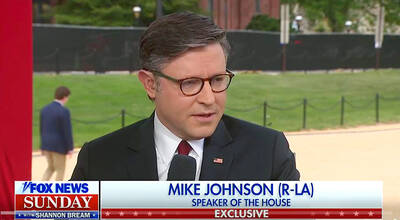
RESOLUTE BACKING: Two Republican senators are planning to introduce legislation that would impose immediate sanctions on China if it attempts to invade Taiwan US House of Representatives Speaker Mike Johnson on Sunday reaffirmed US congressional support for Taiwan, saying the US and “all freedom-loving people” have a stake in preventing China from seizing Taiwan by force. Johnson made the remarks in an interview with Fox News Sunday on US President Donald Trump’s summit with Chinese President Xi Jinping (習近平) last week. In an interview that aired on Friday on Fox News, just as Trump wrapped up a high-stakes visit to China, he said he has yet to green-light a new US$14 billion arms package to Taiwan and that it “depends on China.” “It’s a very good
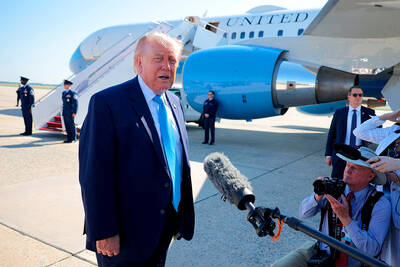
US President Donald Trump yesterday said he would speak to President William Lai (賴清德) as his administration considers whether to move ahead with a US$14 billion weapons sale to Taiwan — a potential arms deal that has drawn criticism from China. “Well, I’ll speak to him. I speak to everybody,” Trump told reporters yesterday when asked if he had any plans to call his counterpart, although he did not offer a time frame for when such a conversation could take place. Trump previously said he would speak to the person “that’s running Taiwan,” without specifying who he meant. “We have that situation very


 RSS
RSS