


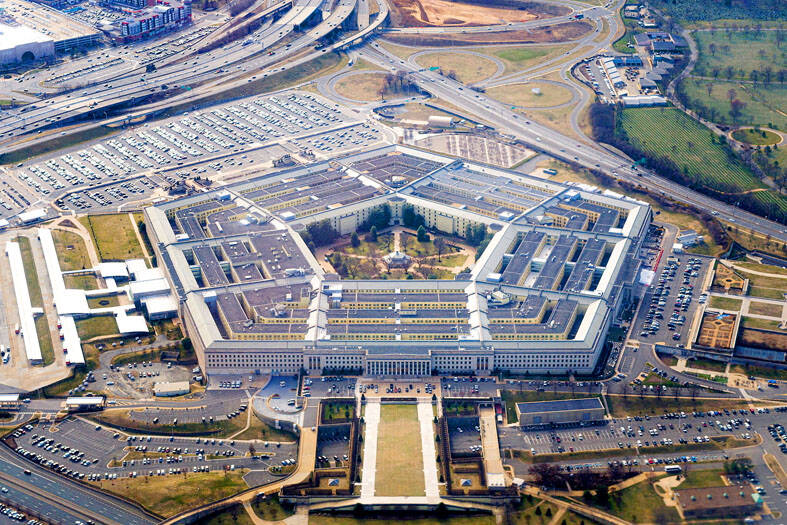
Beijing could eventually see a full invasion of Taiwan as the only “prudent” way to bring about unification, the US Department of Defense said in an annual report to the US Congress on Tuesday.
The Pentagon’s Annual Report to Congress: Military and Security Developments Involving the People’s Republic of China 2025, was in many ways similar to last year’s report, but reorganized the analysis of the options China has to take over Taiwan.
Beijing’s leaders generally view the Chinese People’s Liberation Army’s (PLA) capabilities for a Taiwan campaign as improving, but they remain uncertain about its readiness to seize the nation while countering potential US involvement, the report said.
Photo, Reuters
Beijing is busy refining several military options to force unification with Taiwan, ranging from coercive actions short of war to a full-scale “joint island landing campaign” (JILC), it said.
A landing campaign involving a large-scale amphibious invasion of Taiwan would be the most decisive and riskiest option, it said.
It would require highly complex, coordinated operations to “break through Taiwan’s shore defenses and establish a beachhead that allowed the PLA to build up enough combat power to seize key targets or territory to force unification,” the report said.
However, despite the risks and Beijing’s preference for less dramatic options, “it is preparing for a JILC and could determine that it is the only prudent option for compelling unification,” it said.
“We lack information about whether Beijing has determined the viability of other unification options, and the decisiveness of a JILC will probably make it an increasingly more appealing option as the decision space for other options is constrained,” it said.
The three less-dramatic options, also covered in last year’s report, were coercion short of war, a joint firepower strike campaign and a joint blockade campaign.
Over the past year, the PLA has conducted operations exercising key elements of those options, including drills focused on blockading key ports, striking sea and land targets, and countering possible US military intervention.
Coercion could include of combining escalating military pressure with economic, informational and diplomatic tools to compel Taipei’s capitulation and could include cyberattacks, electronic warfare or conventional strikes against Taiwan’s political, military and communications infrastructure, the report said.
The goal would be to instill fear and degrade public confidence, with the aim of forcing negotiations on Beijing’s terms without launching a full invasion, it said.
The success of that option would depend heavily on Taiwan’s resilience and will to resist Chinese coercion, as well as external support from the US and others, it said.
A joint firepower strike campaign would involve missile and aircraft strikes against key government and military targets “to degrade Taiwan’s defenses, decapitate its military and political leadership or undermine the public’s resolve to resist,” it said.
Such operations would require complex coordination across PLA services, potentially limiting their effectiveness, it said.
A joint blockade campaign would employ maritime and air blockades to cut off Taiwan’s vital imports over weeks or months while conducting missile strikes and possible seizure of Taiwan’s outlying islands “to compel Taiwan to negotiate or surrender,” it said.
The report did not offer any assessment of the factors that would determine the potential success or failure of a blockade strategy.
In Taipei, National Security Institute deputy secretary-general Ho Cheng-hui (何澄輝) said that the expansion of Chinese military capabilities has reached “crisis proportions” for Taiwan, as the strength of the US and its allies would be at an ebb in 2027.
Taiwan bolstering its defensive capabilities would decrease the risk of conflict, Ho said.
Conversely, if the defense budget is frozen, Taiwan’s military would essentially be disarmed, which would lower the threshold China must match to launch an invasion, he said.
“The US is voicing its opinion in an unusually public manner to prevent Taiwan from weakening itself into a tailspin of escalating risks just as the window of vulnerability opens in 2027,” Ho said.
The US deterrence strategy is predicated on bolstering the budgets and military capabilities along the first island chain to make a war too costly to contemplate for Beijing, Institute for National Defense and Security Research analyst Shen Ming-shih (沈明室) said.
Taiwan’s refusal to arm itself while other nations in the first island chain are bolstering their defenses not only goes against the US’ strategic vision, but would open a gap on the line of defense at its most threatened point, Shen said.
Additional reporting by Fang Wei-li

SILENCING CRITICS: In addition to blocking Taiwan, China aimed to prevent rights activists from speaking out against authoritarian states, a Cabinet department said The Ministry of Foreign Affairs (MOFA) yesterday condemned transnational repression by Beijing after RightsCon, a major digital human rights conference scheduled to be held in Zambia this week, was abruptly canceled due to Chinese pressure over Taiwanese participation. This year’s RightsCon, the world’s largest conference discussing issues “at the intersection of human rights and technology,” was scheduled to take place from tomorrow to Friday in Lusaka, and expected to draw 2,600 in-person attendees from 150 countries, along with 1,100 online participants. However, organizers were forced to cancel the event due to behind-the-scenes pressure from China, the ministry said, expressing its “strongest condemnation”
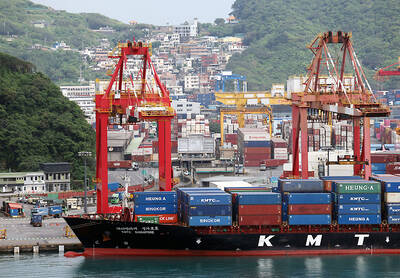
Taiwan’s economy grew far faster than expected in the first quarter, as booming demand for artificial intelligence (AI) applications drove a surge in exports, spilling over into investment and consumption, the Directorate-General of Budget, Accounting and Statistics (DGBAS) said yesterday. GDP growth was 13.69 percent year-on-year during the January-to-March period, beating the DGBAS’ February forecast by 2.23 percentage points and marking the most robust growth in nearly four decades, DGBAS senior official Chiang Hsin-yi (江心怡) told a news conference in Taipei. The result was powered by exports, which remain the backbone of Taiwan’s economy, Chiang said. Outbound shipments jumped 51.12 percent year-on-year to
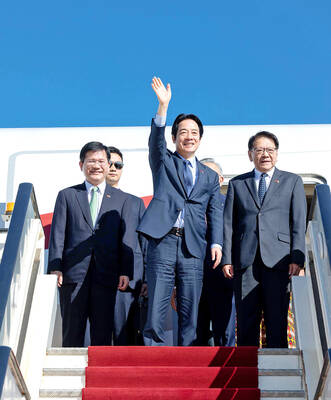
DELAYED BUT DETERMINED: The president’s visit highlights Taiwan’s right to international engagement amid regional pressure from China President Willaim Lai (賴清德) yesterday arrived in Eswatini, more than a week after his planned visit to Taiwan’s sole African ally was suspended because of revoked overflight permits. “The visit, originally scheduled for April 22, was postponed due to unforeseen external factors,” Lai wrote on social media. “After several days of careful arrangements by our diplomatic and national security teams, we successfully arrived today.” Lai said he looked forward to further deepening Taiwan-Eswatini relations through closer cooperation in the economy, agriculture, culture and education, as well as advancing the nation’s international partnerships. The president was initially scheduled to arrive in time to celebrate
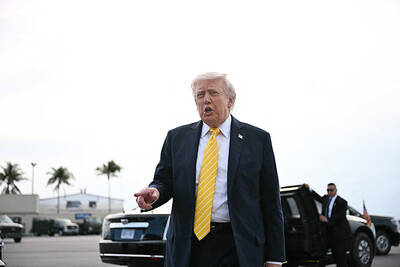
Iran’s Islamic Revolutionary Guard Corp (IRGC) yesterday said the US faced a choice between an “impossible” military operation or a “bad deal” with Tehran, after US President Donald Trump disparaged Iran’s latest peace proposal. Negotiations between the two countries have been deadlocked since a ceasefire came into effect on April 8, with only one round of direct peace talks held so far. Iran’s Tasnim and Fars news agencies reported that Tehran had submitted a 14-point proposal to mediator Pakistan, but Trump was quick to cast doubt on it. “I will soon be reviewing the plan that Iran has just sent to us, but


 RSS
RSS