


The US Department of State on Tuesday said that it would deny visas to a former EU commissioner and four others, accusing them of seeking to “coerce” US social media platforms into censoring viewpoints they oppose.
“These radical activists and weaponized NGOs [non-governmental organizations] have advanced censorship crackdowns by foreign states — in each case targeting American speakers and American companies,” the department said in a statement announcing the sanctions.
The measure targeted Thierry Breton, the former top tech regulator at the European Commission, who often clashed with tech tycoons over their obligations to follow EU rules.
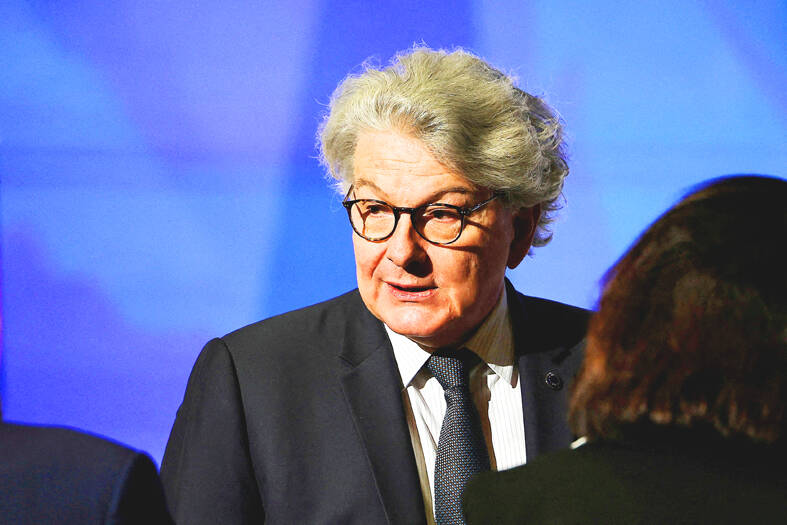
Photo: Reuters
Breton was described by the department as the “mastermind” of the EU’s Digital Services Act (DSA), a major piece of legislation that imposes content moderation and other standards on major social media platforms operating in Europe.
French Minister for Europe and Foreign Affairs Jean-Noel Barrot said on X that his country “strongly condemns” the visa restrictions, adding that Europe “cannot let the rules governing their digital space be imposed by others upon them.”
“The Digital Services Act was democratically adopted in Europe... it has absolutely no extraterritorial reach and in no way affects the United States,” Barrot said.
The DSA stipulates that major platforms must explain content-moderation decisions, provide transparency for users and ensure researchers can carry out essential work, such as understanding how much children are exposed to dangerous content.
Breton, who left the European Commission last year, on X slammed the ban as a “witch hunt,” comparing the situation to the McCarthy era in the US in the 1950s, when officials were chased out of government for alleged ties to communism.
“To our American friends: Censorship isn’t where you think it is,” he added.
The visa ban also targeted Imran Ahmed of the Center for Countering Digital Hate, a nonprofit that fights online hate, misinformation and disinformation that also fell in the crosshairs of Elon Musk after his takeover of Twitter, later renamed X.
Also subject to the ban were Anna-Lena von Hodenberg and Josephine Ballon of HateAid, a German organization that the state department said functions as a trusted flagger for enforcing the DSA.
Clare Melford, who leads the UK-based Global Disinformation Index, rounded out the group.

SILENCING CRITICS: In addition to blocking Taiwan, China aimed to prevent rights activists from speaking out against authoritarian states, a Cabinet department said The Ministry of Foreign Affairs (MOFA) yesterday condemned transnational repression by Beijing after RightsCon, a major digital human rights conference scheduled to be held in Zambia this week, was abruptly canceled due to Chinese pressure over Taiwanese participation. This year’s RightsCon, the world’s largest conference discussing issues “at the intersection of human rights and technology,” was scheduled to take place from tomorrow to Friday in Lusaka, and expected to draw 2,600 in-person attendees from 150 countries, along with 1,100 online participants. However, organizers were forced to cancel the event due to behind-the-scenes pressure from China, the ministry said, expressing its “strongest condemnation”
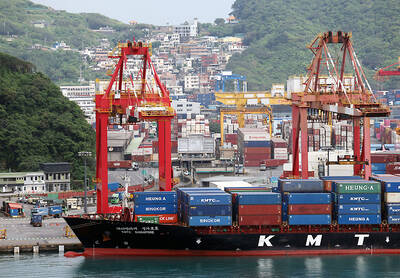
Taiwan’s economy grew far faster than expected in the first quarter, as booming demand for artificial intelligence (AI) applications drove a surge in exports, spilling over into investment and consumption, the Directorate-General of Budget, Accounting and Statistics (DGBAS) said yesterday. GDP growth was 13.69 percent year-on-year during the January-to-March period, beating the DGBAS’ February forecast by 2.23 percentage points and marking the most robust growth in nearly four decades, DGBAS senior official Chiang Hsin-yi (江心怡) told a news conference in Taipei. The result was powered by exports, which remain the backbone of Taiwan’s economy, Chiang said. Outbound shipments jumped 51.12 percent year-on-year to
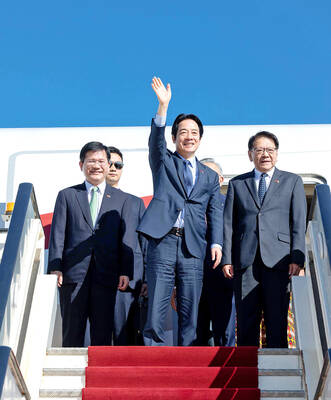
DELAYED BUT DETERMINED: The president’s visit highlights Taiwan’s right to international engagement amid regional pressure from China President Willaim Lai (賴清德) yesterday arrived in Eswatini, more than a week after his planned visit to Taiwan’s sole African ally was suspended because of revoked overflight permits. “The visit, originally scheduled for April 22, was postponed due to unforeseen external factors,” Lai wrote on social media. “After several days of careful arrangements by our diplomatic and national security teams, we successfully arrived today.” Lai said he looked forward to further deepening Taiwan-Eswatini relations through closer cooperation in the economy, agriculture, culture and education, as well as advancing the nation’s international partnerships. The president was initially scheduled to arrive in time to celebrate
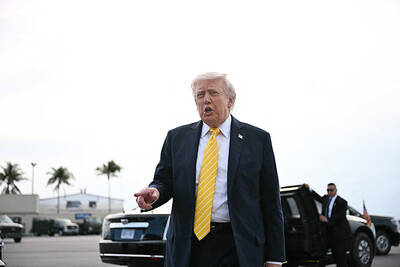
Iran’s Islamic Revolutionary Guard Corp (IRGC) yesterday said the US faced a choice between an “impossible” military operation or a “bad deal” with Tehran, after US President Donald Trump disparaged Iran’s latest peace proposal. Negotiations between the two countries have been deadlocked since a ceasefire came into effect on April 8, with only one round of direct peace talks held so far. Iran’s Tasnim and Fars news agencies reported that Tehran had submitted a 14-point proposal to mediator Pakistan, but Trump was quick to cast doubt on it. “I will soon be reviewing the plan that Iran has just sent to us, but


 RSS
RSS