


Closer bilateral collaboration between Taiwan and Japan is important to enhance joint deterrence capabilities and prevent a “Taiwan contingency,” Japanese Representative Keisuke Suzuki told a news conference in Taipei yesterday as he concluded a three-day visit to the country.
Suzuki, a former Japanese minister of justice in the Cabinet of former Japanese prime minister Shigeru Ishiba and a member of the ruling Liberal Democratic Party (LDP), arrived on Monday with his delegation.
They met with President William Lai (賴清德), Vice President Hsiao Bi-khim (蕭美琴) and Taipei Mayor Chiang Wan-an (蔣萬安).
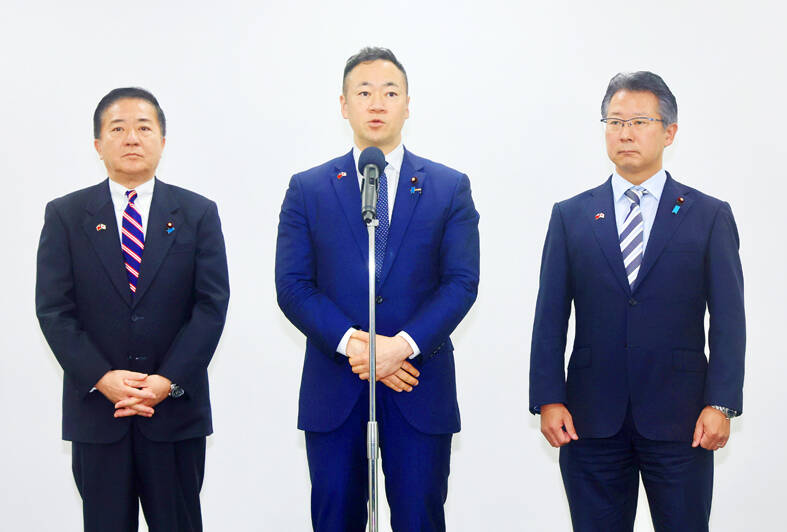
Photo: CNA
“We exchanged views concerning ways to enhance Japan-Taiwan relations, and touched on issues relating to the latest regional situations,” Suzuki said via an interpreter.
“We have concluded that to make sure a Taiwan contingency does not happen, we need to beef up our deterrence capabilities,” he said, without elaborating.
Asked whether he discussed ways to enhance bilateral defense cooperation during the meetings in Taipei, Suzuki did not give a direct answer.
He refused to disclose details of his talks with Taiwanese officials, saying only that both sides agreed to work closely to uphold regional peace and stability.
Japanese representatives Akihisa Nagashima, a former special adviser to Ishiba, and Junichi Kanda, a former vice minister of justice, both of the LDP, were also members of the delegation.
Their visit came as Tokyo and Beijing spar over remarks by Japanese Prime Minister Sanae Takaichi about Japan’s potential response to a “Taiwan contingency.”
Takaichi said that a Chinese attack on Taiwan would count as a situation threatening Japan’s survival and thus could warrant a military response from Tokyo, which drew an angry reaction from Beijing.
China’s actions against Japan have included travel and study advisories, a ban on Japanese marine products and military drills.
Nagashima told the news conference that the Taipei trip was planned months in advance and has nothing to do with the situation with China.
Lawmakers traveling overseas to conduct exchanges would continue despite the lack of official ties between Tokyo and Taipei, he said.

A signaling system malfunction disrupted high-speed rail (HSR) services beginning at 8am today, with trains temporarily reduced to three northbound and three southbound trains per hour as authorities conduct inspections. The malfunction occurred on a section of track in Miaoli County during pre-operation checks early this morning, forcing northbound and southbound trains to use a single track, the HSR operator said. The regular schedule has been replaced with three hourly trains offering only nonreserved seating in each direction, stopping at every station, it said, adding that business class cars would still have reserved seating. Departures from terminal stations are scheduled at the top

Taiwan is still in the process of assessing the possibility of recruiting workers from Eswatini, the Ministry of Foreign Affairs said yesterday, adding that its goal is to help Eswatini upgrade its vocational training centers. If there are plans to recruit workers from Eswatini, safeguarding national security, protecting public health and ensuring the employment rights of Taiwanese would be prerequisites, Department of West Asian and African Affairs Director-General Yen Chia-liang (顏嘉良) told a news conference. Key considerations would also include filling labor shortages in specific industries, and fostering bilateral professional and technical exchanges, he said. Yen was asked about the progress of labor

A US uncrewed surface vessel (USV) encountered multiple Chinese warships during an autonomous transit of the Taiwan Strait, US defense company Seasats said in a statement on Wednesday. Seasats announced that a Lightfish USV had completed the first autonomous transit of the Taiwan Strait. Over five days, the USV traversed the entire length of the Strait while constantly monitoring surface vessel traffic, the company said. The Lightfish encountered multiple Chinese warships, one of which was a Chinese People’s Liberation Army Navy (PLAN) Type 056 corvette, it said. The Chinese vessels were operating “well within Taiwan’s exclusive economic zone without transmitting their identity via the

VERBOSE VESSELS: A CGA cutter and a China Coast Guard exchanged verbal barbs for more than a day in Taiwanese-controlled waters before the Chinese vessel left The Taiwanese and Chinese coast guards had a standoff near the strategically located Pratas Islands (Dongsha Islands, 東沙群島) in the north of the South China Sea, the Coast Guard Administration (CGA) said yesterday. The two sides engaged in intense radio exchanges over sovereignty claims during the 33-hour standoff. China Coast Guard vessel 3501 eventually left the restricted waters, 26.6 nautical miles (49.2km) west of the Pratas Islands, at 5pm yesterday, the CGA said. Lying approximately between southern Taiwan and Hong Kong, the Taiwan-controlled Pratas are seen by some security experts as vulnerable to Chinese attack due to their distance — more than


 RSS
RSS