


The Legislative Yuan yesterday passed amendments to the Road Traffic Management and Penalty Act (道路交通管理處罰條例) that increase penalties for certain traffic contraventions.
They were passed without any objections.
The amendments are to raise the fine for using mobile phones, computers or other similar devices to call, text or send or receive data while riding a motorcycle to NT$1,200 from NT$1,000.
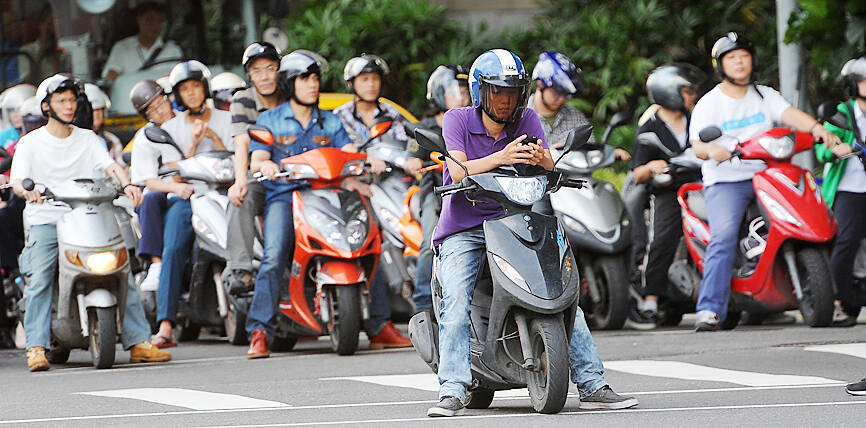
Photo: Liu Hsin-de, Taipei Times
The fine for doing so while driving a car is NT$3,000.
They would also raise the fine for holding, smoking or lighting a cigarette while driving a car or motorcycle to NT$1,200 from NT$600.
Drivers who fail to reduce their speed in areas marked as school or hospital zones, and who cause death or injury are to face sentences that are increased by up to half of the original penalty.
There has been an increase in the number of traffic accidents, and children and elderly people who are more vulnerable to traffic often use roads around schools and hospitals, the bill says.
For cases involving alcohol or drug testing, the amendments revise the starting point of the police reporting deadline to the date that test results are delivered to police units, rather than the date of the contravention.
The change addresses administrative loopholes that have posed potential public safety risks, as delays in urine test results have in some cases exceeded the statutory reporting deadline of two months, preventing authorities from suspending offenders’ licenses, the bill says.
It also says that if a car accident involving injuries with unclear liability is sent for external appraisal, the statutory period starts from the date the appraisal is completed.
If police instead rely on their own analysis, they must issue a citation within three months.
Also yesterday, the legislature passed amendments to the Railway Act (鐵路法) that impose criminal penalties for using violence, coercion or threats to obstruct railway personnel while they are carrying out their duties.
Under the amendment, such offenses are punishable by up to three years in prison and a fine of up to NT$300,000.
If the obstruction results in death, offenders face life imprisonment or a prison term of more than seven years, while cases resulting in serious injury carry terms of three to 10 years.
The revisions were modeled on provisions addressing emergency room violence under the Medical Care Act (醫療法), with the aim of strengthening on-duty safety protections for railway personnel.
The amended law also authorizes railway operators to refuse service when there is a risk that passengers could obstruct railway personnel through violence, coercion or threats.
Before the government-run Taiwan Railways Administration became corporatized on Jan. 1 last year, such violence could be prosecuted under Article 135 of the Criminal Code punishing threats or violence against a public official.
Since the beginning of last year, the clause no longer applied to Taiwan Railway Corp’s new hires, necessitating more direct provisions to crack down on violence against railway employees.
There have been 14 cases of such violence this year.
The amendments also raised fines to deter improper profit-seeking involving train tickets.
Those who resell train tickets at higher prices or exchange them for improper profits would face fines ranging from 10 to 50 times the ticket fare, based on the number of tickets involved.
The amended law also imposes fines of NT$30,000 to NT$300,000 on privately run and state-owned railway operators that fail to take necessary safety measures or do not effectively train and manage their personnel.
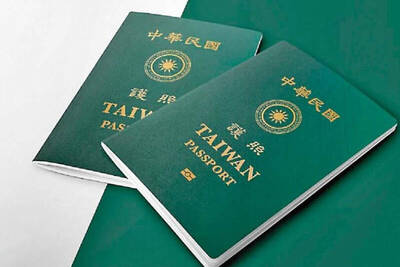
The Taiwanese passport ranked 33rd in a global listing of passports by convenience this month, rising three places from last month’s ranking, but matching its position in January last year. The Henley Passport Index, an international ranking of passports by the number of designations its holder can travel to without a visa, showed that the Taiwan passport enables holders to travel to 139 countries and territories without a visa. Singapore’s passport was ranked the most powerful with visa-free access to 192 destinations out of 227, according to the index published on Tuesday by UK-based migration investment consultancy firm Henley and Partners. Japan’s and

NATIONAL SECURITY THREAT: An official said that Guan Guan’s comments had gone beyond the threshold of free speech, as she advocated for the destruction of the ROC China-born media influencer Guan Guan’s (關關) residency permit has been revoked for repeatedly posting pro-China content that threatens national security, the National Immigration Agency said yesterday. Guan Guan has said many controversial things in her videos posted to Douyin (抖音), including “the red flag will soon be painted all over Taiwan” and “Taiwan is an inseparable part of China,” while expressing hope for expedited “reunification.” The agency received multiple reports alleging that Guan Guan had advocated for armed reunification last year. After investigating, the agency last month issued a notice requiring her to appear and account for her actions. Guan Guan appeared as required,

Japan and the Philippines yesterday signed a defense pact that would allow the tax-free provision of ammunition, fuel, food and other necessities when their forces stage joint training to boost deterrence against China’s growing aggression in the region and to bolster their preparation for natural disasters. Japan has faced increasing political, trade and security tensions with China, which was angered by Japanese Prime Minister Sanae Takaichi’s remark that a Chinese attack on Taiwan would be a survival-threatening situation for Japan, triggering a military response. Japan and the Philippines have also had separate territorial conflicts with Beijing in the East and South China
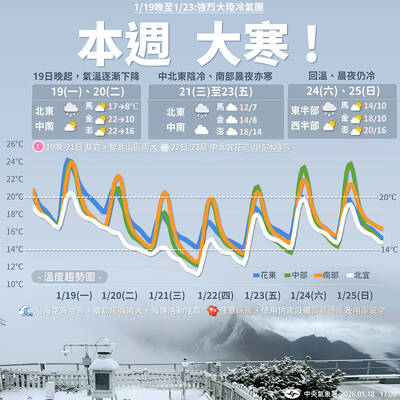
A strong cold air mass is expected to arrive tonight, bringing a change in weather and a drop in temperature, the Central Weather Administration (CWA) said. The coldest time would be early on Thursday morning, with temperatures in some areas dipping as low as 8°C, it said. Daytime highs yesterday were 22°C to 24°C in northern and eastern Taiwan, and about 25°C to 28°C in the central and southern regions, it said. However, nighttime lows would dip to about 15°C to 16°C in central and northern Taiwan as well as the northeast, and 17°C to 19°C elsewhere, it said. Tropical Storm Nokaen, currently


 RSS
RSS