


President William Lai (賴清德) yesterday expressed hope that Taiwan and Japan can deepen cooperation in various fields and work together to maintain a free and open Indo-Pacific region.
Lai made the remarks while welcoming a delegation led by Japanese Representative Koichi Hagiuda, who is incumbent secretary-general of the Japan-ROC Diet Members’ Consultative Council and executive acting secretary-general of Japan’s ruling Liberal Democratic Party (LDP).
He led a delegation of Hachioji city councilors to visit Taiwan from Sunday to today.
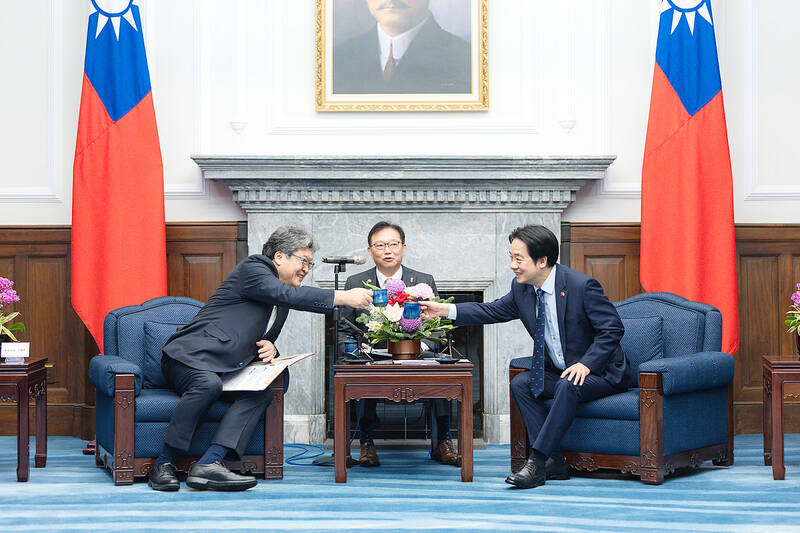
Photo: Screen grab from the Presidential Office’s Flickr page
At a meeting at the Presidential Office, Lai said he had met with Hagiuda at the launch event for the Abe Shinzo Research Center in Taipei in September.
Since Japanese Prime Minister Sanae Takaichi assumed office, she has in many international public events, including the Japan-US Summit Meeting, ASEAN Japan Summit and APEC Summit, repeatedly expressed support for the Taiwan-Japan relationship and emphasized peace and stability in the Taiwan Strait, Lai said.
“On behalf of Taiwanese, I want to express our appreciation,” he said, adding that as Takaichi has continued to receive strong support from Japanese, he believes the nation would be able to contribute even more to peace and stability in the Strait and the Indo-Pacific region.
“I sincerely look forward to Taiwan and Japan deepening collaboration in national security strategy, regional cooperation, economic security, high-tech industries and societal resilience, and work together to achieve a ‘free and open Indo-Pacific,’” he said.
Lai said Taiwan and Japan should cherish their precious friendship, continue to strengthen bilateral cooperation and interaction, and face challenges together.
All democratic countries should come together to protect freedom and democracy, and to avoid being divided and conquered by adversaries, he said, thanking Hagiuda and Taiwan’s friends for their long-term support for peace in the region.
For Japan, Taiwan is an important partner and friend with shared values, close economic relations and people-to-people exchanges, Hagiuda said.
Takaichi last month met with Taiwan’s representative to the APEC Summit, Lin Hsin-i (林信義) at the APEC Economic Leaders’ Meeting in South Korea, to discuss enhancing cooperation in economics and disaster prevention, he said.
In addition, the LDP has long engaged in exchanges with Taiwan through its youth division, fostering a lasting friendship, he said, adding that he looks forward to further deepening cooperation and exchanges.
In a Japan-Taiwan Exchange Association survey, Taiwanese ranked Japan as their favorite country, while a corresponding survey showed that nearly 80 percent of Japanese felt a sense of closeness toward Taiwan, and that Taiwan-Japan relations are considered the best in history, he said.
China lodged a diplomatic complaint with Japan regarding the visit, stating that China “firmly opposed” the meeting and urging Japan to “reflect deeply on its mistake.”
Hagiuda’s visit comes with diplomatic ties between Tokyo and Beijing at their lowest in years after Takaichi last month suggested that a Chinese attack on Taiwan could be a “survival-threatening situation,” that could necessitate a military response from Tokyo.
China responded vehemently and has been pushing for the Japanese leader to retract her statement.
Another five-member Japanese legislative delegation led by Hirofumi Takinami, a member of the Japanese House of Councillors, is also visiting Taiwan from yesterday through Thursday, the Ministry of Foreign Affairs said.
The group is to meet with Lai and other government officials.
Takinami, who is married to a Taiwanese, has for years enthusiastically promoted Taiwan-Japan parliamentary exchanges, the ministry said.
Additional reporting by Reuters and CNA

SILENCING CRITICS: In addition to blocking Taiwan, China aimed to prevent rights activists from speaking out against authoritarian states, a Cabinet department said The Ministry of Foreign Affairs (MOFA) yesterday condemned transnational repression by Beijing after RightsCon, a major digital human rights conference scheduled to be held in Zambia this week, was abruptly canceled due to Chinese pressure over Taiwanese participation. This year’s RightsCon, the world’s largest conference discussing issues “at the intersection of human rights and technology,” was scheduled to take place from tomorrow to Friday in Lusaka, and expected to draw 2,600 in-person attendees from 150 countries, along with 1,100 online participants. However, organizers were forced to cancel the event due to behind-the-scenes pressure from China, the ministry said, expressing its “strongest condemnation”
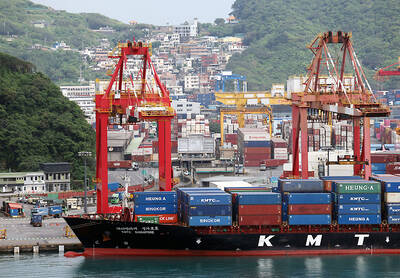
Taiwan’s economy grew far faster than expected in the first quarter, as booming demand for artificial intelligence (AI) applications drove a surge in exports, spilling over into investment and consumption, the Directorate-General of Budget, Accounting and Statistics (DGBAS) said yesterday. GDP growth was 13.69 percent year-on-year during the January-to-March period, beating the DGBAS’ February forecast by 2.23 percentage points and marking the most robust growth in nearly four decades, DGBAS senior official Chiang Hsin-yi (江心怡) told a news conference in Taipei. The result was powered by exports, which remain the backbone of Taiwan’s economy, Chiang said. Outbound shipments jumped 51.12 percent year-on-year to
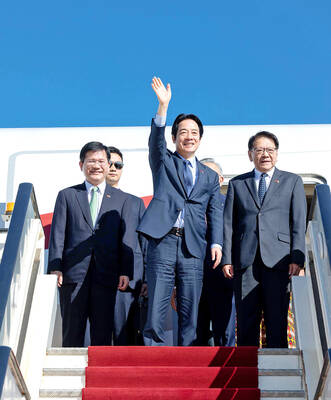
DELAYED BUT DETERMINED: The president’s visit highlights Taiwan’s right to international engagement amid regional pressure from China President Willaim Lai (賴清德) yesterday arrived in Eswatini, more than a week after his planned visit to Taiwan’s sole African ally was suspended because of revoked overflight permits. “The visit, originally scheduled for April 22, was postponed due to unforeseen external factors,” Lai wrote on social media. “After several days of careful arrangements by our diplomatic and national security teams, we successfully arrived today.” Lai said he looked forward to further deepening Taiwan-Eswatini relations through closer cooperation in the economy, agriculture, culture and education, as well as advancing the nation’s international partnerships. The president was initially scheduled to arrive in time to celebrate
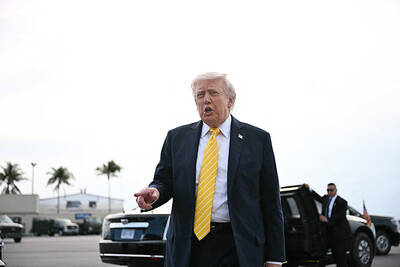
Iran’s Islamic Revolutionary Guard Corp (IRGC) yesterday said the US faced a choice between an “impossible” military operation or a “bad deal” with Tehran, after US President Donald Trump disparaged Iran’s latest peace proposal. Negotiations between the two countries have been deadlocked since a ceasefire came into effect on April 8, with only one round of direct peace talks held so far. Iran’s Tasnim and Fars news agencies reported that Tehran had submitted a 14-point proposal to mediator Pakistan, but Trump was quick to cast doubt on it. “I will soon be reviewing the plan that Iran has just sent to us, but


 RSS
RSS