


EU leaders yesterday agreed to provide a massive interest-free loan to Ukraine to meet its military and economic needs for the next two years, but they failed to bridge differences with Belgium that would have allowed them to use frozen Russian assets to raise the funds.
The IMF estimated that Ukraine would need 137 billion euros (US$160 billion) next year and in 2027. The government in Kyiv is on the verge of bankruptcy and desperately needs the money by spring.
The plan had been to use some of the 210 billion euros of Russian assets that are frozen in Europe, mostly in Belgium.
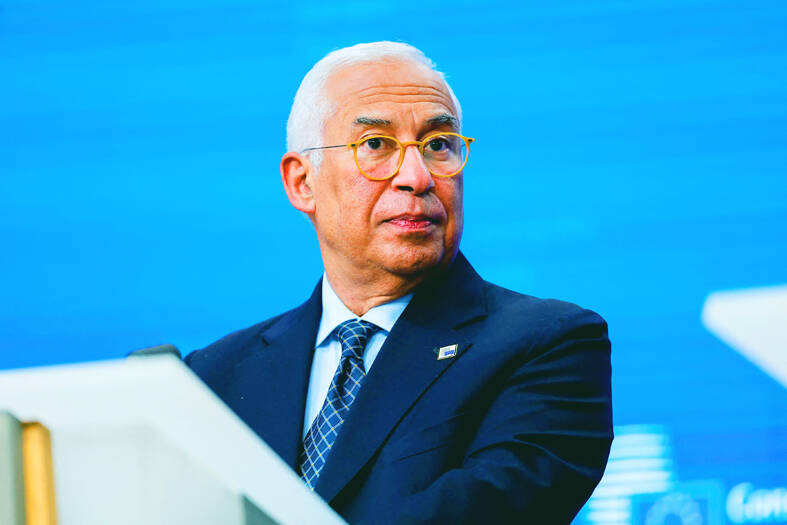
Photo: Reuters
The leaders reassured Belgium they would protect it from any Russian retaliation if it backed the “reparations loan” plan, but as the talks bogged down, the leaders opted to borrow the money on capital markets.
“We have a deal. Decision to provide 90 billion euros of support to Ukraine for 2026-[20]27 approved. We committed, we delivered,” EU Council President Antonio Costa wrote on social media.
Not all countries agreed to the loan package. Hungary, Slovakia and the Czech Republic refuse to support Ukraine and opposed it, but a deal was reached in which they did not block the package and were promised protection from any financial fallout.
Hungarian Prime Minister Viktor Orban, who is Russian President Vladimir Putin’s closest ally in Europe and describes himself as a peacemaker, said: “I would not like a European Union in war.”
“To give money means war,” Orban said.
German Chancellor Friedrich Merz also hailed the decision.
“The financial package for Ukraine has been finalized,” Merz said, adding that “Ukraine is granted a zero-interest loan.”
The frozen assets would remain blocked until Russia has paid war reparations to Ukraine, he said.
Ukrainian President Volodymyr Zelenskiy has said that would cost more than 600 billion euros.
“If Russia does not pay reparations, we will — in full accordance with international law — make use of Russian immobilized assets for paying back the loan,” Merz said.
Zelenskiy had appealed for a quick decision to keep Ukraine afloat in the new year.
Polish Prime Minister Donald Tusk warned early on Thursday that it would be a case of sending “either money today or blood tomorrow” to help Ukraine.
The plan to use frozen Russian assets got bogged down as Belgian Prime Minister Bart de Wever rejected the scheme as legally risky, and warned that it could harm the business of Euroclear, the Brussels-based financial clearing house where 193 billion euros in frozen assets are held.
Belgium was rattled last week when Russia’s central bank launched a lawsuit against Euroclear to prevent any loan being provided to Ukraine using its money, which is frozen under EU sanctions slapped on Moscow after its launched its full-scale war in 2022.
“For me, the reparations loan was not a good idea,” De Wever said. “When we explained the text again, there were so many questions that I said, I told you so, I told you so. There are a lot of loose ends. And if you start pulling at the loose ends in the strings, the thing collapses.”
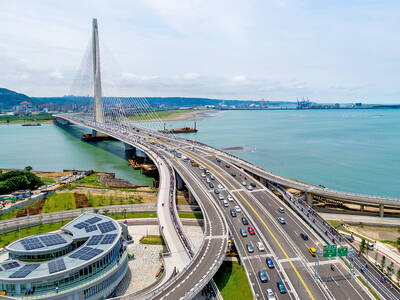
The Ministry of Transportation and Communications yesterday inaugurated the Danjiang Bridge across the Tamsui River in New Taipei City, saying that the structure would be an architectural icon and traffic artery for Taiwan. Feted as a major engineering achievement, the Danjiang Bridge is 920m long, 211m tall at the top of its pylon, and is the longest single-pylon asymmetric cable-stayed bridge in the world, the government’s Web site for the structure said. It was designed by late Iraqi-British architect Zaha Hadid. The structure, with a maximum deck of 70m, accommodates road and light rail traffic, and affords a 200m navigation channel for boats,
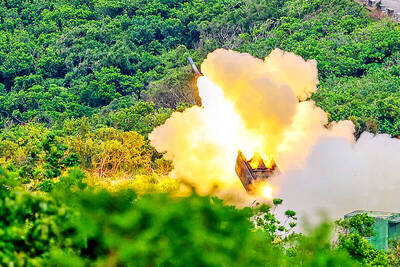
PRECISION STRIKES: The most significant reason to deploy HIMARS to outlying islands is to establish a ‘dead zone’ that the PLA would not dare enter, a source said A High Mobility Artillery Rocket System (HIMARS) would be deployed to Penghu County and Dongyin Island (東引) in Lienchiang County (Matsu) to force the Chinese military to retreat at least 100km from the coastline, a military source said yesterday. Taiwan has been procuring HIMARS and Army Tactical Missile Systems (ATACMS) from the US in batches. Once all batches have been delivered, Taiwan would possess 111 HIMARS units and 504 ATACMS, which have a range of 300km. Considering that “offense is the best defense,” the military plans to forward-deploy the systems to outlying islands such as Penghu and Dongyin so that

Taiwan Semiconductor Manufacturing Co (TSMC, 台積電), the world’s largest foundry service provider, yesterday said that global semiconductor revenue is projected to hit US$1.5 trillion in 2030, after the figure exceeds US$1 trillion this year, as artificial intelligence (AI) demand boosts consumption of token and compute power. “We are still at the beginning of the AI revolution, but we already see a significant impact across the whole semiconductor ecosystem,” TSMC deputy cochief operating officer Kevin Zhang (張曉強) said at the company’s annual technology symposium in Hsinchu City. “It is fair to say that in the past decade, smartphones and other mobile devices were

‘CLEAR MESSAGE’: The bill would set up an interagency ‘tiger team’ to review sanctions tools and other economic options to help deter any Chinese aggression toward Taiwan US Representative Young Kim has introduced a bill to deter Chinese aggression against Taiwan, calling for an interagency “tiger team” to preplan coordinated sanctions and economic measures in response to possible Chinese military or political action against Taiwan. “[Chinese President] Xi Jinping [習近平] has directed the People’s Liberation Army to be ready to invade Taiwan by 2027. China has a plan. America should have one too,” Kim said in a news release on Thursday last week. She introduced the “Deter PRC [People’s Republic of China] aggression against Taiwan act” to “ensure the US has a coordinated sanctions strategy ready should


 RSS
RSS