


The US House Select Committee on the Chinese Communist Party (CCP) yesterday released a bipartisan report titled Ten More for Taiwan identifying urgent, near-term steps to deter Chinese aggression.
Committee Chair John Moolenaar and Ranking Member Raja Krishnamoorthi built on the original Ten for Taiwan report from May 2023.
Ten More for Taiwan “makes explicit that Taiwan is not — and will not be — a bargaining chip with the Chinese Communist Party,” Krishnamoorthi said.

Photo: CNA
Since the previous report, the CCP has “increased the risk of conflict over Taiwan, underscoring the need to deepen US-Taiwan economic, defense and political cooperation to maintain peace and stability in the Taiwan Strait,” the committee said in a statement.
Taiwan has “only grown more essential” to US prosperity, as it was Washington’s seventh-largest trading partner last year, is a key link in global supply chains and an important investor in the US, the report said.
“[Chinese President] Xi Jinping (習近平) has ordered his military to be ready to take Taiwan by 2027 if necessary, so 2026 is an urgent year to build deterrence in the Taiwan Strait,” Moolenaar said.
This means increasing weapons stockpiles, enhancing logistics capabilities and creating dilemmas for the Chinese People’s Liberation Army (PLA), he said.
The 10 actions include affirming the US’ commitment to Taiwanese security and deepening economic ties with the nation by advancing and completing trade, tax, travel and technology agreements, continuing exchanges and pushing investment.
The US Congress should pass legislation to deter Chinese economic coercion and protect critical supply chains, it said.
The US should also expand and streamline security assistance to Taiwan using mutually beneficial defense industrial cooperation programs and mitigate supply chain dependencies on China.
Moreover, it should improve air and missile defense capabilities, accelerate regional infrastructure and integrate with allies, including Japan and the Philippines, to establish intelligence-sharing initiatives and multilateral exercises, it said.
The report also highlighted the importance of aiding Taiwan in diversifying its energy supply with increased imports of liquid natural gas.
Taiwan’s civil defense and military training cooperation with the US needs to be enhanced, the report said.
Finally, the US should impose costs on China over its ties with Russia, while strengthening readiness against authoritarian threats, it said, adding that Beijing is the chief enabler of the Kremlin’s war machine through its “no limits” partnership with Moscow.
The US should learn lessons from Russia’s invasion of Ukraine, as China is closely monitoring the outcome of the war, the report said.
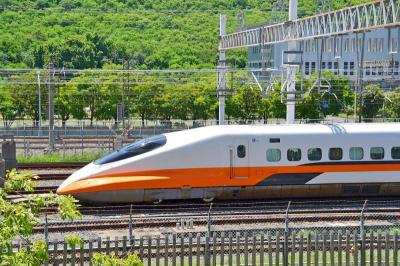
A signaling system malfunction disrupted high-speed rail (HSR) services beginning at 8am today, with trains temporarily reduced to three northbound and three southbound trains per hour as authorities conduct inspections. The malfunction occurred on a section of track in Miaoli County during pre-operation checks early this morning, forcing northbound and southbound trains to use a single track, the HSR operator said. The regular schedule has been replaced with three hourly trains offering only nonreserved seating in each direction, stopping at every station, it said, adding that business class cars would still have reserved seating. Departures from terminal stations are scheduled at the top

Taiwan is still in the process of assessing the possibility of recruiting workers from Eswatini, the Ministry of Foreign Affairs said yesterday, adding that its goal is to help Eswatini upgrade its vocational training centers. If there are plans to recruit workers from Eswatini, safeguarding national security, protecting public health and ensuring the employment rights of Taiwanese would be prerequisites, Department of West Asian and African Affairs Director-General Yen Chia-liang (顏嘉良) told a news conference. Key considerations would also include filling labor shortages in specific industries, and fostering bilateral professional and technical exchanges, he said. Yen was asked about the progress of labor

A US uncrewed surface vessel (USV) encountered multiple Chinese warships during an autonomous transit of the Taiwan Strait, US defense company Seasats said in a statement on Wednesday. Seasats announced that a Lightfish USV had completed the first autonomous transit of the Taiwan Strait. Over five days, the USV traversed the entire length of the Strait while constantly monitoring surface vessel traffic, the company said. The Lightfish encountered multiple Chinese warships, one of which was a Chinese People’s Liberation Army Navy (PLAN) Type 056 corvette, it said. The Chinese vessels were operating “well within Taiwan’s exclusive economic zone without transmitting their identity via the
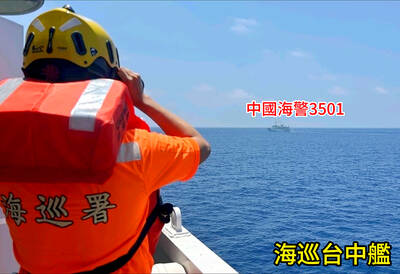
VERBOSE VESSELS: A CGA cutter and a China Coast Guard exchanged verbal barbs for more than a day in Taiwanese-controlled waters before the Chinese vessel left The Taiwanese and Chinese coast guards had a standoff near the strategically located Pratas Islands (Dongsha Islands, 東沙群島) in the north of the South China Sea, the Coast Guard Administration (CGA) said yesterday. The two sides engaged in intense radio exchanges over sovereignty claims during the 33-hour standoff. China Coast Guard vessel 3501 eventually left the restricted waters, 26.6 nautical miles (49.2km) west of the Pratas Islands, at 5pm yesterday, the CGA said. Lying approximately between southern Taiwan and Hong Kong, the Taiwan-controlled Pratas are seen by some security experts as vulnerable to Chinese attack due to their distance — more than


 RSS
RSS