


The Ministry of the Interior yesterday ordered Taiwanese Internet service providers (ISPs) to block access to Chinese social media app Xiaohongshu (小紅書, also known as RedNote in English) for a year, after detecting hundreds of instances of fraud on the platform.
The ISPs have been instructed to block access to the app to its more than 3 million users in Taiwan, effective immediately, Deputy Minister of the Interior Ma Shih-yuan (馬士元) told a news conference at the National Police Agency’s Fraud Prevention Center.
The order is being implemented via protocols governing domain name system (DNS) response policy zones, he said.

Photo: Reuters
Xiaohongshu meets none of the nation’s 15 cybersecurity standards governing online platforms, which puts its millions of Taiwanese users at imminent danger of fraud, he said.
The bureau said in a statement that 1,706 cases of fraud have been identified since last year through the app, with financial losses exceeding NT$247 million (US$7.9 million).
The company that owns the China-based app, Xingyin Information Technology (Shanghai) Co (行吟資訊科技(上海)) does not have an office in Taiwan and has not responded to regulators’ requests to submit a plan to improve data security on its platform, Ma said.
The measures are necessary for authorities to compensate victims of crime and protect consumer rights, he said, adding that Meta Platforms Inc, Alphabet Inc, ByteDance Ltd (字節跳動) and LY Corp, the operator of the Line messaging app, are all in compliance with Taiwanese law.
By comparison, Xingyin has not responded to government legal filings in the 52 days since their receipt, Ma said.
The government must take action against Xiaohongshu or admit the abdication of its regulatory responsibilities, he said, adding that inaction would also be unfair to companies that follow the law.
The decision is part of the ministry’s comprehensive anti-fraud strategy, not an action specifically targeting Xiaohongshu, officials said.
The government has blocked access to 45,059 platform-operating entities, 95 percent of which were based in a foreign nation, they said.
As Xiaohongshu owns more than 1,000 Internet protocol addresses, the government ban would not shut down the app at once, officials said.
Instead, the platform would likely see DNS response policy zone protocols gradually degrade streaming speeds until the corporation complies with laws and regulations, or its service becomes unusable, they said.

National Taiwan University (NTU) yesterday said it disqualified a person from an entrance examination for using AI smart glasses to cheat, along with two others for making untruthful statements in their curriculum vitae. The three applicants were given null scores, Taiwan’s highest-ranked university said, calling on prospective students to be honest in the admissions process. NTU registrar Lee Hung-sen (李宏森) said that the cheating applicant wore a hat and thick-rimmed glasses to the second written exam for medical school, claiming that they felt cold. Suspicions were aroused when the applicant stared oddly at the test for long stretches while steadily bringing the paper
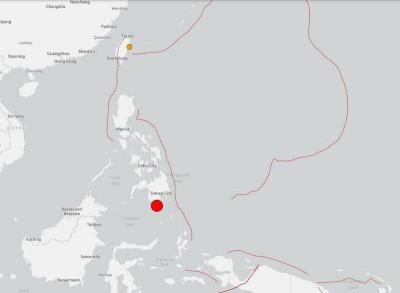
A magnitude 7.8 earthquake struck off the southern coast of Mindanao in the Philippines at 7:38am today, prompting the US Tsunami Warning System to issue an alert for neighboring countries, including Taiwan. The system issued a purple alert indicating a "tsunami threat." The potential threat zone includes Taiwan, the Philippines, Papua New Guinea, Yap and Palau. Philippine authorities were assessing the damage from the quake, with the office of civil defense seeking to verifying initial reports that 15 people had been killed and 129 injured in the region, mostly from falling debris. Arlene Hollero, disaster chief of Maasim town in the Philippines' Sarangani Province,

‘GRAY ZONE’ PRESSURE: Beijing’s activities are intended to create the deceitful impression that China has jurisdiction over the area around Taiwan, the CGA said Taiwan’s rights over its territorial waters and exclusive economic zone must not be violated by any country, the Mainland Affairs Council said yesterday, adding that it will not accept any unprovoked actions. The council issued the remarks in response to the China Coast Guard conducting maritime enforcement drills near eastern Taiwan and claiming to fully exercise China’s maritime administrative law enforcement authority. The Coast Guard Administration (CGA) has been closely monitoring the situation and is taking concrete steps to defend the nation’s sovereignty and secure its waters, the council said. China has no sovereign rights over the waters off eastern
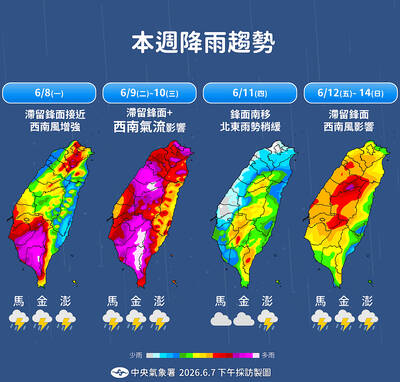
Heavy rain is expected to affect parts of Taiwan this week, the Central Weather Administration (CWA) said yesterday as a meteorologist said the active part of the annual plum rain season has started. A stationary plum rain front and southwesterly winds would bring unstable weather and abundant moisture to Taiwan from today for about a week, with the heaviest rainfall forecast for tomorrow and Wednesday, the CWA said. The agency said western and northeastern Taiwan, and mountainous areas in the east and southeast, could expect showers or thunderstorms on those two days, with localized heavy rain possible. Other parts of


 RSS
RSS