


Representative to Japan Lee Yi-yang (李逸洋) yesterday thanked the Japanese public for distinguishing between Taiwanese and Chinese, citing a survey that showed nearly three-quarters of Japanese feel a sense of closeness toward Taiwan.
The Taipei Economic and Cultural Representative Office (TECRO) in Japan yesterday released the latest poll on Japanese attitude toward Taiwan.
The office has since 2016 been commissioning Tokyo-based Central Research Services to conduct a poll of 1,000 Japanese aged 20 to 89. The poll had been conducted annually until 2021, after which it was done every other year. People this year were polled via telephone from Oct. 24 to 28.
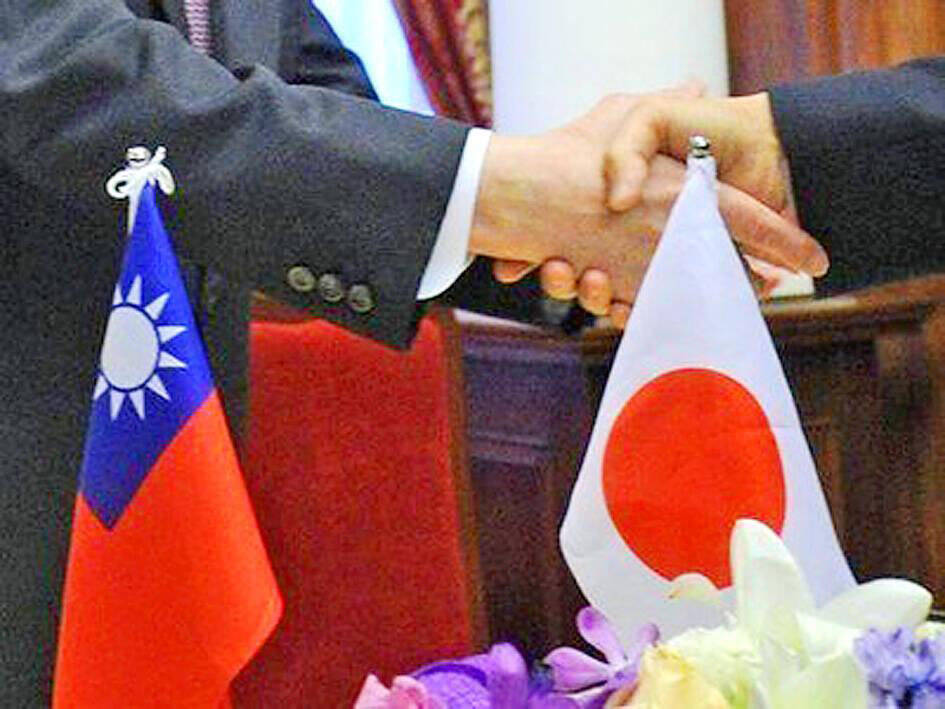
Photo: CNA
The survey showed that 74.5 percent of Japanese felt a sense of closeness toward Taiwan, Lee said, adding that 63.6 percent of Japanese considered Taiwan trustworthy, and 68.5 percent believed Taiwan and Japan have a good relationship.
The figure fell slightly from 76.6 percent in 2023, and is also lower than the 81 percent in the poll conducted by the Japan-Taiwan Exchange Association in April, he said.
TECRO will continue to improve Taiwan-Japan exchanges to promote positive impressions of Taiwan among Japanese, Lee said, adding that Taiwanese must work together as a whole in different fields to enhance Taiwan’s international image.
The poll showed a stark contrast between Japan-Taiwan ties and Japan-China relations, he said.
The Japan-China Public Opinion Poll jointly carried out by a Japanese civic organization and the Chinese government has yet to be published, Lee said, adding that it should have been published early last month, but has been postponed twice.
Citing last year’s Japan-China Public Opinion Poll, Lee said that 89 percent of Japanese had negative impressions of China, while 87.7 percent of Chinese held unfavorable opinions of Japan.
The results were starkly different from those between Taiwan and Japan, he said.
People in many countries cannot distinguish between Taiwanese and Chinese, but Japanese clearly understand the difference and would not confuse one with the other, Lee said, thanking the Japanese public.
The TECRO poll also showed that Taiwan topped the list of Asian countries that Japanese feel the closest to, with 44 percent of respondents choosing Taiwan.
Things that would pop up in mind when Japanese hear the word “Taiwan” included friendship with Japan (73.5 percent), good food (43 percent), historical ties with Japan (36.5 percent), abundant tourism resources (26.1 percent), globally lauded semiconductors (23.7 percent), the cross-strait situation (22.4 percent), the large number of Taiwanese visiting Japan (20.8 percent), a free, democratic country (19.7 percent), economically developed (17.9 percent), diverse culture (10.9 percent) and high-quality Taiwan-made products, the poll showed.
As for why Japanese feel close to Taiwan, the reasons cited included Taiwanese being amiable (72.3 percent), time-honored bilateral exchanges (40.5 percent) and strong economic ties (31.4 percent), the poll showed.
They find Taiwan trustworthy because the nation is friendly with Japan (69.7 percent); they shared common values of freedom and democracy (50.8 percent); historical bonds (37.7 percent); Taiwan is a peaceful country (33 percent); and Taiwan is an economic and trade partner (31 percent), it showed.
Fields where respondents said bilateral exchanges should be enhanced included tourism (46.2 percent), economy (45.2 percent), and political and security protection (40.3 percent), the poll showed.
Asked what bilateral issues caused the most concerns to them, 49.6 percent of respondents said “the impact of the cross-strait situation on Japan,” while 22.5 percent said “no special concern,” 9 percent cited “territorial disputes” and 7.2 percent said “economic competition,” the survey showed.
Factors respondents considered crucial to Asian-Pacific peace and stability included diplomatic dialogue and coordination (54.5 percent), establishing Japan-US-Taiwan cooperation (36.1 percent), strengthening Japan’s defense capabilities (34 percent), active US involvement in defending Taiwan (25.4 percent), Taiwan’s self-defense capabilities (24.5 percent), enhancing the Japan-US coalition (24.4 percent), and unity among like-minded countries, such as those in Europe (23.4 percent), the poll showed.
The poll also showed that 59.3 percent of Japanese have read news stories about Taiwan.
What impressed respondents the most included military drills in the Taiwan Strait (64.9 percent), Taiwanese cuisine (48.9 percent), semiconductors (38.1 percent), and Taiwan’s tourism and culture (37.1 percent), it showed.
The poll showed that 61.7 percent of Japanese knew about Chinese interference in Taiwan’s participation in international organizations.
Up to 64.8 percent of Japanese support Taiwan’s participation in international institutions such as the UN, the WHO or the International Civil Aviation Organization, while only 2.8 percent disagreed, the poll showed.

‘NO SECURITY RISK’: The Railway Bureau reassured the public that the technicians’ activities were limited to technical guidance and did not involve sensitive systems The Railway Bureau yesterday said it had invited eight Chinese technicians to assist with an airport MRT construction project. The bureau issued the confirmation after an Internet user said Chinese nationals had entered the construction zone of Taiwan Taoyuan International Airport’s Terminal 3 project. They asked why “individuals from an enemy state” were allowed access to such a major national infrastructure project, which raised serious concerns over Taiwan’s industrial safety, sensitive systems and information security. The bureau’s Northern Region Engineering Branch Office said subcontractor Taiwan Handle Industrial Co (台灣手把工業) of the Taoyuan airport MRT’s “Contract No. CU05 Project A14 Station Civil, MEP &

A US uncrewed surface vessel (USV) encountered multiple Chinese warships during an autonomous transit of the Taiwan Strait, US defense company Seasats said in a statement on Wednesday. Seasats announced that a Lightfish USV had completed the first autonomous transit of the Taiwan Strait. Over five days, the USV traversed the entire length of the Strait while constantly monitoring surface vessel traffic, the company said. The Lightfish encountered multiple Chinese warships, one of which was a Chinese People’s Liberation Army Navy (PLAN) Type 056 corvette, it said. The Chinese vessels were operating “well within Taiwan’s exclusive economic zone without transmitting their identity via the
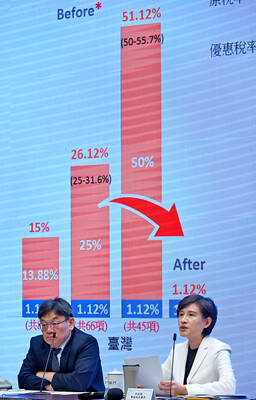
GREATER REACH? Auto parts and wood products would face tariffs of up to 15%, matching those targeting the EU, Japan and South Korea, Vice Premier said The US has announced that preferential tariff treatment for Taiwan’s non-semiconductor Section 232 goods would take effect retroactively from May 1, the Executive Yuan said yesterday. The US government yesterday posted a notice on the Federal Register’s public inspection Web site previewing tariff concessions for Taiwan under a memorandum of understanding (MOU) on Taiwan-US investment after two months of negotiations. The MOU signed on Jan. 15 stipulated three major preferential tariff arrangements: a 15 percent “reciprocal” tariff rate for Taiwan without stacking most-favored nation (MFN) rates; preferential Section 232 treatment for semiconductors and related products; and preferential Section 232 treatment for non-semiconductor

TIT-FOR-TAT: The US allegedly revoked the visa of a Chinese national working at Xinhua News Agency in the US in response to Beijing’s expulsion of Vivian Wang The Presidential Office yesterday condemned China for expelling a New York Times correspondent from Beijing following the newspaper’s interview with President William Lai (賴清德), saying the move highlighted Beijing’s suppression of press freedom and its threat to international news media. Taiwan has noted a series of recent incidents in which Beijing used similar tactics to “threaten and pressure international media outlets and journalists,” Presidential Office spokeswoman Karen Kuo (郭雅慧) said in a statement. “This concerns not only press freedom and freedom of expression, but also the safety of journalists, and Taiwan and relevant partners are paying close attention to the situation,” she


 RSS
RSS