


The Directorate-General of Budget, Accounting and Statistics (DGBAS) yesterday sharply raised its GDP growth forecast for this year from 4.45 percent to 7.37 percent, the fastest expansion in 15 years, thanks to strong global demand for electronics used in artificial intelligence (AI) applications.
The revised outlook marks the best performance since 2009 and represents a 2.92 percentage point jump from the agency’s August estimate, driven overwhelmingly by technology exports linked to AI, and new-generation smartphones and other mobile devices.
“The upgrade reflects much stronger second-half showings than previously projected,” DGBAS Minister Chen Shu-tzu (陳淑姿) said.
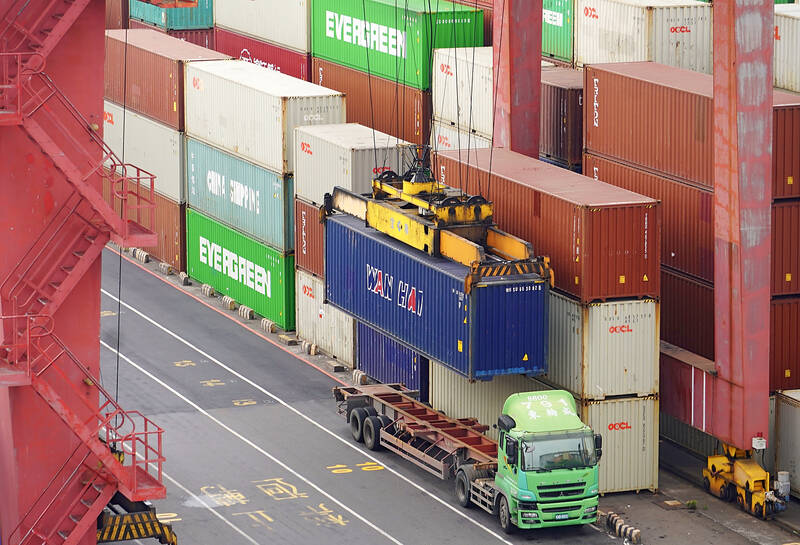
Photo: CNA
The economy grew 8.21 percent year-on-year in the third quarter, better than a 7.64 percent increase indicated in last month’s advance report, she said, adding that the outperformance stemmed mainly from aggressive capital spending by US hyperscale cloud companies on AI-related hardware, which benefited local suppliers.
These investments boosted third-quarter exports by 36.49 percent, while imports climbed 24.91 percent, as domestic tech manufacturers increased purchases of raw materials and equipment to satisfy customer needs, Chen said.
In all, external trade contributed 7.57 percentage points to third-quarter growth, the strongest contribution since 2008.
Meanwhile, private consumption provided only limited support, with household spending rising by 1.19 percent in the third quarter, and modest growth in domestic tourism and higher stock market turnover partly offset by sluggish retail and restaurant activity along with weak car sales, the DGBAS said.
Taiwanese spent 7.59 percent more on overseas travel, while domestic tourism spending rose only 0.76 percent, it added.
The economic growth momentum is expected to carry into the current quarter.
The DGBAS said it is looking at a fourth-quarter growth of 7.91 percent, far exceeding the previous projection of 1.61 percent.
Exports are forecast to surge 36.84 percent during the October-to-December period to US$172.3 billion, supported by sustained global demand for AI servers, chips and related components, it said.
Despite the rapid acceleration in output, inflation would remain well-controlled, it said.
The consumer price index is expected to rise 1.67 percent this year and 1.61 percent next year, helped by soft global oil prices and mild food inflation, the DGBAS said.
The agency also said it expects GDP growth to moderate to 3.54 percent next year, as global trade growth would slow to 2.3 percent from 3.6 percent this year.
Exports could reach US$664.4 billion next year, 6.32 percent higher than this year’s exceptionally high base, the DGBAS said, adding that Taiwan is well-positioned to outperform as AI adoption deepens, sovereign AI initiatives expand, global hardware demand remains solid and new advanced semiconductor capacity comes online.

A signaling system malfunction disrupted high-speed rail (HSR) services beginning at 8am today, with trains temporarily reduced to three northbound and three southbound trains per hour as authorities conduct inspections. The malfunction occurred on a section of track in Miaoli County during pre-operation checks early this morning, forcing northbound and southbound trains to use a single track, the HSR operator said. The regular schedule has been replaced with three hourly trains offering only nonreserved seating in each direction, stopping at every station, it said, adding that business class cars would still have reserved seating. Departures from terminal stations are scheduled at the top

Taiwan is still in the process of assessing the possibility of recruiting workers from Eswatini, the Ministry of Foreign Affairs said yesterday, adding that its goal is to help Eswatini upgrade its vocational training centers. If there are plans to recruit workers from Eswatini, safeguarding national security, protecting public health and ensuring the employment rights of Taiwanese would be prerequisites, Department of West Asian and African Affairs Director-General Yen Chia-liang (顏嘉良) told a news conference. Key considerations would also include filling labor shortages in specific industries, and fostering bilateral professional and technical exchanges, he said. Yen was asked about the progress of labor

A US uncrewed surface vessel (USV) encountered multiple Chinese warships during an autonomous transit of the Taiwan Strait, US defense company Seasats said in a statement on Wednesday. Seasats announced that a Lightfish USV had completed the first autonomous transit of the Taiwan Strait. Over five days, the USV traversed the entire length of the Strait while constantly monitoring surface vessel traffic, the company said. The Lightfish encountered multiple Chinese warships, one of which was a Chinese People’s Liberation Army Navy (PLAN) Type 056 corvette, it said. The Chinese vessels were operating “well within Taiwan’s exclusive economic zone without transmitting their identity via the

VERBOSE VESSELS: A CGA cutter and a China Coast Guard exchanged verbal barbs for more than a day in Taiwanese-controlled waters before the Chinese vessel left The Taiwanese and Chinese coast guards had a standoff near the strategically located Pratas Islands (Dongsha Islands, 東沙群島) in the north of the South China Sea, the Coast Guard Administration (CGA) said yesterday. The two sides engaged in intense radio exchanges over sovereignty claims during the 33-hour standoff. China Coast Guard vessel 3501 eventually left the restricted waters, 26.6 nautical miles (49.2km) west of the Pratas Islands, at 5pm yesterday, the CGA said. Lying approximately between southern Taiwan and Hong Kong, the Taiwan-controlled Pratas are seen by some security experts as vulnerable to Chinese attack due to their distance — more than


 RSS
RSS