


The Executive Yuan yesterday advanced a NT$1.25 trillion (US$39.89 billion) special defense budget bill announced by President William Lai (賴清德) a day earlier, explicitly citing “military threats from the Chinese Communist Party” (CCP) for the first time.
Article 1 of the bill says that the proposed law would counter sustained growth of the CCP’s military threats by acquiring weapons and equipment to enhance the armed forces’ defensive resilience and asymmetric capabilities.
That would include building a “Taiwan dome” air-defense system with high-level detection and interception capabilities using high-tech systems and artificial intelligence to accelerate the kill chain, and building a “non-red” supply chain by investing in the national defense industry, the Ministry of National Defense said.
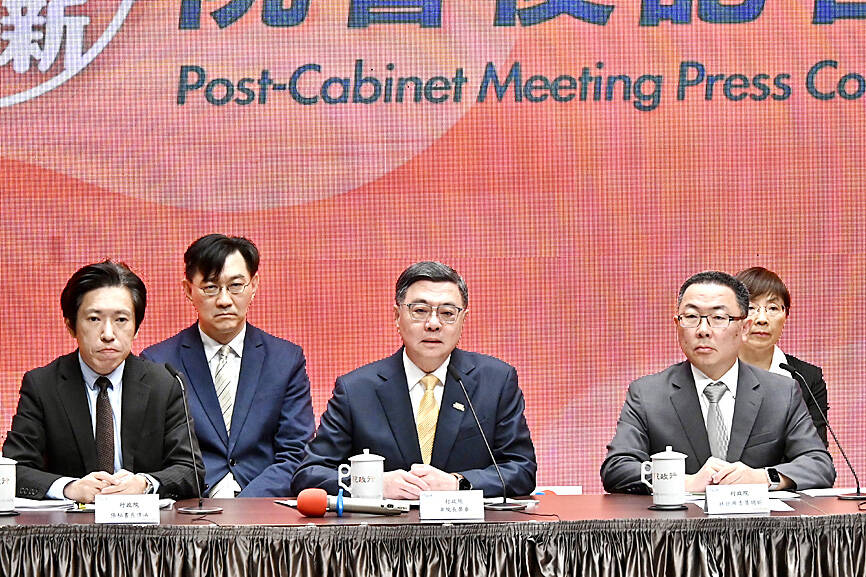
Photo: George Tsorng, Taipei Times
Premier Cho Jung-tai (卓榮泰) urged opposition parties to back the bill, stressing the need to improve self-defense amid rising Chinese threats.
Given the military coercion of Beijing, the government has a responsibility to show its determination to safeguard Taiwan’s sovereignty, Cho said.
The bill is to be sent to the opposition-controlled Legislative Yuan for review.
The opposition Chinese Nationalist Party (KMT) and Taiwan People’s Party have said that the budget would rely heavily on debt financing, and would lead to cuts to social welfare, education and other programs.
The parties said that they would scrutinize the plan to ensure tax funds are used responsibly.
The bill lists seven major procurement categories: precision artillery; long-range precision-strike missiles; uncrewed vehicles and anti-drone systems; air-defense, anti-ballistic missile and anti-armor missile systems; artificial intelligence-assisted systems; equipment to enhance sustained combat endurance; and systems jointly developed or procured with the US.
The spending is to be funded through special budgets and would not be subject to Article 23 the Budget Act (預算法) that restricts use of capital for recurrent expenditures, the bill says.
Funding can be drawn from prior-year budget surpluses or raised through borrowing, with annual borrowing limits exempted from restrictions under Article 5-7 of the Public Debt Act (公共債務法).
The special ordinance and special budgets would take effect on the date of promulgation and remain in force until Dec. 31, 2033.
Separately, Minister of National Defense Wellington Koo (顧立雄) said that Taiwan has already held preliminary talks with the US about what weapons it wants to buy as part of the budget.
Purchases from the US naturally constitute a significant part of the spending plans, Koo said.
Taiwan has formally obtained from the US Department of Defense the procurement item quantities, pricing information, transaction timelines and other details, showing that the US is willing to provide the weapons, he said, adding that no details can be revealed before a formal notification to the US Congress.
The budget would also generate 90,000 jobs and bring a direct economic benefit to Taiwan of NT$400 billion, Koo said.
Additional reporting by Reuters and CNA

The nation’s fastest supercomputer, Nano 4 (晶創26), is scheduled to be launched in the third quarter, and would be used to train large language models in finance and national defense sectors, the National Center for High-Performance Computing (NCHC) said. The supercomputer, which would operate at about 86.05 petaflops, is being tested at a new cloud computing center in the Southern Taiwan Science Park in Tainan. The exterior of the server cabinet features chip circuitry patterns overlaid with a map of Taiwan, highlighting the nation’s central position in the semiconductor industry. The center also houses Taiwania 2, Taiwania 3, Forerunner 1 and
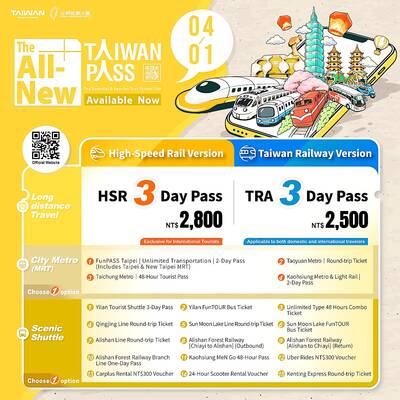
MORE POPULAR: Taiwan Pass sales increased by 59 percent during the first quarter compared with the same period last year, the Tourism Administration said The Tourism Administration yesterday said that it has streamlined the Taiwan Pass, with two versions available for purchase beginning today. The tourism agency has made the pass available to international tourists since 2024, allowing them to access the high-speed rail, Taiwan Railway Corp services, four MRT systems and four Taiwan Tourist Shuttles. Previously, five types of Taiwan Pass were available, but some tourists have said that the offerings were too complicated. The agency said only two types of Taiwan Pass would be available, starting from a three-day pass with the high-speed rail and a three-day pass with Taiwan Railway Corp. The former costs NT$2,800
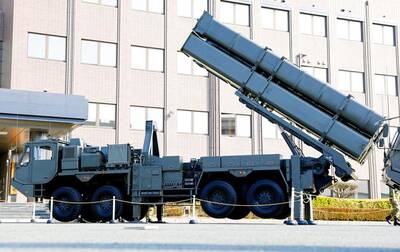
Japan has deployed long-range missiles in a southwestern region near China, the Japanese defense minister said yesterday, at a time when ties with Beijing are at their lowest in recent years. The missiles were installed in Kumamoto in the southern region of Kyushu, as Japan is attempting to shore up its military capacity as China steps up naval activity in the East China Sea. “Standoff defense capabilities enable us to counter the threat of enemy forces attempting to invade our country ... while ensuring the safety of our personnel,” Japanese Minister of Defense Shinjiro Koizumi said. “This is an extremely important initiative for
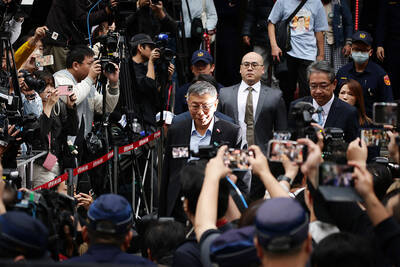
FIRST TRIAL: Ko’s lawyers sought reduced bail and other concessions, as did other defendants, but the bail judge denied their requests, citing the severity of the sentences Former Taipei mayor Ko Wen-je (柯文哲) was yesterday sentenced to 17 years in prison and had his civil rights suspended for six years over corruption, embezzlement and other charges. Taipei prosecutors in December last year asked the Taipei District Court for a combined 28-year, six-month sentence for the four cases against Ko, who founded the Taiwan People’s Party (TPP). The cases were linked to the Core Pacific City (京華城購物中心) redevelopment project and the mismanagement of political donations. Other defendants convicted on separate charges included Chinese Nationalist Party (KMT) Taipei City Councilor Angela Ying (應曉薇), who was handed a 15-year, six-month sentence; Core Pacific


 RSS
RSS