

Taiwan’s future should be decided by Taiwanese, German-Taiwan Parliamentary Friendship Group chairman Till Steffen said yesterday, while giving former president Tsai Ing-wen (蔡英文) a tour of the German parliament building.
Tsai arrived in Berlin on Sunday and the following day delivered a keynote speech at the Berlin Freedom Conference titled “Threats facing democracies: Taiwan’s experience defending freedom.”
Tsai yesterday attended a tea gathering at the Bundestag, joined by former friendship group chairman of 15 years Klaus-Peter Willsch, German defense affairs specialist Roderich Kiesewetter and Federal Ministry of Education, Family Affairs, Senior Citizens, Women and Youth Parliamentary State Secretary Michael Brand.
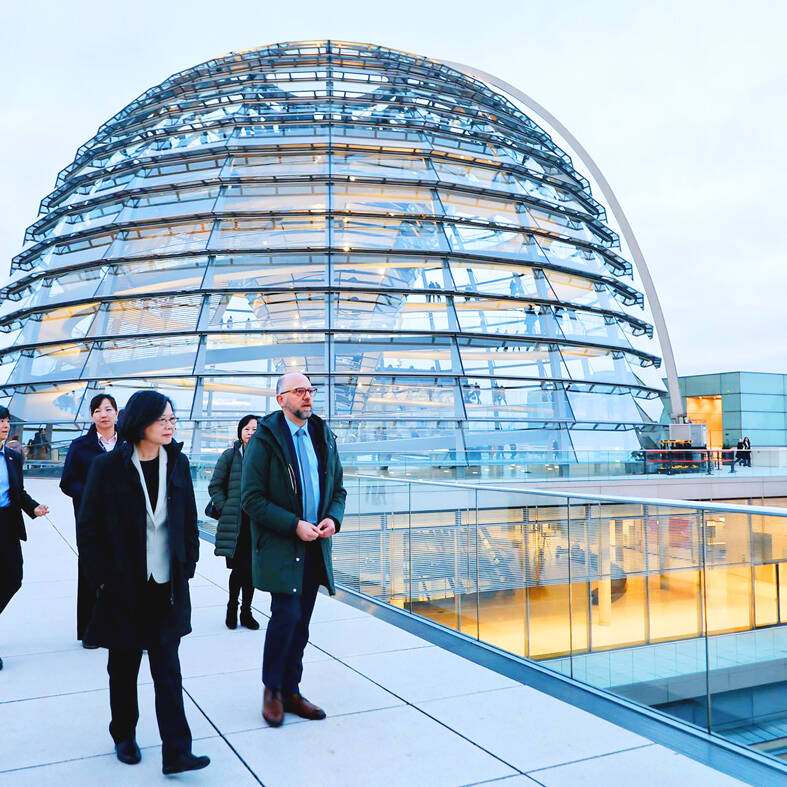
Photo: Screen grab from Tsai’s Facebook page
Noting that the Reichstag, the building that houses the German parliament, is at the former border between East and West Germany, Steffen said he wanted to convey to Taiwan that “Germany’s unification was decided by the parliaments freely elected by both East and West Germany.”
“Similarly, Taiwan’s future should be decided by a parliament freely elected by the Taiwanese people. This is the democratic choice we support,” he added.
Tsai said that Taiwan and Germany have many opportunities to work together, citing Germany’s strong industrial capabilities and Taiwan’s own technological prowess.

Photo: Screen grab from Tsai’s Facebook page
The two countries can work together on many issues, and both sides should make efforts to achieve these goals, she added.
Later writing on Facebook about Der Bevolkerung in the Reichstag, Tsai said that each lawmaker adds in a bag of earth from their constituency to the art installation.
It symbolizes that the fate of the nation should be determined by the people who live in it, she said.
In an interview with the German-language daily Die Welt, Tsai reiterated that Taiwan is determined to increase is self-defense capabilities.
In an age in which artificial intelligence is quickly gaining prevalence, Taiwan is critical for the continued development of global technology and economy, she said, adding that in semiconductors, Taiwan is irreplaceable in the near future.
As long as democratic partners worldwide continue to support Taiwan, it would be able to go from “Taiwan can help” to “Taiwan is supporting,” Tsai said.
Prior to her visit, Tsai said that as a trustworthy member of the international community, Taiwan would continue to stand with Europe and other like-minded countries to demonstrate its commitment to freedom and democracy.
Additional reporting by CNA

FRIDAY, SATURDAY: While Typhoon Champi might weaken, officials warned about large waves, while some transport services and tourist spots have been affected Typhoon Champi is forecast to have the greatest effect on Taiwan tomorrow and on Saturday, with a sea warning issued late last night and a land warning expected afternoon today, the Central Weather Administration (CWA) said yesterday. The storm’s projected track has shifted slightly westward and it could begin moving away from Taiwan toward Japan’s Kyushu island on Saturday, with the warnings potentially lifted as early as Saturday afternoon, CWA forecaster Chang Cheng-chuan (張承傳) said. As of yesterday afternoon, Champi was about 910km east-southeast of Oluanpi (鵝鑾鼻), Taiwan proper’s southernmost point, CWA data showed. Its maximum sustained winds had weakened slightly to
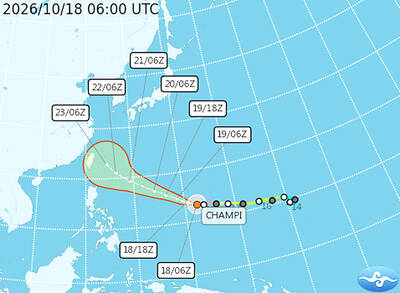
A sea warning for Typhoon Champi could be issued as early as Wednesday night, possibly followed by a land warning on Thursday night or Friday, as the storm approaches Taiwan, the Central Weather Administration (CWA) said yesterday. The typhoon is expected to have its greatest impact on Taiwan on Friday and Saturday, bringing heavy rain to central and northern Taiwan and to Yilan and Hualien counties in the east, CWA forecaster Liu Pei-teng (劉沛滕) said. As of 2pm yesterday, Champi was about 2,470km east-southeast of Oluanpi (鵝鑾鼻), Taiwan’s southernmost tip, moving westnorthwest at 20kph. It had maximum sustained winds of 191kph and a
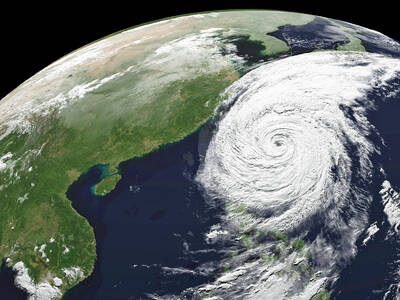
TOTAL COVERAGE: Champi’s outer band is expected to blanket the entire nation, with the center coming closest tonight or tomorrow before leaving tomorrow evening School and work across most of the nation has been canceled today, as Typhoon Champi is expected to skirt the northeast edge of Taiwan proper. As of 9pm, all municipalities except for Kinmen County had announced cancelations. Taitung County last night announced closures on Green Island (綠島) and Orchid Island (Lanyu, 蘭嶼), but did not announce for the rest of the county until 6am today. Stock market settlements scheduled for today would be postponed to the next business day, the Taiwan Stock Exchange said. The announcements came after the Central Weather Administration (CWA) yesterday expanded its land warning for Champi to 19 regions
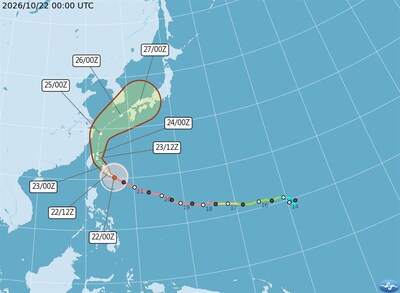
The Central Weather Administration (CWA) today issued a land warning for Typhoon Champi, which is expected to bring heavy rain and strong winds to Taiwan through Saturday. The land warning covered Yilan, Hualien, Taitung and Pingtung counties, CWA data showed. The CWA also issued a sea warning for Typhoon Champi, urging vessels operating in the Bashi Channel, in the south of the Taiwan Strait, as well as waters north, northeast and southeast of Taiwan, to remain on high alert. As of 11am today, Champi was centered about 520km east-southeast of Oluanpi (鵝鑾鼻), Taiwan's southernmost point, moving northwest at 15kph to 20kph, CWA data


 RSS
RSS