


Ukraine was scrambling to turn lights and heating back on yesterday after Russian attacks targeted energy infrastructure, with the state power provider saying its generating capacity was reduced to “zero.”
Moscow, which has escalated attacks on Ukraine’s infrastructure in the past few months, launched hundreds of drones at energy facilities across the country on Saturday.
Ukrainian strikes on Russia’s own infrastructure meanwhile left more than 20,000 people without power in regions bordering Ukraine, local authorities said.
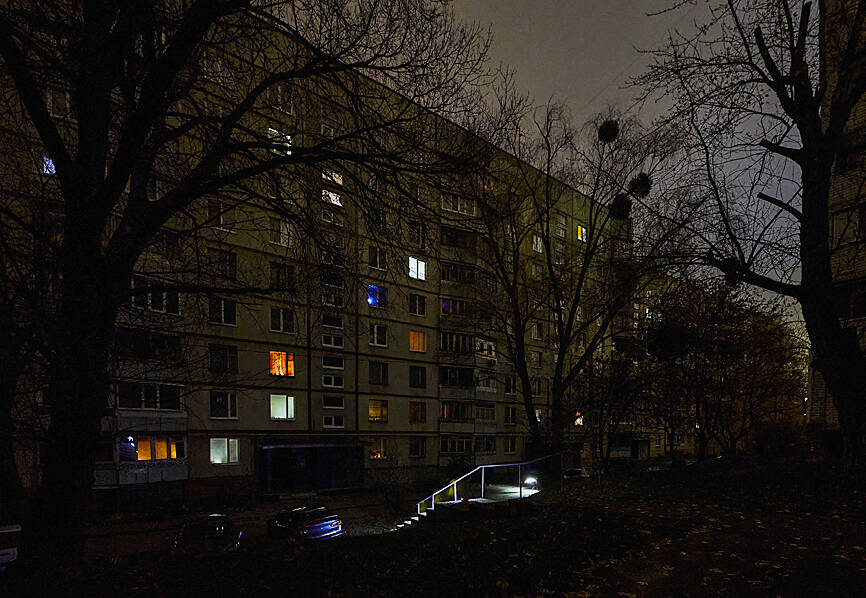
Photo: AP
The Russian attacks interrupted electricity, heat and water supplies in several cities, with state power firm Centerenergo warning its generating capacity “is down to zero.”
“An unprecedented number of missiles and countless drones — several per minute — targeted the same thermal power plants that we had restored after the devastating attack of 2024,” Centrenergo said in a statement.
Power was cut for between eight and 16 hours a day across most regions of Ukraine yesterday, state power transmission system operator Ukrenergo said, while repairs were carried out and energy sourcing diverted.
Ukrainian Minister of Energy Svitlana Hrynchuk called it “one of the most difficult nights” since Russia sent troops into Ukraine in February 2022.
While the situation had somewhat stabilized, regions including Kyiv, Dnipropetrovsk, Donetsk, Kharkiv, Poltava, Chernihiv and Sumy could continue to see regular power cuts, Hrynchuk said on Saturday evening.
“The enemy inflicted a massive strike with ballistic missiles, which are extremely difficult to shoot down. It is hard to recall such a number of direct strikes on energy facilities since the beginning of the invasion,” she told local broadcaster United News.
Russian drones had targeted two nuclear power substations deep in western Ukraine, Ukrainian Minister of Foreign Affairs Andrii Sybiha said, calling on the UN’s nuclear watchdog to respond.
“Russia is deliberately endangering nuclear safety in Europe. We call for an urgent meeting of the IAEA Board of Governors to respond to these unacceptable risks,” he wrote on Telegram late on Saturday, referring to the International Atomic Energy Agency.
Sybiha also urged China and India — traditionally large buyers of Russian oil — to pressure Moscow to cease its attacks.
Russia has targeted the power and heating grid throughout its almost four-year invasion, destroying a large part of the key civilian infrastructure.
The weekend’s barrage was the ninth massive attack on gas infrastructure since early last month, Ukraine’s energy company Naftogaz said.
Kyiv’s School of Economics estimated in a report that the attacks shut down half of Ukraine’s natural gas production.
Ukraine has in turn stepped up strikes on Russian oil depots and refineries in recent months, seeking to cut off Moscow’s vital energy exports and trigger fuel shortages across the country.

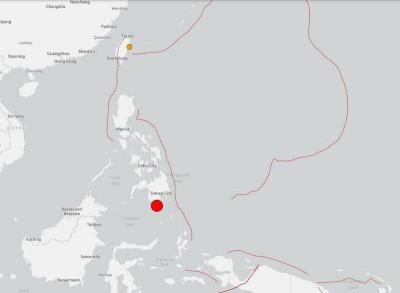
A magnitude 7.8 earthquake struck off the southern coast of Mindanao in the Philippines at 7:38am today, prompting the US Tsunami Warning System to issue an alert for neighboring countries, including Taiwan. The system issued a purple alert indicating a "tsunami threat." The potential threat zone includes Taiwan, the Philippines, Papua New Guinea, Yap and Palau. Philippine authorities were assessing the damage from the quake, with the office of civil defense seeking to verifying initial reports that 15 people had been killed and 129 injured in the region, mostly from falling debris. Arlene Hollero, disaster chief of Maasim town in the Philippines' Sarangani Province,

RESILIENCE: Taiwan plays a key role in semiconductors, energy, information infrastructure and advanced manufacturing, AIT Director Raymond Greene said Taiwan’s continued investment in deterrence and resilience remains vital, especially in uncrewed systems and other emerging technologies, American Institute in Taiwan (AIT) Director Raymond Greene said yesterday. Greene made the remarks at the annual National Strategic Summit on Supply Chain Resilience held by the Research Institute for Democracy, Society and Emerging Technology (DSET), a government-backed think tank. As Taiwan last year became the US’ fourth-largest trading partner and supply chain security is becoming more important, cooperation in emerging technologies continues to deepen between the two countries, he said. The US is committed to accelerating innovation, building key infrastructure, strengthening cooperation

The National Chungshan Institute of Science and Technology yesterday showcased its locally developed variants of the Vision 60 robotic patrol dog, which it plans to deploy on the nation’s outlying territories in the South China Sea. The variants were produced under the Joint Lab project — created by the institute and domestic companies — and assembled with domestically produced motors, lenses and artificial intelligence (AI) systems alongside licensed tech from the US, Missile and Rocket Systems Research Division deputy director Jen Kuo-kang (任國光) told the media event at a military base in Taipei’s Dazhi (大直) area. Taiwan has built up its strengths

‘GRAY ZONE’ PRESSURE: Beijing’s activities are intended to create the deceitful impression that China has jurisdiction over the area around Taiwan, the CGA said Taiwan’s rights over its territorial waters and exclusive economic zone must not be violated by any country, the Mainland Affairs Council said yesterday, adding that it will not accept any unprovoked actions. The council issued the remarks in response to the China Coast Guard conducting maritime enforcement drills near eastern Taiwan and claiming to fully exercise China’s maritime administrative law enforcement authority. The Coast Guard Administration (CGA) has been closely monitoring the situation and is taking concrete steps to defend the nation’s sovereignty and secure its waters, the council said. China has no sovereign rights over the waters off eastern


 RSS
RSS