


A Chinese research vessel docked in the Cook Islands on Saturday as it probed the Pacific nation’s deep-sea mining potential, a fledgling industry of mounting interest to both Beijing and Washington.
The Da Yang Hao (大洋號) docked in the palm-shaded port of Avatiu on a “scientific research cruise” through the tropical archipelago, the Cook Islands’ Seabed Minerals Authority said.
Huge areas of seabed around the Cook Islands are carpeted in polymetallic nodules, lumpy rocks studded with rare earths and critical minerals such as cobalt, nickel and manganese. The Cook Islands — which lays claim to one of the world’s biggest deposits of polymetallic nodules — signed a contentious deep-sea mining cooperation deal with China earlier this year.
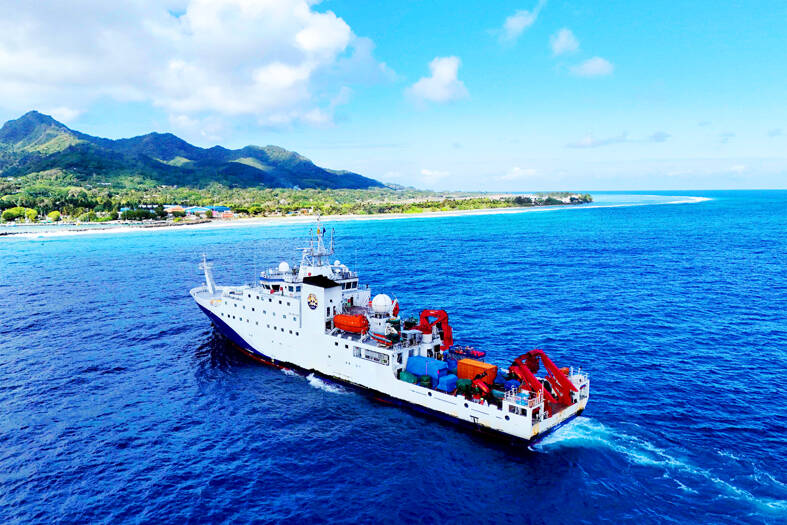
Photo : AFP
“This cruise is about learning by doing,” Seabed Minerals Authority spokesman Edward Herman said. “Our team is actively participating in all activities to build our knowledge and capacity in marine research.”
This included mapping the seabed with sonar arrays and dredging up sediment samples, the authority said.
Fringed by sparkling lagoons, South Pacific nation the Cook Islands has opened its vast ocean territory for deep-sea mining exploration. With existing supplies of critical minerals heavily exposed to trade disputes, the US and China have this year ramped up interest in the highly contentious industry.
Critical minerals, such as cobalt and nickel, are in hot demand for electric vehicles, rechargeable batteries and advanced military technology. The US secured its own agreement to pursue deep-sea mining research with the Cook Islands in August.
Agence France-Presse photos showed the near-100m Da Yang Hao vessel cutting through the Cook Islands’ sleepy main harbor before docking on Saturday morning. The ship was emblazoned with the logo of China’s Ocean Mineral Resources Research Association, which is tasked with the exploration of seabed minerals.
Chinese research vessels have been accused of carrying out surveillance and other military activities under the auspices of scientific work.
Pacific island nation Palau, a staunch US ally in the region, in 2021 alleged that the Da Yang Hao had entered its exclusive economic zone without proper permissions.
The Da Yang Hao arrives in the Cook Islands less than one month after a deep-sea research voyage backed by the US National Oceanic and Atmospheric Administration.
While exploration for deep-sea mining is far advanced, no company or nation has started production on a commercial scale.
Critics fear deep-sea mining would smother marine life with waste, and the noise of heavy machinery would disrupt oceanic migrations.
International regulators are still trying to thrash out environmental rules governing the industry.

A signaling system malfunction disrupted high-speed rail (HSR) services beginning at 8am today, with trains temporarily reduced to three northbound and three southbound trains per hour as authorities conduct inspections. The malfunction occurred on a section of track in Miaoli County during pre-operation checks early this morning, forcing northbound and southbound trains to use a single track, the HSR operator said. The regular schedule has been replaced with three hourly trains offering only nonreserved seating in each direction, stopping at every station, it said, adding that business class cars would still have reserved seating. Departures from terminal stations are scheduled at the top

Taiwan is still in the process of assessing the possibility of recruiting workers from Eswatini, the Ministry of Foreign Affairs said yesterday, adding that its goal is to help Eswatini upgrade its vocational training centers. If there are plans to recruit workers from Eswatini, safeguarding national security, protecting public health and ensuring the employment rights of Taiwanese would be prerequisites, Department of West Asian and African Affairs Director-General Yen Chia-liang (顏嘉良) told a news conference. Key considerations would also include filling labor shortages in specific industries, and fostering bilateral professional and technical exchanges, he said. Yen was asked about the progress of labor

A US uncrewed surface vessel (USV) encountered multiple Chinese warships during an autonomous transit of the Taiwan Strait, US defense company Seasats said in a statement on Wednesday. Seasats announced that a Lightfish USV had completed the first autonomous transit of the Taiwan Strait. Over five days, the USV traversed the entire length of the Strait while constantly monitoring surface vessel traffic, the company said. The Lightfish encountered multiple Chinese warships, one of which was a Chinese People’s Liberation Army Navy (PLAN) Type 056 corvette, it said. The Chinese vessels were operating “well within Taiwan’s exclusive economic zone without transmitting their identity via the

VERBOSE VESSELS: A CGA cutter and a China Coast Guard exchanged verbal barbs for more than a day in Taiwanese-controlled waters before the Chinese vessel left The Taiwanese and Chinese coast guards had a standoff near the strategically located Pratas Islands (Dongsha Islands, 東沙群島) in the north of the South China Sea, the Coast Guard Administration (CGA) said yesterday. The two sides engaged in intense radio exchanges over sovereignty claims during the 33-hour standoff. China Coast Guard vessel 3501 eventually left the restricted waters, 26.6 nautical miles (49.2km) west of the Pratas Islands, at 5pm yesterday, the CGA said. Lying approximately between southern Taiwan and Hong Kong, the Taiwan-controlled Pratas are seen by some security experts as vulnerable to Chinese attack due to their distance — more than


 RSS
RSS