


North Korea yesterday fired what appeared to be multiple short-range ballistic missiles, South Korea’s military said, a week before a key Asia-Pacific leaders’ meeting in South Korea.
It was the first launch of ballistic missiles since May by Pyongyang, which has defied a UN Security Council ban on the weapons.
It was also the first such launch since South Korean President Lee Jae-myung was elected, with a platform of engagement with North Korea.
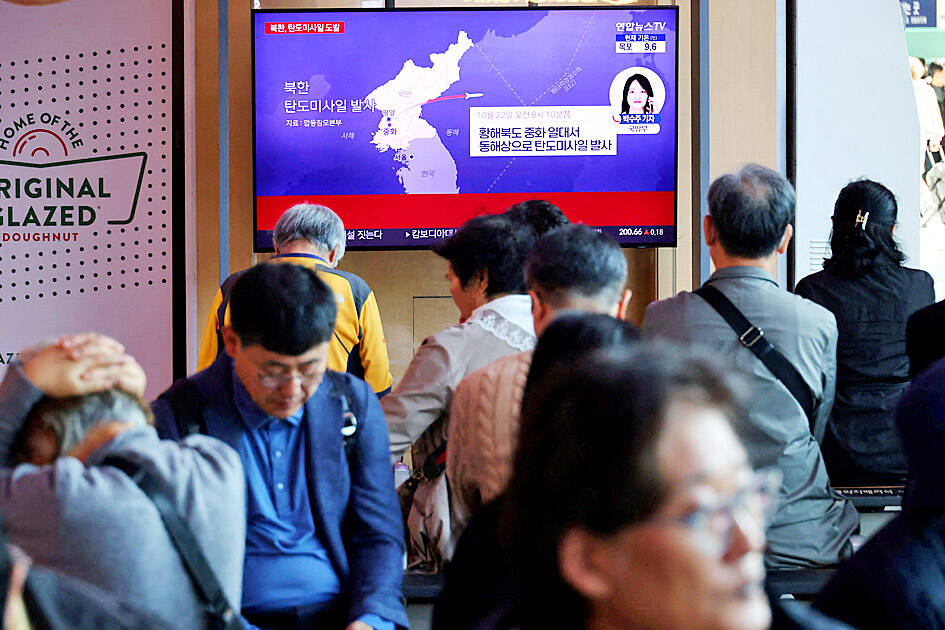
Photo: Reuters
Lee and US President Donald Trump are expected to meet in South Korea next week at an APEC summit. Trump is also expected to meet Chinese President Xi Jinping (習近平).
South Korea detected several projectiles believed to be short-range ballistic missiles fired from an area near North Korea’s capital, Pyongyang, in a northeasterly direction early yesterday, the South Korean Joint Chiefs of Staff said in a statement.
Lee and Trump have discussed the idea of trying to meet North Korean leader Kim Jong-un when the US president visits the South, but Pyongyang has not publicly responded to the idea.
US officials considered, but never confirmed, a trip to the demilitarized zone separating the two Koreas, a person familiar with the discussions said.
South Korea has suspended tours of the Joint Security Area at the inter-Korean border village of Panmunjom until early next month, but has not confirmed any plans for a meeting with Kim.
Trump and Kim held three summits during Trump’s 2017 to 2021 term and exchanged a number of letters that Trump called “beautiful,” before the unprecedented diplomatic effort broke down over US demands that Kim give up his nuclear weapons.
Kim last month expressed “fond memories” of Trump, saying there was no reason to avoid talks with the US if Washington stopped insisting his country give up nuclear weapons, but he would never abandon the nuclear arsenal to end sanctions.
“It is not at all inconceivable that Donald Trump could here in Washington, D.C., say: ‘Denuclearization, that’s our goal, that’s our policy’ and then go up to Panmunjom and say: ‘Oh, you know, Kim Jong-un is a nuclear power,’” Center for Strategic and International Studies Korea chair Victor Cha said.
“Even if it’s a short meeting, in the broader scheme of things, with all that the United States has to deal with these days, it wouldn’t necessarily be a bad thing,” he said.

The Tourism Administration yesterday announced that it would reward repeat international visitors with incentives of up to NT$8,000 to boost inbound tourism. The incentives are available to all international tourists, it said, adding that repeat visitors would be rewarded with NT$5,000 and would receive an additional NT$3,000 if they bring travel companions. The nation received 2,990,657 inbound visitors during the first quarter, marking a 3.8 percent increase from the same period last year, agency data showed. Japanese nationals are among groups visiting Taiwan the most. About 1.48 million Japanese tourists arrived last year, a year-on-year increase of more than 12
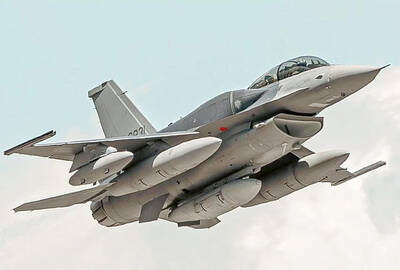
66 FIGHTER JETS: The aircraft is likely undergoing preparations for its transfer to Taiwan — a significant step forward in the nation’s modernization program, a lawmaker said The first of Taiwan’s order of F-16V Block 70 aircraft has been sighted in Texas ahead of delivery, Democratic Progressive Party (DPP) Legislator Wang Ting-yu (王定宇) said. Taiwan’s first F-16V Block 70 two-seat aircraft, tail number 6831, was seen flying from Lockheed Martin’s production facility in Greenville, South Carolina, to Naval Air Station Joint Reserve Base Fort Worth in Texas, Wang wrote on Facebook yesterday. The plane is likely undergoing preparations for its transfer to Taiwan, marking a significant step forward in the Republic of China Air Force’s modernization program, Wang said, citing military analysts. The F-16V Block 70 is a new-build version
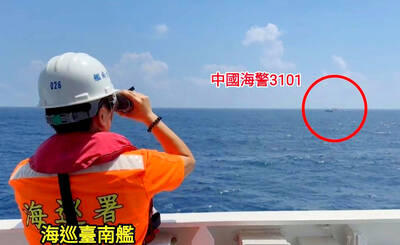
‘BRAZEN’: The holiday did not stop China from activities that infringe on Taiwan’s maritime jurisdiction, but the CGA is ready to defend the nation, Kuan Bi-ling said Beijing is intensifying maritime pressure on Taiwan, but the nation will never yield, Ocean Affairs Council Deputy Minister Sung Chen-en (宋承恩) said. The Coast Guard Administration (CGA) has adopted a “shadowing and monitoring” approach to avoid falling into a Chinese trap to escalate tensions and deepen the conflict, Sung said in an interview published yesterday in the Chinese-language Liberty Times (the Taipei Times’ sister newspaper). China Coast Guard formations patrolling waters east of Taiwan, as well as official Chinese vessels entering areas around Itu Aba Island (Taiping Island, 太平島) and Pratas Islands (Dongsha Islands, 東沙群島) show Beijing’s attempts to significantly step up
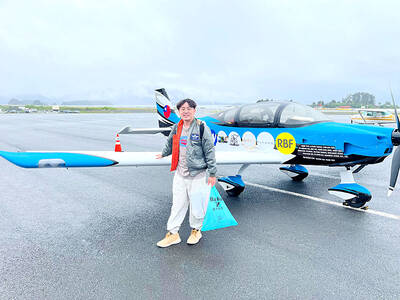
Taiwanese aviator Roger Lin (林睿哲) returned to Taiwan on Saturday after completing a nine-day round-the-world journey in a single-engine aircraft, becoming the first Taiwanese pilot to achieve the feat. Lin departed on June 5 from Los Angeles, California, and continued through Alaska, Japan, Taiwan, the Philippines, Indonesia, Malaysia, Thailand, Nepal, Jordan, Norway, Iceland and Canada before landing at the Taipei International Airport (Songshan) via Los Angeles and Japan. Lin shared numerous photos and videos of his journey on a Facebook page titled “Pilot Roger’s Around the World Flight,” including a video showing his aircraft flying over the Danjiang Bridge and


 RSS
RSS